Nasution Nanang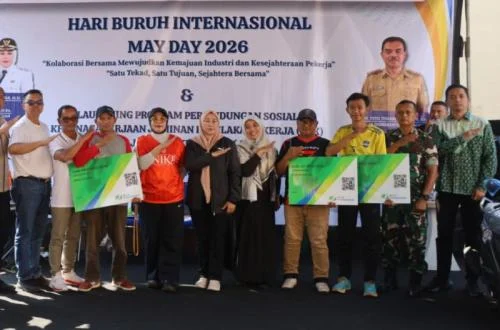
KUNINGAN, West Java – The Kuningan Regency government has officially announced that approximately 6,700 vulnerable workers across its jurisdiction are now beneficiaries of the Jaminan Kecelakaan Kerja (JKK), or Work Accident Insurance, and Jaminan Kematian (JKM), or Death Insurance, programs. This significant expansion of social safety nets was formally unveiled during a commemorative Labor Day event held on Sunday in Kuningan, underscoring the local administration’s commitment to bolstering worker welfare and protection as the region embarks on an ambitious path of economic growth and human capital development. The initiative aims to provide a crucial layer of security for those in precarious employment, often overlooked by traditional social security schemes, thereby fostering a more inclusive and resilient workforce.
The Labor Day commemoration served as a pivotal platform for the Kuningan Regency to highlight its strategic vision for labor protection and economic advancement. Deputy Regent Tuti Andriani emphasized that the implementation of the JKK and JKM programs unequivocally demonstrates the government’s proactive role in safeguarding its workforce. These vital insurance schemes are specifically tailored to reach various segments of the vulnerable labor force, including agricultural workers such as tobacco and clove farmers, as well as other informal sector workers who historically face limited access to comprehensive employment social security. The symbolic handover of BPJS Ketenagakerjaan (Employment Social Security Agency) cards to representatives of these workers marked a tangible step towards realizing this commitment, reinforcing the message that the local government views worker protection as an indispensable pillar of sustainable regional development.
Expanding the Social Safety Net: The Core of JKK and JKM
The Jaminan Kecelakaan Kerja (JKK) and Jaminan Kematian (JKM) programs are integral components of Indonesia’s broader social security system, managed by BPJS Ketenagakerjaan. These programs are designed to offer financial protection and support to workers and their families in the event of work-related accidents, occupational diseases, or death. For vulnerable workers, particularly those in the informal sector, such protections are paramount. Unlike formal sector employees who often receive benefits directly from their employers, informal workers frequently operate without contracts, stable incomes, or any form of social security, leaving them highly exposed to economic hardship should an unforeseen event occur.
The JKK program provides comprehensive coverage for medical treatment, rehabilitation, and compensation for temporary or permanent disability resulting from work accidents or occupational diseases. This includes hospital care, surgical procedures, and prosthetic devices, ensuring that workers can recover without incurring crippling medical debts. In cases of severe disability, it also offers lump-sum payments or periodic benefits to support the worker and their family. The JKM program, on the other hand, provides financial assistance to the heirs of a deceased worker, offering a lump sum payment to help cover funeral expenses and provide immediate financial relief during a time of loss. This dual protection mechanism offers peace of mind and economic stability, allowing workers to focus on their livelihoods with a reduced burden of risk.
Targeting tobacco and clove farmers in Kuningan is particularly strategic. These agricultural sectors often involve physically demanding labor, exposure to various environmental hazards, and reliance on fluctuating market prices, making workers in these fields inherently vulnerable. By extending JKK and JKM coverage to these specific groups, the Kuningan government is directly addressing the unique risks associated with their professions, acknowledging their significant contribution to the local economy while simultaneously mitigating their exposure to unforeseen calamities. The 6,700 individuals now protected represent a substantial portion of the informal workforce in critical sectors within the regency, though efforts are ongoing to broaden this coverage further across the estimated tens of thousands of vulnerable workers in the region. This initiative aligns with national mandates under Law No. 24 of 2011 concerning BPJS, which aims for universal social security coverage, and Presidential Regulation No. 109 of 2013, which specifically addresses the expansion of social security for informal workers.
Labor Day: A Catalyst for Policy Implementation and Worker Engagement
The celebration of Labor Day (May 1st) in Kuningan served not merely as a festive occasion but as a powerful symbol of the government’s renewed commitment to its workforce. Historically, Labor Day in Indonesia, known as Hari Buruh, has evolved from a day of protest and demands for worker rights into a broader platform for dialogue, policy announcements, and expressions of appreciation for labor’s contribution to national development. In Kuningan, this year’s event embodied this evolution, bringing together over 3,000 participants from various companies, labor unions, and government agencies.
Krisyudi, Secretary of the Kuningan Regency Manpower and Transmigration Office (Disnakertrans), highlighted the collaborative spirit underpinning the event. He proudly stated that the entire celebration was executed on a "zero rupiah" budget, meaning all expenses were generously covered through the participation and support of private companies and various stakeholders. This unique funding model underscores a strong public-private partnership and a shared sense of responsibility towards worker welfare in Kuningan. It also reflects a growing trend in local governance where resource optimization through collaboration becomes key to implementing impactful social programs and community events. This collective effort not only demonstrated solidarity but also amplified the message of protection and appreciation, making the symbolic handover of BPJS Ketenagakerjaan cards even more meaningful.
Deputy Regent Tuti Andriani’s address reiterated the local government’s unwavering commitment to enhancing worker welfare through diverse social protection programs. She specifically underscored the focus on the informal sector, a demographic that has historically faced significant barriers in accessing formal employment benefits and social security. By actively addressing this disparity, Kuningan aims to foster a more equitable labor landscape, where every worker, regardless of their employment status, has access to fundamental protections. "We believe a protected workforce is a productive workforce," Andriani implicitly conveyed, signaling a strategic investment in human capital as a driver for regional prosperity.
Investing in Human Capital: The Japan Internship Program
Beyond direct social security, Kuningan is also proactively investing in human capital development and global workforce integration. During the Labor Day event, the regency proudly announced the dispatch of 50 participants to Japan for an intensive internship program. This initiative is a multi-stakeholder collaboration involving Disnakertrans, relevant national ministries, Special Job Exchanges (BKK), and Job Training Institutions (LPK). The program aims to equip young Kuningan residents with advanced skills, professional work ethics, and global competencies, preparing them for highly competitive international job markets.
The decision to send interns to Japan is strategic, given Japan’s advanced industrial sectors, high demand for skilled labor, and rigorous work standards. Participants are expected to gain invaluable hands-on experience in various fields, ranging from manufacturing and engineering to caregiving and hospitality, depending on the specific program pathways. This exposure to international best practices is intended to not only enhance their individual career prospects but also to foster a culture of professionalism and excellence that they can bring back to Kuningan.
Deputy Regent Andriani urged the participants to maximize this unique opportunity, encouraging them to diligently improve their competencies and aspire to become professional, globally competitive workers. The long-term impact of such programs extends beyond individual benefit. Returnees are expected to contribute significantly to the local economy, either by applying their enhanced skills in existing industries, establishing new businesses, or acting as mentors and trainers for future generations of workers. Furthermore, remittances sent home by overseas workers contribute substantially to the local economy, boosting household incomes and stimulating local consumption. This initiative represents a forward-thinking approach to addressing potential skill gaps and preparing Kuningan’s workforce for the demands of a globalized economy.
Economic Boom on the Horizon: Job Creation and the Challenge of Illegal Migration
Kuningan Regency is on the cusp of a significant economic transformation, with projections indicating the establishment of at least five large factories in the near future. This development is expected to generate approximately 30,000 new job opportunities, a monumental shift for the region’s labor market and overall economic landscape. These factories are likely to span various sectors, including manufacturing, processing industries, and potentially textiles or automotive components, drawing on Kuningan’s strategic location and available labor pool. Such an influx of industrial activity promises to reduce unemployment rates, increase local incomes, stimulate small and medium-sized enterprises (SMEs) through supply chains, and necessitate further infrastructure development.
However, this promising outlook comes with a critical caveat. The local government has issued a stern warning to the public regarding the dangers of illegal overseas labor placement, urging citizens to exercise extreme caution and always coordinate with relevant government agencies, particularly Disnakertrans, when seeking employment abroad. The allure of higher wages overseas often leads desperate individuals to fall prey to unscrupulous recruiters who operate outside legal frameworks. These "non-procedural" Indonesian migrant workers (PMI Non-Prosedural) are highly vulnerable to exploitation, human trafficking, unpaid wages, and lack of legal protection in destination countries. Their passports can be confiscated, their working conditions can be unsafe, and they may be forced into debt bondage.
The government’s warning is a proactive measure to safeguard its citizens from these severe risks, especially as economic opportunities expand domestically. Disnakertrans plays a crucial role in providing legitimate information, facilitating legal recruitment processes, and offering pre-departure orientations to ensure that prospective migrant workers are well-informed of their rights and responsibilities. This comprehensive approach – creating local jobs, developing skills for global markets, and simultaneously combating illegal migration – reflects a holistic strategy to empower the workforce while protecting them from exploitation. It underscores the local government’s recognition that economic growth must be accompanied by robust social protections and ethical labor practices.
Strategic Vision and Broader Implications
The initiatives undertaken by the Kuningan Regency government – from expanding social security coverage for vulnerable workers to investing in international skill-building programs and preparing for a domestic industrial boom – collectively reflect a strategic vision aligned with Indonesia’s national development agenda and global Sustainable Development Goals (SDGs). Specifically, these efforts contribute significantly to SDG 8: Decent Work and Economic Growth, which advocates for promoting sustained, inclusive, and sustainable economic growth, full and productive employment, and decent work for all.
By ensuring social protection for its vulnerable workforce, Kuningan is not only fulfilling a moral obligation but also laying a strong foundation for economic resilience. A protected workforce is more secure, less prone to poverty traps, and ultimately more productive. The investment in skills development through programs like the Japan internship further enhances human capital, creating a more competitive and adaptable labor force capable of driving future innovation and growth. The projected establishment of new factories, while promising, also highlights the ongoing challenge of managing rapid industrialization responsibly, ensuring fair labor practices, environmental sustainability, and adequate social infrastructure.
The "zero rupiah" budget for the Labor Day event exemplifies the power of multi-stakeholder collaboration – a model that can be replicated for other social programs. It demonstrates that effective governance often relies not solely on government coffers but on the collective will and resources of the community, private sector, and civil society organizations. Looking ahead, the Kuningan government faces the ongoing challenge of further expanding social security coverage, ensuring compliance among employers (both formal and informal), and continuously monitoring the effectiveness of its programs. The commitment to combat illegal labor migration will require sustained public awareness campaigns, stricter enforcement against illicit recruiters, and seamless coordination with national agencies.
In conclusion, Kuningan Regency’s multifaceted approach to labor welfare and economic development positions it as a progressive local government striving to create a robust, inclusive, and protected workforce. The tangible steps taken, from extending vital insurance to fostering global competencies and preparing for an industrial expansion, signal a clear understanding that a nation’s prosperity is inextricably linked to the well-being and security of its people. As Kuningan moves forward, its continued focus on these critical areas will be paramount in ensuring sustainable growth and an improved quality of life for all its citizens.