Nila Kartika Wati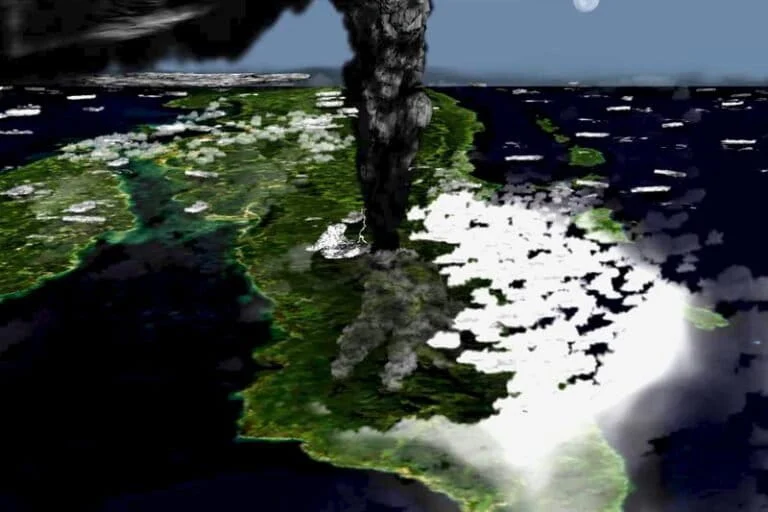
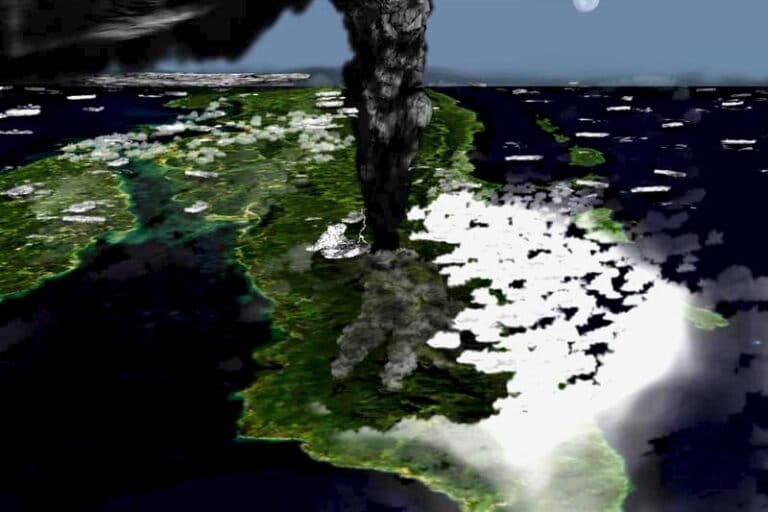
Deep beneath the crystalline waters of the Ryukyu Islands in Japan lies the Kikai caldera, a submerged giant that has long been regarded as a dormant relic of a cataclysmic past. Approximately 7,300 years ago, this formidable supervolcano unleashed the Kikai-Akahoya eruption, an event of such staggering magnitude that it triggered a megatsunami, devastated southern Japanese islands, and blanketed vast swathes of East Asia in a thick layer of volcanic ash. For millennia, the silence of the abyss suggested that the beast had been permanently subdued. However, contemporary scientific findings indicate that Kikai is far from extinct, offering a harrowing glimpse into the persistent vitality of Earth’s most dangerous geological features.
The revelation comes in the wake of a localized volcanic event on May 17, 2026, when the Kikai caldera discharged gas and ash reaching altitudes of 400 meters. While modest in scale, this eruption served as a definitive signal that the plumbing system of a supervolcano can remain active long after its primary cycle of destruction. This event has provided the empirical backbone for a groundbreaking study published in the journal Communications Earth & Environment in March 2026, which introduces the "melt re-injection" model to explain the resurgence of subterranean volcanic activity.
The Mechanism of Melt Re-injection: A New Understanding
For decades, volcanologists struggled to reconcile the apparent dormancy of calderas with the geological reality that they often retain vast thermal energy. The traditional view suggested that once a reservoir depleted its magma during a super-eruption, it would take an improbable amount of time to recharge to dangerous levels. The research team behind the Kikai study, however, challenged this paradigm by employing high-resolution deep-sea seismic refraction surveys.
By measuring the precise velocity of seismic waves as they travel through the oceanic crust, researchers were able to map the density and composition of the sub-seafloor architecture. They discovered that magma does not simply vanish or stagnate; instead, it undergoes a process of natural, continuous re-injection into the shallow reservoirs that fed the original, prehistoric eruptions. This "re-charging" suggests that the magma chambers beneath supervolcanoes are dynamic, interconnected systems rather than static pools. The identification of this process at Kikai provides a critical diagnostic tool that allows scientists to track the inflow of fresh, molten rock into these deep-seated reservoirs, potentially shifting the timeline of volcanic risk assessment from millennia to human-scale observation.
Comparative Volcanology: From Kikai to Toba
The implications of the Kikai findings extend far beyond the Japanese archipelago, casting a new light on other legendary supervolcanoes, most notably Yellowstone in the United States and the Toba caldera in North Sumatra, Indonesia. Both sites are characterized by massive, shallow magma reservoirs that have historically been associated with global climate shifts.
Yellowstone, a perennial focus of global monitoring, is known to harbor a shallow magma reservoir at depths ranging between three and eight kilometers. The application of the melt re-injection model to Yellowstone suggests that even minor fluctuations in seismic wave speed could indicate a significant influx of melt, necessitating a more granular approach to real-time surveillance.
However, the comparison to the Toba caldera is perhaps more sobering. Toba, which underwent its most recent super-eruption approximately 74,000 years ago, stands as a testament to the transformative power of these systems. That eruption ejected an estimated 5,300 cubic kilometers of volcanic material, creating a depression covering 3,000 square kilometers—now the site of the world-renowned Lake Toba. The atmospheric injection of sulfate aerosols from this event is widely cited by paleoclimatologists as a driver for a global "volcanic winter," which lowered average global temperatures by three to five degrees Celsius for several years, potentially creating a bottleneck in human evolution.
Chronology of a Resurgent System
To understand the current state of Toba, researchers have mapped its history over the last 1.6 million years. During this timeframe, Toba has experienced at least four major eruptions. The geological record reveals a pattern: following each collapse of the caldera, the composition of the magma underwent a fundamental shift, and the reservoir system began to expand laterally.
The current research indicates that Toba is currently in a state of "thermal maturation." By analyzing the rate of magma supply—calculated at approximately 0.008 to 0.01 cubic kilometers per year—scientists have estimated that the volume of eruptible magma currently residing beneath the caldera reaches at least 315 cubic kilometers. While this figure is significantly lower than the volumes associated with past super-eruptions, it remains a massive quantity of molten material that is continuously being replenished.
The Complexity of Predictive Modeling
One of the most unsettling conclusions drawn from the study is the inherent unpredictability of these geological giants. Historical and recent data suggest that super-eruptions are not always preceded by the conventional "red flags" that characterize smaller, more frequent eruptions. Traditional monitoring focuses on surface deformation, the release of volcanic gases (such as sulfur dioxide or carbon dioxide), and an increase in local seismic swarms.
However, the Kikai and Toba data suggest that the re-injection process can occur silently. Magma can accumulate at depth for thousands of years without causing significant ground uplift or measurable increases in surface gas emissions. This lack of clear surface signals means that current monitoring techniques may be insufficient to provide early warnings for large-scale volcanic events.
The research team argues that to mitigate future risk, volcanological monitoring must move beyond surface-level parameters. Future efforts should prioritize the continuous monitoring of seismic wave velocity changes, which serve as a proxy for the volume and state of the sub-surface melt. By integrating satellite-based interferometry (InSAR), gravity measurements, and deep-crustal seismic arrays, scientists hope to build a more comprehensive, three-dimensional picture of the "hidden" magma reservoirs.
Implications for Global Hazard Assessment
The realization that supervolcanoes can maintain a state of active replenishment has profound implications for emergency preparedness and global climate forecasting. If the melt re-injection model is indeed a universal trait of caldera-forming volcanoes, it changes how nations with high-risk sites approach long-term urban planning and environmental safety.
For Indonesia, the Toba system represents both a geological marvel and a perpetual, if long-term, hazard. The Indonesian authorities and global research partners have intensified efforts to study the Toba caldera’s crustal properties, acknowledging that the caldera is not a "dead" lake but a living geological system. The emphasis has shifted toward longitudinal studies—monitoring the reservoir over decades rather than months—to identify subtle shifts in the thermal profile that could indicate a change in the state of the reservoir.
Furthermore, the Kikai event of May 2026 serves as a global wake-up call for the scientific community. The fact that an event could occur after 7,300 years of relative quiet highlights the limitations of the "return period" logic often used in hazard assessment. Geological time is vast, and the lifecycle of a supervolcano operates on a scale that often defies the short-term focus of human record-keeping.
Conclusion: Living with the Unknown
The research into Kikai and Toba provides a critical scientific framework for understanding one of Earth’s most formidable natural threats. While the prospect of a super-eruption remains statistically rare, the reality of active, recharging magma chambers beneath these sites confirms that the earth beneath our feet is more dynamic than previously understood.
The transition from viewing these sites as static, dormant landmarks to recognizing them as active, evolving systems is a necessary step in modern geology. As our observational technologies advance—specifically through the use of deep-sea seismic refraction and satellite-based monitoring—the focus must remain on the long-term, systematic gathering of data. The "melt re-injection" model does not predict an imminent catastrophe, but it does serve as a reminder that the quietude of a volcano is not synonymous with its end.
In the face of these hidden giants, the scientific community emphasizes a measured, analytical approach. By acknowledging the limits of current predictive models and committing to the intensive study of sub-surface magma dynamics, we move closer to a deeper understanding of the volatile forces that have, and will continue to, shape the surface of our planet. The task ahead for geophysicists is to decode the subtle, silent language of the earth’s interior, ensuring that when the next significant seismic shift occurs, it is met with knowledge, preparation, and the resilience of a globally informed society.