Azin Asro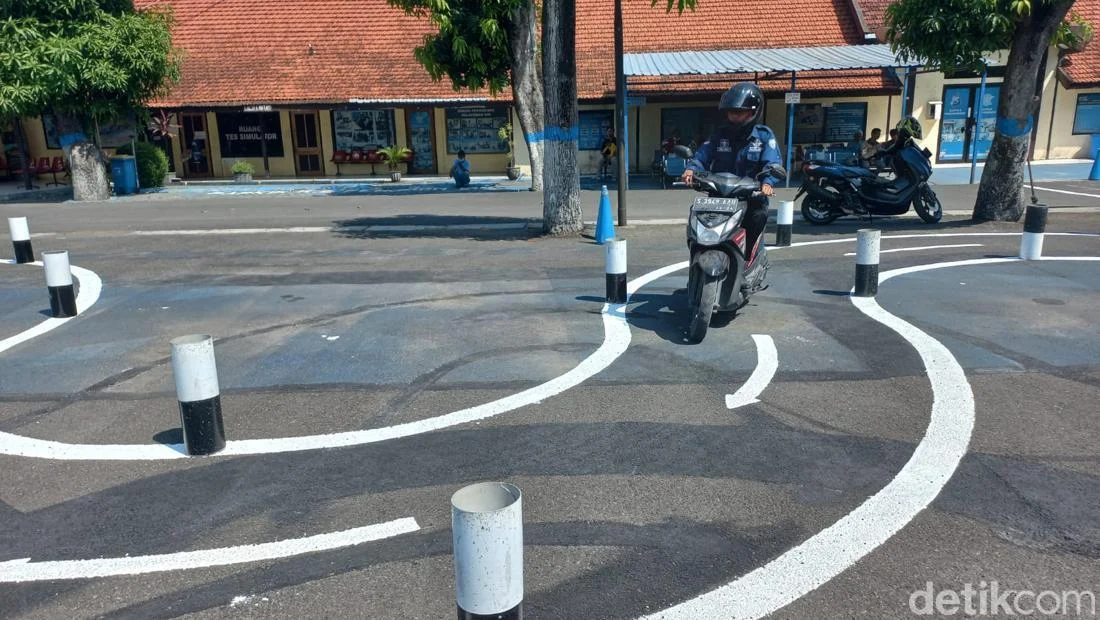
While the Indonesian National Police (Polri) has significantly streamlined the requirements for obtaining a Category C driving license (SIM C), many applicants continue to find the practical examination a daunting hurdle. Recent insights shared by the National Traffic Management Center (NTMC) of the Indonesian National Police reveal that the most frequent causes of failure are not complex maneuvers but rather minor, often overlooked technical errors. The transition from the challenging "figure-8" and "zig-zag" layouts to a more intuitive "S-curve" was intended to make the process more accessible, yet the fundamental requirement for balance and vehicle control remains the primary filter for prospective riders.
According to data and instructional guidance released via the NTMC Korlantas Polri digital platforms, two specific errors are responsible for the vast majority of unsuccessful attempts during the practical test. The first is the premature placement of a foot on the ground. During the maneuvers, the applicant’s feet must remain on the footpegs or floorboard of the motorcycle to demonstrate stability. Touching the asphalt before the vehicle has reached a designated stop point is considered a failure of balance. The second fatal error involves the vehicle making contact with the boundary lines or the markers, such as traffic cones, that define the track. These mistakes are often the result of nervous reactions or improper braking techniques rather than a lack of general riding ability.
Technical Guidance for Stability and Control
Brigadier Sarah of the NTMC Korlantas Polri emphasized that many applicants fail because they panic when they feel the motorcycle becoming unstable. A common mistake is to "counter-act" instability by suddenly revving the engine or jerky throttle movements, which often leads to the rider losing control or overshooting the boundaries. The official recommendation for applicants who feel the motorcycle wobbling is to avoid aggressive throttle inputs and instead apply the brakes smoothly and incrementally. This allows the rider to regain center-of-gravity control without the abrupt weight shifts that cause a foot to drop or a cone to be struck.
This technical nuance highlights the shift in the philosophy of the SIM C exam. The current test is designed to simulate real-world urban riding conditions in Indonesia, where low-speed balance and precise braking are more critical for safety than the high-agility stunts required by the previous "figure-8" curriculum.
The Four Stages of the Modern SIM C Practical Exam
The current practical examination is divided into four distinct segments, each designed to test a specific aspect of motorcycle handling. Understanding the dimensions and requirements of these stages is crucial for any applicant seeking to pass on their first attempt.
The first stage is the Straight Braking Test. In this segment, the applicant must demonstrate the ability to stop the vehicle precisely and safely. The track for this test spans 20 meters, with markers placed at intervals of 2.5 meters. The test concludes at a designated "STOP" area marked by a yellow box. The objective is to reach a specific speed and then decelerate smoothly so that the front tire stops exactly within the box without the rider losing balance or stalling the engine.
The second stage is the U-Turn Test. This maneuver simulates a common requirement on Indonesian roads: the ability to turn around in a limited space. The U-turn is conducted on a track 10 meters long, with the turn itself occupying a 2-meter radius. The distance between the boundary markers is strictly set at 3 meters. Applicants must navigate this turn without their feet touching the ground and without crossing the painted lines.
The third stage, which replaced the widely criticized figure-8 maneuver, is the S-Curve. This section tests the rider’s ability to shift their weight and steer through sequential turns. The S-curve track has a total length of 35 meters. While it is significantly easier than the previous figure-8, it still requires a steady hand and consistent throttle control. This stage is where many applicants accidentally hit the side cones because they fail to look ahead toward the exit of the curve, focusing instead on the front wheel.
The final stage is the Emergency Avoidance Reaction Test. This is arguably the most critical section for road safety. It consists of a 1.6-meter straight track followed by a 4-meter "avoidance" zone where the applicant must steer the bike to the left or right based on a signal, simulating a sudden obstacle in the road. The total length of this segment is 24 meters, with a 3-meter gap between the final markers. This tests the rider’s reflexes and their ability to perform a sudden lane change without losing control.
Evolution of the SIM C Testing Standards
The overhaul of the SIM C practical exam was officially implemented in August 2023 following a direct order from the Chief of the Indonesian National Police, General Listyo Sigit Prabowo. The reform was prompted by widespread public feedback suggesting that the previous exam—which included the infamous figure-8 and zig-zag tracks—was unnecessarily difficult and did not accurately reflect the skills needed for safe daily commuting. Critics often joked that the old test was more suited for circus performers than average citizens.
The National Police conducted a comprehensive evaluation of the testing standards, comparing them with international benchmarks and analyzing accident data. The resulting "S-curve" layout is significantly wider than the previous tracks, increasing from 1.5 times the width of the vehicle to 2.5 times the width. This change was designed to eliminate the "unreasonable" difficulty while maintaining a rigorous standard for balance and safety.
Supporting Data and Legal Framework
The issuance of driving licenses in Indonesia is governed by Police Regulation (Peraturan Kepolisian or Perpol) Number 2 of 2023, which amended Perpol Number 5 of 2021 regarding the Issuance and Marking of Driving Licenses. These regulations define the categories of SIM C based on the engine displacement of the motorcycle:
- SIM C: For motorcycles with an engine displacement of up to 250cc.
- SIM CI: For motorcycles with an engine displacement between 250cc and 500cc, or electric motorcycles of equivalent power.
- SIM CII: For motorcycles with an engine displacement exceeding 500cc.
To apply for a SIM CI, a rider must have held a standard SIM C for at least 12 months. Similarly, a SIM CII requires holding a SIM CI for at least one year. This tiered system ensures that riders of high-performance motorcycles have sufficient experience before moving to more powerful machines.
Financially, the costs for obtaining a SIM C are regulated under Government Regulation Number 76 of 2020 concerning Types and Rates of Non-Tax State Revenue (PNBP). The official fee for a new SIM C is Rp 100,000, while a renewal costs Rp 75,000. However, applicants must also account for additional costs such as the mandatory health check (Rikkes) and psychological evaluation, which are conducted by third-party providers authorized by the police.
Official Responses and Public Impact
The simplification of the SIM C test has been met with generally positive reactions from the public and road safety advocates. Traffic observers note that while the test is easier to pass, the focus has shifted toward practical safety. By removing the "stunt-like" maneuvers, the police have reduced the barrier to legal riding, which in turn encourages more citizens to undergo the official testing process rather than seeking illegal alternatives or "shortcuts."
Official statements from the Traffic Corps (Korlantas) indicate that the goal of the new test is to produce "humanist and skilled" drivers. Brigadir General Yusri Yunus, a senior official at Korlantas, previously stated that the priority is to ensure that every license holder understands the rules of the road and possesses the basic mechanical skills to avoid accidents. The police have also integrated digital technology through the SINAR (SIM Nasional Presisi) application, allowing for digital theory tests and license renewals, further modernizing the relationship between the state and the motorist.
Broader Implications for Road Safety in Indonesia
The reform of the SIM C practical exam is part of a larger national strategy to reduce traffic fatalities. According to data from the Indonesian National Police, motorcycles are involved in over 70% of all traffic accidents in the country. Therefore, the SIM C test serves as a primary gatekeeper for public safety.
By focusing on "trivial" mistakes like feet touching the ground or hitting cones, the police are reinforcing the importance of low-speed maneuvering and situational awareness. These skills are vital in Indonesia’s densely populated urban centers, where riders must frequently navigate stop-and-go traffic and narrow lanes.
Furthermore, the simplification of the test is expected to increase the number of legally licensed riders. Higher rates of licensure allow the government to better track driver populations and enforce traffic laws through systems like the Electronic Traffic Law Enforcement (ETLE). When riders are properly tested and licensed, they are more likely to be aware of the consequences of traffic violations, contributing to a more disciplined and safer driving culture across the archipelago.
In conclusion, while the SIM C practical exam has been made more accessible by replacing the figure-8 with the S-curve, it remains a test of discipline and fine motor control. The "trivial" errors highlighted by NTMC Korlantas serve as a reminder that safe riding is built on the fundamentals of balance, precise braking, and calm reactions. Aspiring riders are encouraged to practice these specific skills and approach the exam with a thorough understanding of the track’s dimensions and the technical expectations of the examiners.