Nila Kartika Wati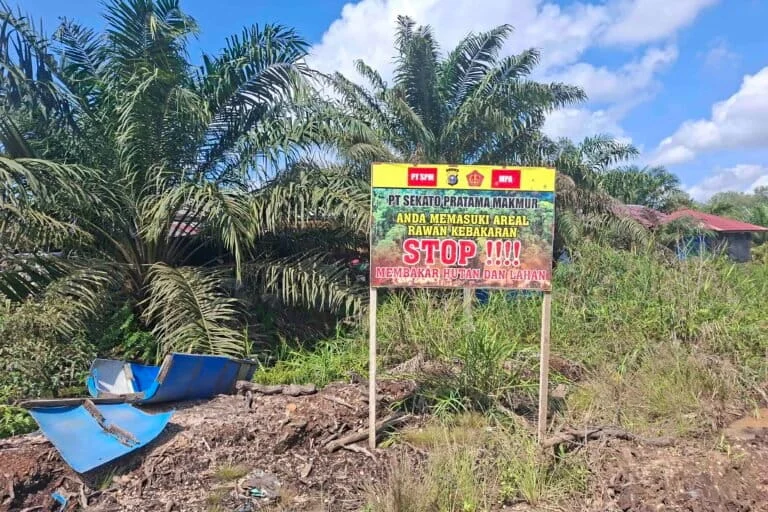
The landscape of Riau Province continues to be scarred by recurring forest and land fires, known locally as karhutla, with recent investigations revealing significant discrepancies in law enforcement and corporate accountability within the concessions of major pulp, paper, and palm oil entities. Despite the presence of police seals and warning banners in certain locations, vast tracts of charred peatland remain outside the scope of active investigation, raising concerns among environmental advocates about a persistent culture of impunity for large-scale landholders. Recent field monitoring and satellite analysis conducted in mid-2026 have identified hundreds of hectares of burned forest within the boundaries of companies such as PT Sekato Pratama Makmur, PT Meskom Agro Sarimas, PT Riau Andalan Pulp and Paper, and PT Arara Abadi, yet the legal response remains uneven and, in many cases, non-existent.
Discrepancies in the Heart of Bengkalis: The Case of PT SPM
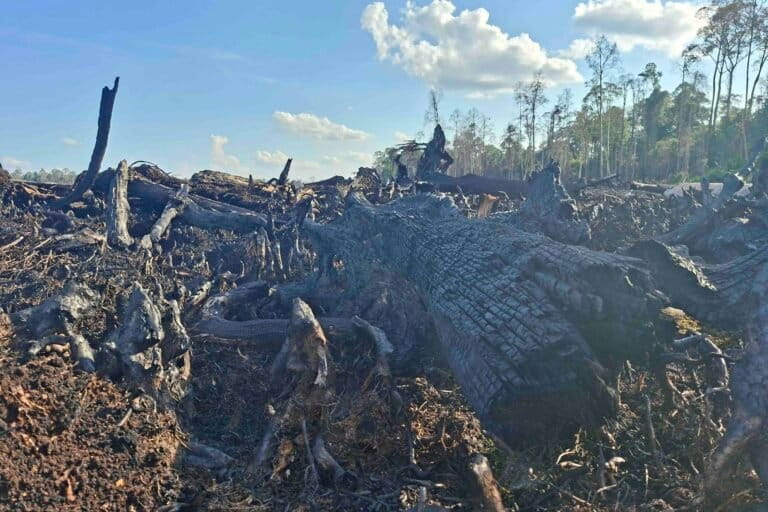
In the Dusun Air Raja area of Tanjung Leban Village, Bandar Laksamana District, the remnants of a significant fire event are still visible months after the flames were extinguished. On May 12, 2026, a seal from the Bengkalis Resort Police’s Criminal Investigation Unit remained planted in the peat soil, though the official notice claimed an affected area of only approximately two hectares. However, independent spatial analysis tells a far more devastating story. The scorched earth, characterized by blackened tree roots, charred stumps, and scattered logs, extends far beyond the policed perimeter.
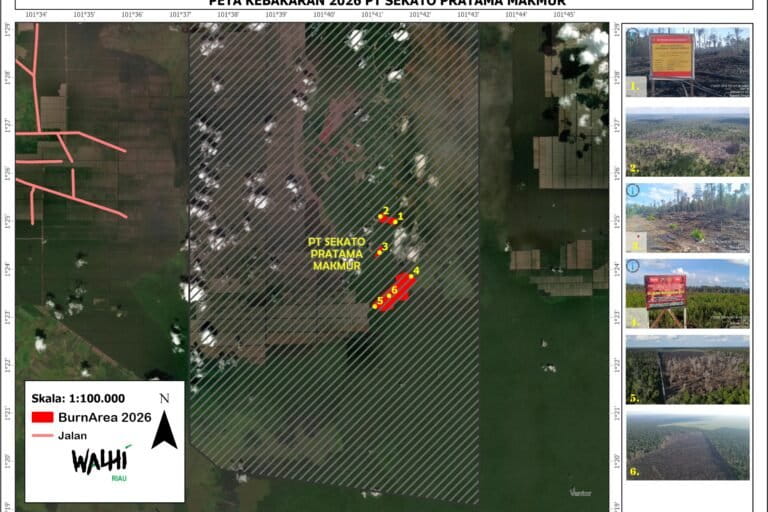
Evidence on the ground, including information boards and concession maps, identifies the land as belonging to PT Sekato Pratama Makmur (SPM), a business unit under the umbrella of APP Sinar Mas. While the police banner failed to name the owner of the land, overlaying the location with the official Forest Utilization Business Permit (PBPH) maps confirms the corporate tenure. Satellite imagery from Sentinel-2 analyzed for the period between February and March 2026 suggests that the fire at PT SPM was not an isolated two-hectare incident. Instead, the fires occurred across three distinct points within the concession, totaling an estimated 115.3 hectares.
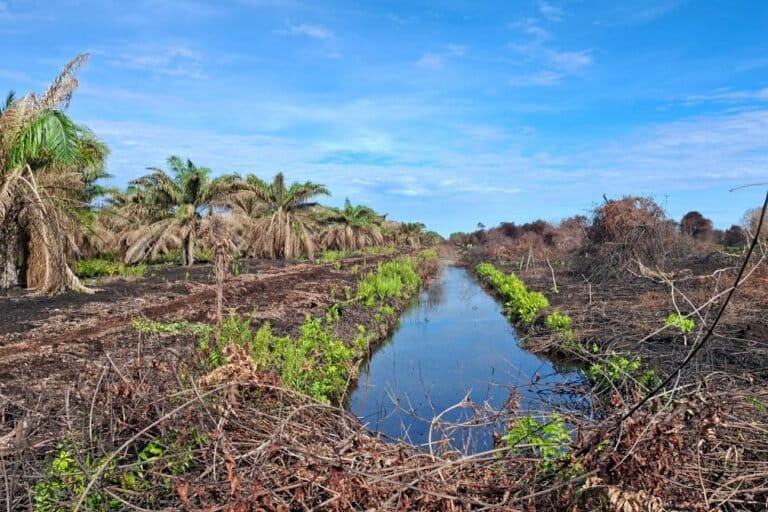
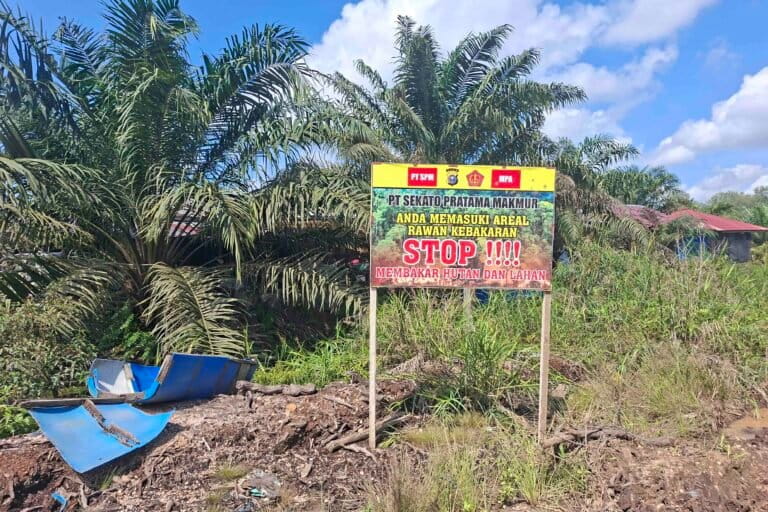
The largest of these points, covering 99.7 hectares, sits between secondary natural forest and acacia plantations, bordered by a network of drainage canals. Despite the scale of the destruction at the second and third locations, no police tape or investigation notices were found. Instead, only corporate warning signs—featuring the logos of PT SPM, the Riau Regional Police, and the Indonesian Navy—were present, warning the public against lighting fires under threat of criminal prosecution. This creates a narrative where the corporation appears as a victim of external factors rather than a party responsible for the management and protection of its own concession.
Coastal Vulnerability and Investigative Silence at PT Meskom
Approximately 126 kilometers away, in the coastal village of Meskom, another peatland fire ravaged the concession of PT Meskom Agro Sarimas (Meskom) during the same period in early 2026. Social media footage from February 12 showed thick plumes of smoke billowing from the scrubland as excavators worked to move soil, presumably to create firebreaks. By May, the site remained a graveyard of blackened organic matter and ash.
Satellite data indicates that 164.1 hectares were burned within the Meskom concession, situated a mere 300 meters from the shoreline. This area is particularly sensitive; residents report that the coastline in Meskom is receding by up to 15 meters annually due to abrasion. The destruction of the peat and the lack of protective mangroves in front of the burned zone have left the land increasingly vulnerable to the encroaching sea.
Despite the scale of the fire and the clear environmental risk, the legal response has been markedly different from that at PT SPM. There are no police seals, no investigative markers, and no visible signs of an ongoing probe into the cause of the fire or potential negligence by the company. When questioned, local law enforcement officials, including the Bengkalis Police’s Head of Criminal Investigation, have remained largely unresponsive to inquiries regarding the status of these cases.
The Siak Incident: Blaming the Neighbors
In Siak Regency, specifically in the Olak Village of Sungai Mandau District, PT Riau Andalan Pulp and Paper (RAPP)—a subsidiary of the APRIL Group—experienced a fire that consumed 71.9 hectares of peat forest. The fire, which occurred around March 2026, required an intense, around-the-clock suppression effort by local residents. Community members recalled spending their Eid al-Fitr holidays fighting the flames rather than celebrating with their families.
In a written response, the APRIL Group’s corporate communications team did not deny that the fire occurred within their subsidiary’s concession. However, they maintained that the fire originated from community-owned land outside their boundaries. The company claimed it deployed full resources for suppression and has since initiated rehabilitation efforts by planting indigenous tree species. While the company stated that the incident was reported to the authorities, the Siak Resort Police reported that their only active karhutla prosecution in 2026 involved a local farmer who burned 10 hectares of land to plant chili peppers. This starkly highlights the "sharp downward, blunt upward" nature of environmental law enforcement, where smallholders face the full weight of the law while corporate incidents are categorized as external accidents.
Pelalawan and the Shifting of Liability
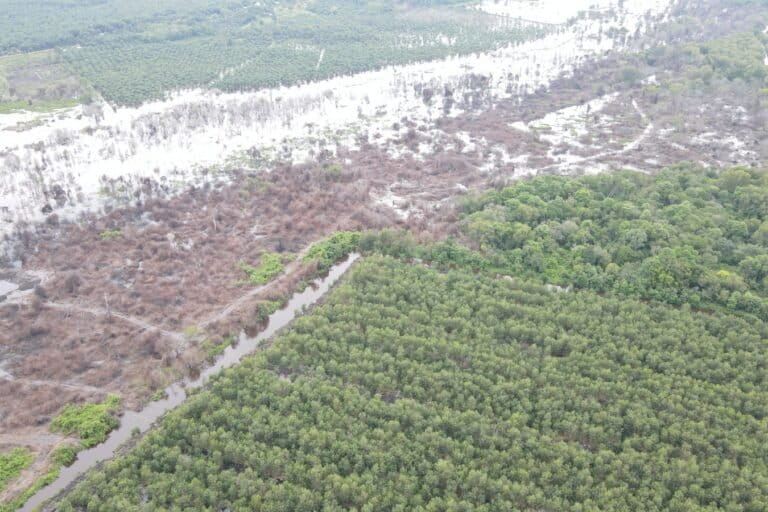
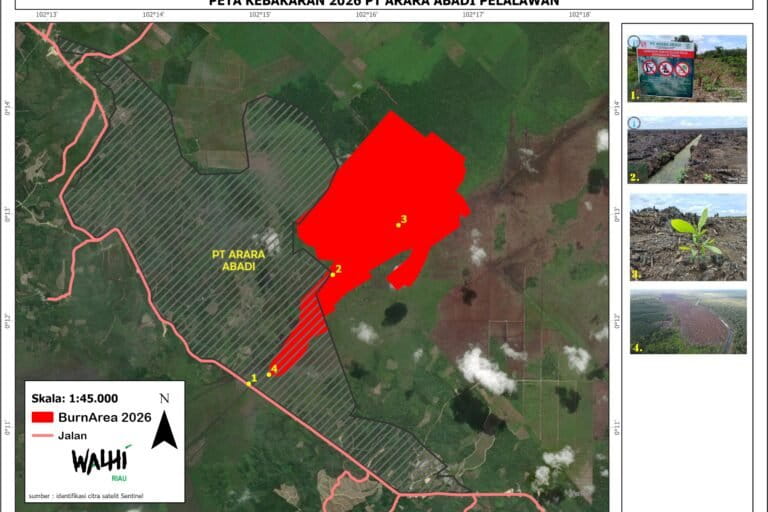
The trend of diverting responsibility is also evident in the case of PT Arara Abadi in Pelalawan Regency. In March 2026, a massive fire broke out in the Pangkalan Terap area, consuming over 600 hectares of peat forest. Approximately 59.6 hectares of this fire fell directly within the concession of PT Arara Abadi, another major unit of APP Sinar Mas.
By the time investigators visited the site in May, the company had already cleared the charred remains, dug new canals, and begun planting acacia seedlings. Interestingly, the investigation by the Pelalawan Police has focused not on the industrial forest holder, but on the Riau Tani Berkah Sejahtera (RTBS) Cooperative. This shift in focus is significant, as the cooperative primarily deals with agricultural crops rather than industrial pulpwood. The lack of transparency regarding how liability is assigned in these overlapping or adjacent land claims remains a point of contention for environmental monitors.
The Historical Context of Legal Failure in Riau
The current lack of corporate prosecution is not a new phenomenon in Riau. Environmental organizations such as Walhi Riau and Jikalahari point to a long history of "SP3" (Order to Stop Investigation) issuances that have favored large corporations. In 2008, 14 corporations involved in illegal logging saw their cases dropped. Similarly, between 2015 and 2016, 15 companies suspected of involvement in massive forest fires were granted SP3s.
Eko Yunanda, Executive Director of Walhi Riau, argues that the failure to target "big players" is the primary reason forest fires continue to be an annual crisis. "Law enforcement against corporations is not functioning as it should," Yunanda stated. He highlighted that while the Ministry of Environment and Forestry (now split into two entities) sealed several companies in 2025—including PT Adei Crumb Rubber and PT Sumatera Riang Lestari—there has been little to no public update on the progress of those cases or any administrative sanctions such as permit revocations.
The recent institutional split between the Ministry of Environment and the Ministry of Forestry has also added a layer of complexity. Advocates worry that the separation will lead to a "dilution" of enforcement power. Okto Yugo Setiyo of Jikalahari noted that the role of forestry law enforcement (Gakkum) has become increasingly invisible, even though his organization has reported five major companies for fire violations in the past year.
Analysis of Implications and the Need for Transparency
The ecological implications of these fires are profound. Riau’s peatlands are among the deepest in the world, acting as massive carbon sinks. When these lands burn, they release centuries of stored carbon into the atmosphere, contributing significantly to regional haze and global climate change. Furthermore, the practice of "clearing and planting" immediately after a fire—as seen in the Arara Abadi case—suggests that fires may sometimes be used as a low-cost tool for land preparation, despite being strictly illegal under Law No. 32 of 2009 on Environmental Protection and Management.
From a legal standpoint, the government often invokes the "prudential principle" and the "due process of law" as reasons for the slow pace of corporate investigations. Ristianto Pribadi, a spokesperson for the Ministry of Forestry, explained that a "hotspot" or burned area within a concession does not automatically constitute a crime. He argued that officials must first verify whether the company fulfilled its obligations regarding fire prevention infrastructure and response teams.
However, groups like Pantau Gambut argue that this "wait-and-see" approach lacks the necessary transparency. Putra Septian, a campaigner for the group, insists that the government must provide an open, evidence-based investigation platform that the public can access. Without such transparency, the suspicion remains that the legal system is biased toward those with the capital to navigate bureaucratic complexities, while the environment and local communities bear the ultimate cost.
As the 2026 fire season continues, the eyes of the international community and local civil society remain on Riau. The recurring nature of these fires in the same corporate concessions suggests that current deterrents are insufficient. Until the "big players" are held to the same standard as the small-scale farmers, the cycle of smoke, ash, and ecological degradation in Sumatra’s peatlands is unlikely to break. The demand for "legal certainty" is not just about punishment; it is about ensuring the survival of Riau’s remaining natural forests and the health of the millions of people who live in the shadow of the haze.