Nila Kartika Wati
Mama Persila Sanyi, a 70-year-old elder from Kampung Enggros in Jayapura, carries the memory of a pristine Youtefa Bay in her mind, a stark contrast to the murky reality she navigates today. Decades ago, the mangrove forests of the bay provided crystal-clear waters where women from the indigenous community could easily harvest shellfish, crabs, and shrimp. Today, the act of foraging—once a source of sustenance and communal joy—has become a physical ordeal. Every time Sanyi returns from the mangroves after searching for bia (clams), her skin is besieged by intense itching and rashes, a direct consequence of the escalating pollution that has transformed this once-sacred ecosystem into a dumping ground for urban waste and industrial runoff.
The degradation of Youtefa Bay is not an isolated environmental incident but a complex confluence of rapid urbanization, insufficient waste management, and the prioritization of commercial infrastructure over ecological preservation. As the city of Jayapura expands, the mangroves, which serve as the lungs and the natural filtration system of the coast, are being suffocated by a literal and metaphorical tide of progress.
The Transformation of a Sanctuary into a Waste Repository
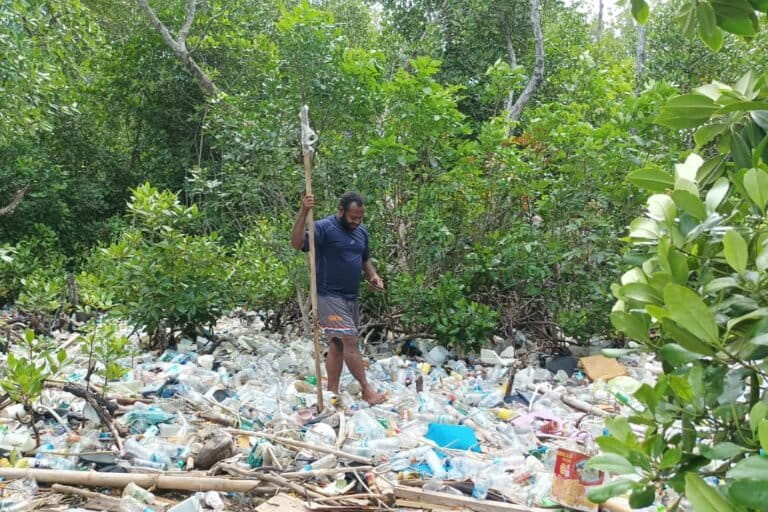
The visual state of the Youtefa Bay mangroves has reached a critical point. Berta Sanyi, another indigenous woman from the Enggros community, describes the current state of the forest as a "mall." This sardonic comparison refers to the staggering variety of consumer waste entangled in the intricate root systems of the mangrove trees. The roots, which are biologically designed to trap sediment and provide nurseries for marine life, are now catching a grim inventory of modern life: plastic bottles, styrofoam containers, discarded mattresses, and, most alarmingly, hazardous medical waste such as used syringes and intravenous drip bags.
This accumulation of waste is more than an aesthetic blight; it is a public health crisis and an ecological disaster. The presence of medical waste suggests a breakdown in the city’s specialized disposal systems, while the sheer volume of plastics indicates that the bay has become the terminal point for Jayapura’s poorly managed drainage and river systems. For the women of Enggros, who spend hours waist-deep in these waters to gather food, the chemical and biological contaminants are a daily occupational hazard.
A History of Legal Protection Versus Practical Reality
The irony of the destruction in Youtefa Bay lies in its long-standing legal status. On paper, the area is one of the most protected zones in Papua. As early as 1978, the region was designated as a protected forest area. This status was further reinforced in 1996 when it was established as a Natural Tourism Park (Taman Wisata Alam – TWA). Under these designations, large-scale land conversion and habitat destruction are strictly prohibited.
However, the reality on the ground reflects a systemic failure to bridge the gap between policy and practice. Along the coastline stretching from Hamadi Beach to Holtekamp, the "green belt" is being systematically replaced by gray infrastructure. The conversion of mangrove land into cafes, restaurants, kiosks, and guesthouses has proceeded with apparent impunity. This commercial encroachment is driven by the area’s increasing popularity as a weekend destination for Jayapura’s growing middle class, creating a paradox where the very nature people come to enjoy is being destroyed to accommodate them.
Quantifying the Loss: Statistical Evidence of Decline
The scale of the environmental retreat is documented in alarming detail by local academic institutions and government agencies. Research conducted by Cenderawasih University in Jayapura provides a longitudinal look at the crisis. Between 1994 and 2017, the mangrove cover in Youtefa Bay plummeted by 159.33 hectares. This represents a staggering 40.59 percent loss in just over two decades. The total area, which originally spanned 392.45 hectares, had shriveled to just 233.12 hectares by the end of the study period.
Recent data from the Papua Natural Resources Conservation Center (BBKSDA) suggests that the pace of degradation has not slowed. Between 2022 and 2024, an additional 7.81 hectares of mangrove forest were lost. The total recorded area under BBKSDA oversight dropped from 124.3 hectares to 116.49 hectares in a mere 24-month window. These figures represent more than just lost trees; they represent a significant reduction in the bay’s capacity to sequester carbon, protect the shoreline from erosion, and sustain the local food chain.
Infrastructure and the Price of Connectivity
While small-scale commercial encroachment is a constant pressure, large-scale infrastructure projects have delivered the most sudden and transformative shocks to the ecosystem. Petronela Maruje, the head of the Enggros Village Women’s Community, has been a frontline witness to these changes. She notes that the construction of the iconic Youtefa Bridge (famously known as the Red Bridge), which began in 2015, and the development of the rowing competition facilities for the 2021 National Sports Week (PON XX), significantly altered the bay’s landscape.
While these projects are celebrated as milestones of Papuan development and connectivity, Maruje highlights the hidden cost paid by the indigenous inhabitants. "When that construction happened, the fish started to disappear because the mangrove trees were cut down," she explains. The removal of the mangroves destroyed the spawning grounds for fish and the habitats for crabs and shellfish, effectively "closing" the natural kitchen that has fed the Enggros and Tobati people for generations.
The Cultural and Social Toll on Indigenous Women
In the indigenous Papuan worldview, particularly for those living in the water-bound villages of Youtefa Bay, the mangroves are not merely a "resource" but a vital social and cultural space. For the women, the forest is a sanctuary—a place where they can work away from the heat of the sun, gather firewood, and engage in communal dialogue. The loss of the mangroves is therefore a form of cultural displacement.
Petronela Maruje emphasizes that for the women of Enggros, the mangroves are synonymous with the "kitchen." In traditional Papuan society, the division of labor often sees women taking responsibility for the gathering of coastal protein. As the forest thins and the waters become toxic, the food security of these households is directly threatened. The time required to find enough food for a single meal has tripled, and the quality of the catch has diminished, forcing many families to rely more heavily on expensive, store-bought processed foods.
Legal Enforcement and the Limits of Intervention
There have been sporadic attempts to stem the tide of illegal activity. In 2023, a joint task force comprising the BBKSDA Papua, the Papua Regional Police, and the Jayapura City Government took action against parties involved in the illegal filling of mangrove areas along the Hamadi road. This practice, known as penimbunan, involves dumping soil and rocks over mangrove roots to create solid ground for construction.
Chandra Irwanto Lumban, a Forestry Extension Expert at BBKSDA Papua, confirmed that legal proceedings were initiated. "The case of mangrove filling has been handled by Gakkum (the Law Enforcement Center of the Ministry of Environment and Forestry) and is currently in the court process," he stated. However, while such high-profile enforcement actions send a message, they often function as reactive measures rather than a comprehensive deterrent. By the time the authorities intervene, the ecological damage is often irreversible, as the buried root systems die and the local soil chemistry is permanently altered.
Seeking a Path Forward: Ecotourism and Awareness
Experts and community leaders are now searching for a "middle way" that allows for economic development without the total destruction of the bay’s ecological integrity. Anna M. Labok, a lecturer in Urban and Regional Planning at the University of Science and Technology Jayapura, advocates for the implementation of a strict ecotourism model. Under this concept, any development within the Natural Tourism Park would be required to maintain the existing vegetation, using elevated wooden walkways and low-impact structures rather than land reclamation and concrete.
However, for community leaders like Petronela Maruje, the solution is not found in more policies, but in a fundamental shift in human awareness. She observes that the current trajectory of development is characterized by short-term thinking that ignores the long-term survival of the region. "They are destroying this nature, they are destroying their own lives in the future," Maruje says, her voice heavy with the weight of witnessing a vanishing heritage.
Implications for the Future of Jayapura
The crisis in Youtefa Bay serves as a microcosm of the broader environmental challenges facing rapidly developing coastal cities in Indonesia. The loss of over 40% of the bay’s mangroves significantly increases the vulnerability of Jayapura to the impacts of climate change, including rising sea levels and more frequent storm surges. Without the natural buffer of the mangrove roots, coastal erosion will accelerate, potentially threatening the very infrastructure—the roads, cafes, and bridges—that led to the trees’ removal in the first place.
Furthermore, the plight of the Enggros and Tobati women highlights the intersectional nature of environmental degradation. It is the indigenous populations, who contributed the least to the pollution and development frenzy, who suffer the most immediate and severe consequences. As the "mall of trash" continues to grow and the green walls of the bay continue to recede, the window for meaningful restoration is closing. The future of Youtefa Bay now depends on whether the government and the public can move beyond viewing the mangroves as a hurdle to development and start seeing them as the essential foundation for the city’s long-term survival.