Azin Asro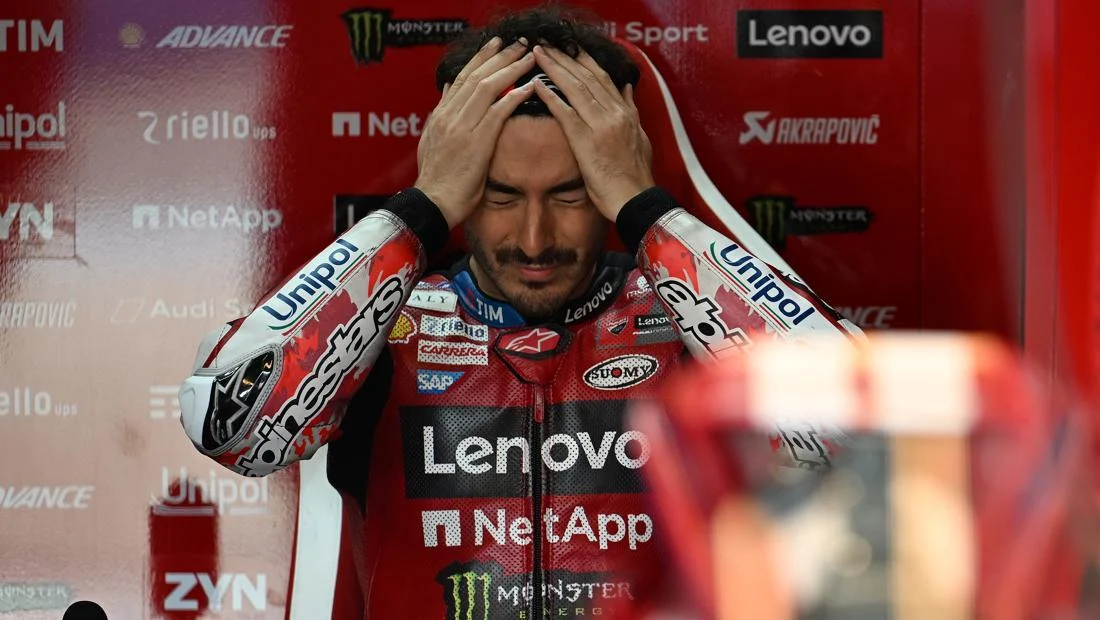
The landscape of the MotoGP World Championship witnessed a dramatic shift at the Bugatti Circuit as defending champion Francesco "Pecco" Bagnaia suffered a significant setback, crashing out of a podium-contesting position during the French Grand Prix. Despite demonstrating formidable pace throughout the practice and qualifying sessions, the Ducati Lenovo Team rider saw his efforts unraveled on the sixteenth lap, an incident that has raised critical questions regarding the technical consistency of his machinery. Bagnaia, who had secured pole position earlier in the weekend, appeared to be on a trajectory toward a podium finish before an abrupt loss of front-end traction sent him into the gravel at the first corner, marking a disappointing end to a weekend that had otherwise showcased his elite competitive form.
A Weekend of Dominance Interrupted by Race-Day Volatility
The French Grand Prix at Le Mans is historically known for its demanding "stop-and-go" nature, characterized by heavy braking zones and short bursts of acceleration. For Francesco Bagnaia, the weekend began with the precision that has become his trademark. During Saturday’s qualifying session, the Italian rider navigated the 4.185-kilometer circuit with surgical accuracy, clocking a lap time that secured him the pole position. This performance reinforced the narrative that the Ducati Desmosedici remains the benchmark of the field, and Bagnaia its most capable pilot.
However, the transition from qualifying trim to race-day endurance proved problematic. As the lights went out for the main event, Bagnaia struggled to maintain his advantage. A sluggish launch saw him swallowed by the chasing pack, dropping from the front of the grid to fifth place by the end of the opening lap. This initial setback forced the reigning champion into a recovery mode, a scenario that requires not only high speed but also immense tire management to avoid premature degradation.
Detailed Chronology: The Rise and Fall at Le Mans
The early stages of the race were a testament to Bagnaia’s resilience. While Marco Bezzecchi established a commanding lead at the front, Bagnaia began a methodical climb back through the field. By the middle stages of the race, the Ducati factory rider had successfully dispatched his rivals to reclaim second place. At this juncture, Bagnaia was positioned directly behind Bezzecchi, the championship leader at the time, and seemed to be consolidating a safe second-place finish which would have provided vital points for his title defense.
The chronology of the incident began to take shape around the ninth and tenth laps. While his lap times remained competitive, Bagnaia later reported a creeping sense of instability. The gap between himself and Bezzecchi began to fluctuate, not because of a lack of engine power, but due to a deteriorating "feel" for the motorcycle’s front end. By lap 15, the issue had reached a critical threshold. As Bagnaia entered the high-speed Turn 1 on lap 16, the front tire lost grip entirely, offering no feedback or opportunity for correction. The resulting slide ended his race instantly, leaving the Ducati Lenovo garage in a state of disbelief.
Technical Analysis: The Mystery of the Front-End Failure
In the immediate aftermath of the crash, initial speculation pointed toward rider error—perhaps an over-ambitious entry speed or a slight deviation from the racing line. However, Bagnaia was quick to clarify the nature of the incident in his post-race briefings. Speaking to technical analysts and media outlets, he emphasized that the crash was the result of a recurring mechanical or setup-related anomaly rather than a lapse in judgment.
"We worked well and improved a lot this weekend," Bagnaia stated, reflecting on the progress made during Friday and Saturday. "We were in a good position in the race today, and although we struggled a lot at the start, I managed to get back to my pace." The core of the issue, according to Bagnaia, was a progressive loss of confidence in the front end of the bike. This "confidence" in MotoGP terms refers to the rider’s ability to sense the limit of the tire’s grip through the handlebars. When this feedback diminishes, the rider becomes a passenger to the bike’s mechanical whims.
Bagnaia noted that the problem worsened lap by lap. "Unfortunately, we had a small problem, and lap after lap, I lost confidence in the front part, trying to maintain the same speed. It can happen, and we will try to overcome it. We know why I fell, so the team is definitely working on it, but it was not human error." This distinction is vital for the team’s internal morale and technical direction. If the crash were a result of "over-riding," the solution would be psychological; because it is mechanical, it requires a deep dive into data telemetry, suspension damping, and tire pressure management.
Parallels with the Spanish Grand Prix
One of the most concerning aspects of the Le Mans crash is its similarity to Bagnaia’s previous outing at the Grand Prix of Spain. In that event, Bagnaia also experienced a mid-race loss of front-end stability that compromised his finishing position. By referencing the Spanish GP, Bagnaia highlighted a potential systemic issue with the current setup of his Desmosedici under specific thermal or aerodynamic conditions.
In modern MotoGP, the introduction of sophisticated front-ride-height devices and complex winglet configurations has made the bikes highly sensitive to the "dirty air" generated by leading riders. When following another bike closely—as Bagnaia was following Bezzecchi—the front tire can overheat, causing the internal pressure to spike. This often leads to a "washout" where the tire loses its contact patch. Bagnaia’s comments suggest that the Ducati engineers must find a way to make the bike more resilient when running in the slipstream of competitors, ensuring that the front-end geometry remains stable even as tire pressures fluctuate.
The Broader Impact on the World Championship Standings
The zero-point finish at Le Mans has significant implications for the 2024 championship race. In a season defined by its intensity and the high level of competition from both factory and satellite teams, every retirement is magnified. Marco Bezzecchi’s victory, combined with strong performances from Jorge Martin and the Aprilia duo of Aleix Espargaro and Maverick Viñales, has tightened the gap at the top of the standings.
Bagnaia’s crash represents more than just lost points; it represents a missed opportunity to assert dominance. In the premier class, psychological momentum is a tangible factor. By failing to finish while in a podium position, Bagnaia allows his rivals to believe that the defending champion is vulnerable to technical inconsistencies. However, the sheer pace Bagnaia showed by taking pole position suggests that when the bike is operating within its optimal window, he remains the fastest man on the grid. The challenge for the Ducati Lenovo Team is to widen that window of operation.
Official Team Reactions and Engineering Outlook
While the riders are the face of the sport, the engineers in the Ducati garage are the ones tasked with solving the puzzle. Team Manager Davide Tardozzi and Technical Guru Gigi Dall’Igna are known for their data-driven approach to racing. Following Bagnaia’s feedback, the team has reportedly begun an exhaustive analysis of the telemetry from lap 1 through lap 16.
The objective is to identify the exact moment the front-end geometry began to deviate from the predicted model. Sources within the paddock suggest that the team is looking into the interaction between the hard-compound front tire favored by Bagnaia and the specific braking loads at Le Mans. "We know exactly why I fell, and that is something that helps us a lot," Bagnaia reiterated. This suggests that the data has already revealed a specific anomaly—perhaps a sensor failure or a specific hydraulic fluctuation in the front forks—that can be rectified before the next round.
Looking Forward: The Road to Catalunya
Despite the frustration of the French Grand Prix, Bagnaia remains outwardly optimistic. The MotoGP calendar moves next to the Circuit de Barcelona-Catalunya, a track known for its long straights and challenging, low-grip surface. This will be a different kind of test for the Ducati, as the emphasis will shift from heavy braking to edge grip and tire longevity.
"I have full confidence in the work we are doing, and I am sure we will arrive in Barcelona next week after making a big step forward since testing," Bagnaia said. His focus is now on matching, or exceeding, the performance of the Aprilia RS-GP, which has historically performed exceptionally well at the Catalan circuit. The rivalry between Ducati and Aprilia is expected to reach a fever pitch in Spain, and Bagnaia’s ability to bounce back from the Le Mans disaster will be a defining moment of his season.
The technical team at Borgo Panigale will likely spend the intervening days refining the front-end maps of the Desmosedici. For Bagnaia, the goal is simple: eliminate the technical "ghosts" that have haunted his last two races and return to the clinical consistency that earned him the number one plate. As the championship heads into the heart of the European season, the margin for error has vanished, and the pressure on the factory Ducati squad to deliver a flawless machine has never been higher.
In conclusion, while the French Grand Prix will be remembered as a missed opportunity for Francesco Bagnaia, it also serves as a stark reminder of the razor-thin margins in modern motorcycle racing. The transition from a pole-winning lap to a low-side crash is a matter of millimeters and milliseconds. For Bagnaia and Ducati, the focus is no longer on what went wrong in the gravel of Le Mans, but on ensuring that the lessons learned there provide the foundation for a triumphant return in Catalunya. The championship remains a marathon, not a sprint, and the resilience of the reigning champion will be his greatest asset in the weeks to come.