Azin Asro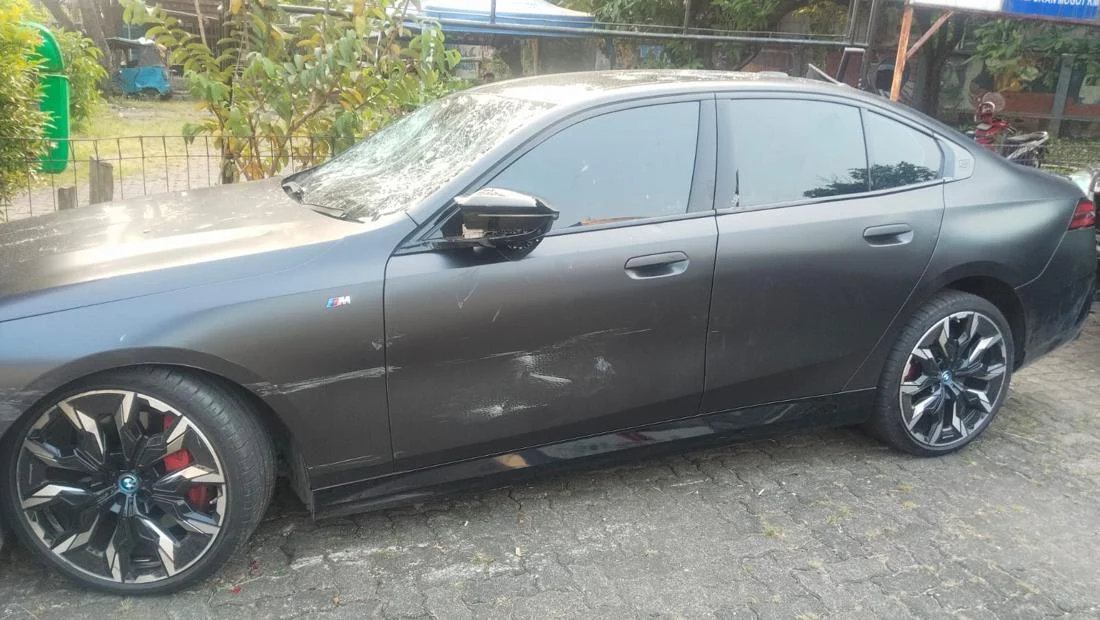
A high-performance luxury electric vehicle, identified as a 2024 BMW i5 M60 xDrive, became the center of a chaotic scene in West Jakarta after a traffic collision escalated into a public pursuit and subsequent property damage. The incident, which occurred on Jalan Meruya Selatan in the Kebon Jeruk sub-district, highlights the volatile nature of traffic disputes in the capital and the growing presence of high-end electric vehicles on Jakarta’s congested thoroughfares. While the confrontation initially threatened to spiral into a major legal battle involving both traffic violations and vigilante justice, the West Jakarta Metro Police have confirmed that the situation has since been resolved through a mediation process between the parties involved.
The incident began during the busy morning commute at approximately 08:15 WIB. According to official police reports and eyewitness accounts, the BMW i5, bearing the registration number B-77-NRI, was traveling from north to south along Jalan Meruya Selatan. The area, known for its proximity to several educational institutions and residential clusters, is a notorious bottleneck during peak hours. As the vehicle navigated the arterial road, it collided with a motorcycle that was approaching from the opposite direction, heading north. The impact caused the motorcyclist to lose balance and fall onto the asphalt, resulting in injuries that, while not life-threatening, required immediate attention.
Chronology of the Incident and Public Reaction
The situation transitioned from a standard traffic accident into a public disturbance when the driver of the BMW allegedly failed to stop immediately after the collision. Witnesses at the scene, including several online motorcycle taxi (ojol) drivers who frequently congregate in the Meruya area, perceived the driver’s actions as an attempt to flee the scene of the accident. In Jakarta’s social landscape, the "hit-and-run" perception often triggers a swift and collective response from bystanders, particularly from the community of two-wheeled motorists.
As the BMW attempted to move away from the point of impact, a group of residents and motorists began a pursuit. The high-performance electric sedan, despite its significant acceleration capabilities, was hampered by the dense morning traffic, allowing the mob to surround the vehicle. Frustrated by the perceived evasion, several individuals began to strike the car, causing visible damage to its exterior. The scene was characterized by high tension until local law enforcement intervened to prevent further escalation.
Kompol Reza Hafiz Gumilang, the Acting Chief of Traffic at the West Jakarta Metro Police, confirmed that while the car was pursued and targeted by the crowd, officers managed to secure both the vehicle and the driver before the situation turned more violent. "The car was indeed chased by the masses, but it was successfully secured by our officers on duty," Kompol Reza stated in a briefing following the event. The driver was subsequently taken into custody for questioning to determine the exact cause of the accident and the reason for the delayed stop.
Technical Profile of the BMW i5 M60 xDrive
The vehicle involved in the incident is not a common sight on Indonesian roads, representing the pinnacle of BMW’s current electric sedan lineup. The BMW i5 M60 xDrive is the high-performance "M" variant of the electric 5 Series, which was officially launched in the Indonesian market recently. With a market valuation (NJKB) listed in the Jakarta Samsat database at approximately IDR 2,571,000,000 (roughly $160,000 USD), the car represents a significant investment in green technology and luxury.
Technically, the i5 M60 xDrive is equipped with a dual-motor setup providing all-wheel drive, capable of producing a staggering 601 horsepower and up to 820 Nm of torque when using M Sport Boost or Launch Control. This allows the heavy sedan to sprint from 0 to 100 km/h in just 3.8 seconds. The presence of such high-performance capabilities in a densely populated urban environment like Meruya raises questions about the suitability of sports-tuned EVs for Jakarta’s narrow and unpredictable secondary roads.
Further investigation into the vehicle’s administrative records revealed an interesting paradox regarding its operational costs. Despite its multi-billion rupiah price tag, the annual tax obligation for the vehicle is remarkably low. Under current Indonesian government regulations aimed at accelerating the adoption of battery electric vehicles (BEVs), the Motor Vehicle Tax (PKB) for electric cars is set at 0%. Consequently, the owner of the B-77-NRI BMW is only required to pay the Mandatory Contribution to the Road Traffic Accident Fund (SWDKLLJ), which amounts to a mere IDR 143,000 per year.
However, the Samsat records also indicated a minor administrative oversight. The vehicle was found to have a late payment status, incurring a fine of IDR 35,000. While the amount is negligible compared to the car’s value, it added a layer of scrutiny to the driver’s profile during the police investigation. The vehicle’s registration is valid until March 2026, confirming it is a new addition to Jakarta’s growing fleet of luxury EVs.
Official Investigation and the Path to Mediation
Following the incident, the West Jakarta Traffic Police’s Accident Unit (Unit Gakkum) took over the case. The primary focus of the investigation was to determine whether the driver had a deliberate intent to flee or if the delay in stopping was a result of shock or the search for a safe location to pull over—a common defense in such scenarios.
AKP Joko Siswanto, the Head of the Gakkum Unit, explained that the initial collision occurred when the BMW drifted or moved into the path of the oncoming motorcycle. "Before the accident occurred, the electric sedan was traveling from north to south. It then collided with a motorcycle coming from the south," AKP Joko detailed. The motorcyclist, who was identified as an online transportation driver, was the primary victim of the collision.
In many Indonesian traffic cases, particularly those involving a significant disparity in social or economic standing between the parties, the legal system often facilitates a process known as "Restorative Justice" or "Kekeluargaan" (familial settlement). This approach prioritizes compensation and mutual agreement over formal prosecution, especially when injuries are not fatal and both parties are willing to negotiate.
By Monday afternoon, the police confirmed that a mediation session had been held at the West Jakarta Traffic Office. The session involved the driver of the BMW, the motorcyclist, and representatives from the online taxi community. "The issue has been resolved through a familial settlement," AKP Joko Siswanto confirmed. The driver of the BMW reportedly agreed to cover the medical expenses of the motorcyclist and the repair costs for the damaged two-wheeler. In exchange, the motorcyclist and the involved parties agreed not to pursue further legal action regarding the collision.
Analysis of Implications: Mob Justice and the Luxury Gap
This incident underscores several critical issues facing Jakarta’s urban management and social fabric. The first is the persistent trend of "mob justice" (amuk massa). In Jakarta, the fear of a driver escaping responsibility often leads to immediate, and sometimes violent, collective action. While the crowd’s intent is often to "secure" a perpetrator, the result is frequently the destruction of property and the risk of physical harm to individuals before the facts are established by authorities.
Legal experts suggest that the "hit-and-run" mentality is a symptom of low public trust in the speed of law enforcement response. However, the police have repeatedly warned that damaging a vehicle—even one involved in an accident—is a criminal act under the Indonesian Penal Code (KUHP). In this case, the driver of the BMW chose not to press charges against the individuals who damaged his multi-billion rupiah car, likely as part of the broader "peace agreement" to resolve the initial accident.
Secondly, the incident highlights the social friction between the growing class of luxury EV owners and the general motoring public. The BMW i5 M60 is a symbol of a technological and economic shift. As the Indonesian government continues to provide massive tax incentives for EVs—such as the 0% PKB—more of these high-performance, silent, and extremely fast vehicles will populate the streets. The silence of electric motors can sometimes contribute to accidents, as pedestrians and other motorists may not hear an approaching vehicle, though modern EVs are required to emit acoustic vehicle alerting systems (AVAS) at low speeds.
Finally, the Meruya incident serves as a reminder of the importance of defensive driving in high-density areas. Jalan Meruya Selatan is a corridor characterized by mixed usage, with heavy motorcycle traffic, street vendors, and turning vehicles. The introduction of a 600-horsepower sedan into this environment requires a high level of driver awareness.
The resolution of the case through mediation reflects the pragmatic side of Indonesian traffic law, where "peace" is often preferred over a lengthy and expensive court process. However, the images of a state-of-the-art electric BMW being surrounded and damaged by a mob will likely remain a cautionary tale for luxury car owners navigating the complex and often volatile streets of the capital. As Jakarta moves toward a greener automotive future, the challenges of road safety, social equity, and the rule of law remain as relevant as ever.