Nila Kartika Wati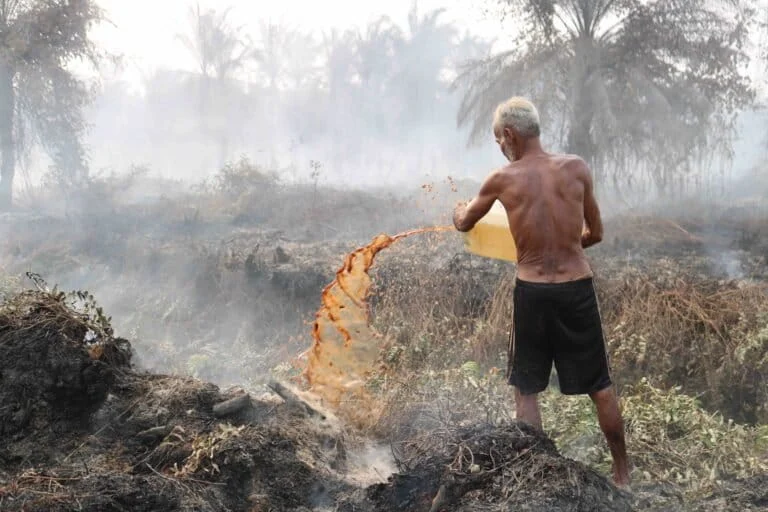
The Indonesian archipelago is currently grappling with a severe environmental emergency as forest and land fires (karhutla) continue to consume vast swaths of territory across Kalimantan, Sumatra, and Papua. According to official data from the Ministry of Forestry, by August 2026, the cumulative area affected by these fires surpassed 202,000 hectares, impacting 340 districts across 36 provinces. As the dry season persists, the national focus has shifted from immediate firefighting efforts to the complex and contentious issue of legal accountability, particularly regarding the role of corporate entities in what appears to be a systemic cycle of environmental degradation.
The Scale of the Crisis and Law Enforcement Response
By early September 2026, the Indonesian National Police (Polri) reported that they had opened approximately 200 formal investigations into fire-related offenses. These efforts have resulted in the apprehension of 138 individuals designated as suspects. Chief of the Indonesian National Police, General Listyo Sigit Prabowo, confirmed that of these suspects, 119 individuals are accused of intentional burning, while 19 cases are attributed to negligence.
General Prabowo indicated that these figures are preliminary and expected to rise as investigations deepen. However, the focus on individual perpetrators—often low-level laborers or local farmers—has sparked significant criticism from environmental advocacy groups. While police are investigating the potential involvement of eight corporate entities, no formal charges against these companies have been announced to date. Authorities claim they are currently coordinating with the Ministry of Environment and the Ministry of Forestry to scrutinize the involvement of financiers and large-scale landholders behind the field operatives.

The Economics of Arson
The investigative wing of the National Police (Bareskrim Polri) has identified a disturbing trend: the deliberate use of fire as a low-cost mechanism for land clearing. Brigjen Pol Mohammad Irhamni, Director of Tipidter Bareskrim Polri, explained that companies often resort to burning because it is significantly cheaper than mechanical land clearing. Furthermore, the practice offers a short-term agricultural "advantage," as the resulting ash provides temporary nutrients to the soil.
Police are now collaborating with the Financial Transaction Reports and Analysis Center (PPATK) to trace the flow of funds from these operations. The goal is to uncover the "intellectual actors"—the backers and beneficiaries who fund these illegal activities—to move beyond arresting merely the individuals holding the match.
Expert Critiques: The Failure of Mitigation
Environmental experts argue that the current law enforcement approach is insufficient. Asep Komarudin, a forest campaigner for Greenpeace Indonesia, emphasized that the number of arrests is a poor metric for success. "True justice is not measured by how many individuals are detained, but by whether corporate fines are actually collected, whether the burned areas are restored, and whether there is a tangible deterrent effect that prevents fires from returning to the same concessions," Komarudin stated.
The situation is further complicated by the recurrence of El-Nino climate patterns. I Gusti Agung Made Wardana, an environmental law expert at Gadjah Mada University, suggests that corporations often time their land-clearing activities to coincide with dry climate cycles, allowing them to deflect blame by attributing the fires to "extreme weather" rather than human activity. Wardana argues that the state’s failure to implement proactive, early-stage mitigation in high-risk areas during the lead-up to the dry season reflects a systemic negligence that leaves the country vulnerable to recurring ecological disasters.

Data-Driven Analysis of Concessions
Data from the research group Counter Point underscores the correlation between corporate presence and fire hotspots. Since August 1, 2026, over 120,000 fire hotspots have been detected in Kalimantan, with a significant concentration—roughly 45,727—occurring within or within five kilometers of licensed forest concessions. These concessions cover a massive footprint of approximately 14.6 million hectares.
Yayasan Madani Berkelanjutan, an environmental think tank, found that nearly 41% of the areas identified as "indicative burned areas" (AIT) overlap with existing permits and concessions, including palm oil plantations, oil and gas exploration sites, and forest management concessions (PBPH). Furthermore, the government’s ambitious Strategic National Projects (PSN) for food and energy in Merauke, covering 2.32 million hectares, have also become flashpoints, with hundreds of fire hotspots detected within these project boundaries.
The Peatland Crisis
The damage to Indonesia’s peatland ecosystems is particularly catastrophic. Peatlands are critical carbon sinks; when drained and burned, they release massive amounts of greenhouse gases. The group Pantau Gambut has documented an extensive network of canals—totaling over 281,000 kilometers—that have been dug into peat ecosystems to facilitate large-scale industrial plantations. These canals effectively drain the peat, turning the landscape into a tinderbox.
Putra Saptian, a campaigner for Pantau Gambut, has called on the government to cease prioritizing industrial expansion over environmental preservation. "As long as the protection of peatlands is treated as a negotiable item, this crisis will continue to claim victims," he warned. In Pontianak and other parts of West Kalimantan, the air quality has already reached "hazardous" levels, causing severe health risks for the local population.

Legal Hurdles and Regulatory Enforcement
The Ministry of Environment (KLH) has initiated enforcement actions by sealing the operations of 21 companies across Sumatra and Kalimantan. Minister of Environment Jumhur Hidayat stated that the ministry has identified 335 companies with strong indicators of intentional burning. However, the path to prosecution remains long. The ministry is currently conducting verifications to determine whether to pursue administrative sanctions, such as the revocation of operating licenses, or to escalate to criminal and civil litigation.
The Ministry of Forestry (Kemenhut) has also taken steps, issuing warning letters to 20 companies and imposing administrative sanctions on several, including PT MPK, which faced the suspension of its business license due to the severity and repetition of fires within its concession. Despite these measures, critics point to the "stagnant" nature of past cases. For instance, investigations into five forestry companies in Riau regarding 2025 fires have yet to reach a resolution, fueling public skepticism regarding the government’s willingness to hold large corporations fully accountable.
Papua as the New Epicenter
Perhaps the most alarming development in 2026 is the emergence of Papua as a major hotspot for forest and land fires. While West Kalimantan remains the most affected region, Papua Selatan has risen to second place, with nearly 42,000 hectares burned. Most of these fires occurred in July, centered in the Merauke and Mappi regencies.
This trend is particularly worrying because these areas often overlap with protected zones and moratorium areas (PIPPIB). Yosi Amelia of Madani Berkelanjutan noted that when fires penetrate these protected ecosystems, the challenge shifts from simple fire suppression to a global climate catastrophe. The scale of the burning in Papua threatens to undermine Indonesia’s commitment to its "FOLU Net Sink 2030" goals, which aim to make the forestry sector a net carbon sink.

Looking Ahead
The recurring nature of Indonesia’s forest fires suggests that current regulatory frameworks are failing to deter the underlying economic drivers of the crisis. As the government continues to weigh the balance between economic development and ecological integrity, the pressure from both the international community and domestic civil society is mounting.
Without a fundamental shift—from treating fires as isolated incidents to addressing the structural reliance on fire-based land conversion—the 2026 fire season may serve as a grim precursor to future years. For the millions of residents living under a blanket of toxic smoke, the demand remains clear: the state must prioritize the enforcement of existing laws, hold corporate actors accountable for the restoration of degraded lands, and halt the expansion of extractive industries into the nation’s most vulnerable peat and forest ecosystems. The future of Indonesia’s biodiversity and its contribution to the global climate fight hangs in the balance.