Bambang Pamungkas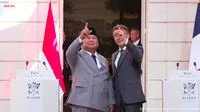
Indonesian President Prabowo Subianto and French President Emmanuel Macron jointly affirmed their unwavering support for the independence of Palestine, advocating for a two-state solution to resolve the protracted conflict in the Middle East. The significant declaration was made during a press briefing following an official reception for President Prabowo hosted by President Macron at the historic Élysée Palace in Paris, France, on the evening of Thursday, May 28, 2026, Western Indonesia Time (WIB). This high-level endorsement from two influential global leaders underscores a growing international consensus on the urgency of achieving lasting peace and justice for the Palestinian people, recognizing the profound implications of regional instability on the global stage.
Contextualizing the High-Level Engagement
President Prabowo Subianto’s visit to Paris in late May 2026 marked a pivotal moment in the bilateral relations between Indonesia and France, extending beyond the immediate focus on the Middle East peace process. The visit was part of a broader diplomatic offensive by the newly inaugurated Indonesian president to strengthen strategic partnerships with key global players, emphasizing economic cooperation, defense collaboration, and shared multilateral values. France, a permanent member of the UN Security Council and a leading voice within the European Union, represents a crucial partner for Indonesia in its pursuit of a more balanced and stable global order. Discussions during the state visit spanned a wide array of topics, including climate change, renewable energy initiatives, digital transformation, and enhancing cultural exchanges. However, the joint statement on Palestine emerged as a centerpiece of the leaders’ discussions, reflecting the pressing humanitarian and geopolitical concerns emanating from the region. The choice of the Élysée Palace, a symbol of French state power and diplomacy, as the venue for this declaration further amplified its significance, projecting a unified front from Jakarta and Paris on one of the world’s most enduring conflicts.
The Indispensable Two-State Solution
President Prabowo articulated Indonesia’s steadfast belief that enduring peace in the Middle East is unattainable without the implementation of a two-state solution, guaranteeing justice and self-determination for the Palestinian people. This stance is not new for Indonesia, a nation that has consistently championed the Palestinian cause since its own independence, rooted in principles of anti-colonialism and solidarity. The two-state solution, which envisions an independent and sovereign Palestinian state existing peacefully alongside Israel, has long been the cornerstone of international diplomatic efforts, enshrined in numerous United Nations resolutions, including Security Council Resolutions 242 (1967) and 338 (1973). These resolutions call for Israel’s withdrawal from territories occupied in 1967 in exchange for peace and secure borders, alongside the recognition of the rights of the Palestinian people. However, decades of negotiations, punctuated by periods of intense conflict and stalled peace talks, have failed to bring this vision to fruition. The expansion of Israeli settlements in the West Bank, the unresolved status of Jerusalem, border disputes, the right of return for Palestinian refugees, and persistent security concerns have presented formidable obstacles to any comprehensive agreement. The joint declaration from Presidents Prabowo and Macron served as a powerful reminder to the international community that despite these challenges, the two-state framework remains the most viable and widely accepted pathway to a just and lasting peace.
Global Repercussions of Middle East Instability
President Prabowo underscored the profound global implications of instability in the Middle East, particularly its direct impact on global energy security and supply chains. The region, a critical nexus for international trade and a primary source of the world’s oil and natural gas, holds disproportionate sway over the global economy. Any significant disruption, whether from conflict or political upheaval, can send ripple effects across continents. Historically, events such as the 1973 oil crisis, the Gulf Wars, and more recent conflicts have demonstrated how quickly regional tensions can translate into soaring energy prices, impacting everything from transportation costs to manufacturing expenses worldwide. Major shipping lanes, including the Suez Canal and the Strait of Hormuz, are vital conduits for global commerce, handling a significant percentage of the world’s maritime trade. Disruptions in these chokepoints, often threatened by regional conflicts, can lead to massive delays, rerouting, and increased insurance costs, severely impacting global supply chains. For an emerging economy like Indonesia, heavily reliant on stable energy markets and robust international trade, sustained peace in the Middle East is not merely a humanitarian ideal but an economic imperative. Unstable energy prices can fuel domestic inflation, hamper economic growth, and strain national budgets, while disrupted supply chains can impede access to critical imports and hinder export capabilities. Prabowo’s emphasis on this interconnectedness highlighted a pragmatic dimension to Indonesia’s diplomatic engagement, linking regional stability directly to global economic resilience and prosperity.
France’s Pioneering Role in European Diplomacy
President Prabowo lauded France for its leadership in rallying European and Western nations to support the two-state solution for Palestinian independence. France has historically played a prominent role in advocating for a balanced approach to the Israeli-Palestinian conflict, often diverging from the more cautious stance of some other Western powers. Paris has consistently emphasized the need for international law and humanitarian principles to guide the peace process. In recent years, as the conflict has intensified and the humanitarian situation in Gaza has deteriorated, France has amplified its calls for a political solution, pushing for a renewed European effort to jumpstart negotiations. This has involved engaging with both Israeli and Palestinian authorities, advocating for humanitarian access, and exploring diplomatic avenues to de-escalate tensions. While the European Union’s collective stance on the conflict has sometimes been characterized by internal divisions, France has often been at the forefront of efforts to forge a more unified and assertive European foreign policy on the issue. This includes promoting the idea of coordinated recognition of a Palestinian state among EU members, an initiative that has gained traction among several European capitals. Macron’s willingness to stand alongside Prabowo in reiterating this commitment sends a strong signal to both regional actors and the broader international community about the concerted diplomatic pressure building for a resolution based on mutual recognition and coexistence.
Indonesia’s Vision for a Multipolar World
Beyond the immediate crisis in the Middle East, President Prabowo also articulated Indonesia’s broader vision for global governance, emphasizing the importance of a multipolar world order. He expressed a desire to see France and Europe assume an even stronger and more robust role in this evolving geopolitical landscape. A multipolar world, characterized by multiple centers of power rather than a single dominant hegemon, is seen by many developing nations, including Indonesia, as conducive to greater balance, equity, and stability in international relations. In such a system, no single nation or bloc can unilaterally dictate global affairs, leading to a more collaborative approach to complex challenges. Indonesia, as a prominent member of ASEAN, the G20, and a long-standing proponent of the Non-Aligned Movement, actively seeks to foster multilateralism and diverse partnerships. Prabowo’s appeal for a stronger European presence aligns with this vision, suggesting that a powerful and united Europe can act as a crucial counterweight and partner in navigating global complexities, from climate change to economic development and regional conflicts. He asserted that such a balanced, multipolar environment would inherently support global peace and foster greater cooperation, rather than competition, among nations. This perspective resonates with Indonesia’s foreign policy tradition of promoting dialogue, fostering consensus, and advocating for a rules-based international order where the voices of diverse nations are heard and respected.
Inferred Reactions and Broader Implications
The joint statement from Presidents Prabowo and Macron is expected to elicit a range of reactions from various international actors, further shaping the complex diplomatic landscape surrounding the Israeli-Palestinian conflict.
-
Palestinian Authority: Palestinian leadership would undoubtedly welcome such a high-profile endorsement. Statements from two major global leaders, particularly from a rising Asian power like Indonesia and a key European player like France, lend significant weight to their long-standing calls for statehood and international recognition. It would likely be viewed as a boost to their diplomatic efforts and a reaffirmation of international support for their aspirations, potentially invigorating calls for renewed peace negotiations.
-
Israel: The Israeli government would likely view the statement with caution, potentially expressing concerns that it could be perceived as premature or as undermining the need for direct negotiations without preconditions. Israel consistently emphasizes its security concerns and its belief that a lasting peace can only be achieved through direct dialogue with the Palestinians, free from external impositions. Such a statement might also be seen as an unhelpful pressure tactic by some within the Israeli political establishment.
-
United States: While historically supportive of a two-state solution, the US has often adopted a nuanced approach, prioritizing Israel’s security and emphasizing the need for direct talks. Washington might acknowledge the sentiment expressed by Paris and Jakarta but would likely reiterate its own framework for peace, which often involves a carefully managed process of negotiations. The US would likely underscore its commitment to working with all parties to achieve a durable solution, possibly without explicitly endorsing the "pioneering" role of France.
-
European Union: Within the EU, the statement could bolster the position of member states that advocate for a more assertive European foreign policy on the Israeli-Palestinian conflict. It might encourage further discussions within the EU regarding collective recognition of Palestine and increased diplomatic pressure for a resolution. However, internal divisions on the specifics of such an approach might persist.
-
Regional Powers: Other Middle Eastern nations, particularly those that have normalized relations with Israel (like the UAE, Bahrain, Morocco, Sudan) or are actively involved in regional mediation (like Egypt, Jordan, Saudi Arabia, Qatar), would likely acknowledge the statement. Their reactions would vary depending on their current diplomatic postures, but broadly, most Arab states support the principle of a two-state solution, albeit with differing tactical approaches.
The broader implications of this joint declaration are significant. It reinforces the international consensus that a two-state solution remains the most viable path to peace and could contribute to renewed diplomatic efforts at the United Nations and other multilateral forums. The confluence of a prominent Southeast Asian leader and a key European head of state articulating this shared vision adds momentum to the global advocacy for Palestinian rights and statehood. Economically, a more stable Middle East, brought about by a comprehensive peace agreement, would alleviate pressures on global energy markets and supply chains, fostering greater predictability for international trade and investment. This joint stance also highlights the evolving nature of global diplomacy, where emerging powers like Indonesia are increasingly playing a more assertive role in shaping international discourse on critical geopolitical issues, often in concert with established global players, thereby contributing to the multipolar world order that President Prabowo envisions.
In conclusion, the joint declaration by Presidents Prabowo Subianto and Emmanuel Macron supporting Palestinian independence and a two-state solution is a powerful reaffirmation of shared values and strategic interests. It not only underscores the deep humanitarian concerns stemming from the conflict but also highlights its far-reaching implications for global stability, energy security, and supply chains. By advocating for a stronger, more united Europe in a multipolar world, Indonesia and France are seeking to foster a more balanced and peaceful international order, where justice and self-determination are upheld as foundational principles for lasting global harmony.