Nila Kartika Wati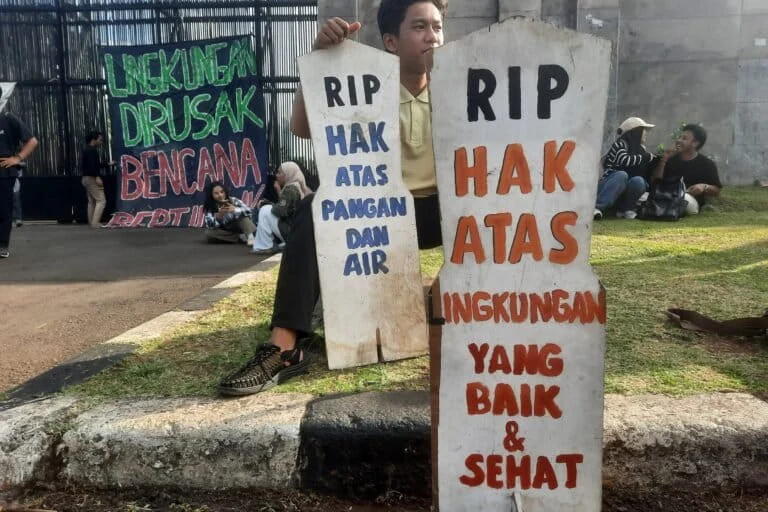
The government speaks from the podium, claiming that disaster management is under control and that recovery efforts have reached completion, yet for those living in makeshift tents, safety remains a distant dream. This sentiment, captured in a poem by Ahmad Syafiq, a young activist from Central Aceh, served as the emotional core of a demonstration held in Jakarta to mark Earth Day. Syafiq, alongside dozens of youth representatives from various Indonesian provinces, converged on the capital to voice their mounting frustration over what they describe as a growing gap between state rhetoric and the environmental reality on the ground. For these activists, the climate crisis is not merely a scientific phenomenon of rising temperatures; it is a fundamental test of justice and state presence in the lives of its most vulnerable citizens.
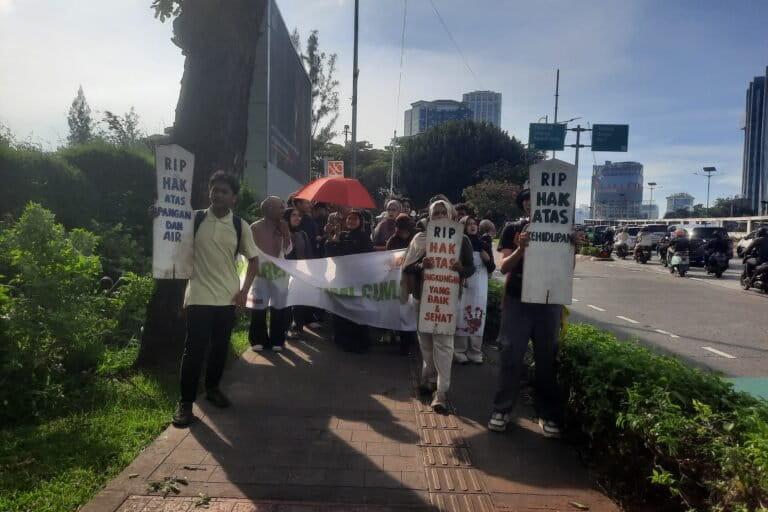
On the afternoon of April 24, a procession of young people marched along Jalan Gatot Subroto toward the House of Representatives (DPR) building in Senayan. The demonstration was marked by somber, symbolic imagery. Instead of traditional festive banners, the participants carried mock tombstones. These markers bore inscriptions such as "RIP Right to Life," "RIP Right to a Good and Healthy Environment," and "RIP Right to Food and Water." A large banner reading "There is Only One Earth" was unfurled as the group arrived at the parliamentary gates at approximately 3:17 PM WIB. The choice of funereal symbols was intentional, signaling the youth’s belief that the legal and environmental protections intended to safeguard their future are being systematically buried by current industrial and legislative trends.
The protest reflects a deepening sense of "climate anxiety" among Indonesia’s Generation Z and Millennials, who feel they are being forced to inherit a degraded planet due to decisions made by older generations. Muhammad Iqbal, a 20-year-old student and protest participant, highlighted the physical toll of the changing climate. He noted that temperatures in urban centers like Ciputat, South Tangerang, have frequently hit 36 degrees Celsius, making the simple act of commuting to campus an arduous struggle against extreme heat. Iqbal argued that these conditions are not natural occurrences but are the direct result of policy failures, including massive land-use conversion, deforestation, and the uncontrolled expansion of extractive industries.
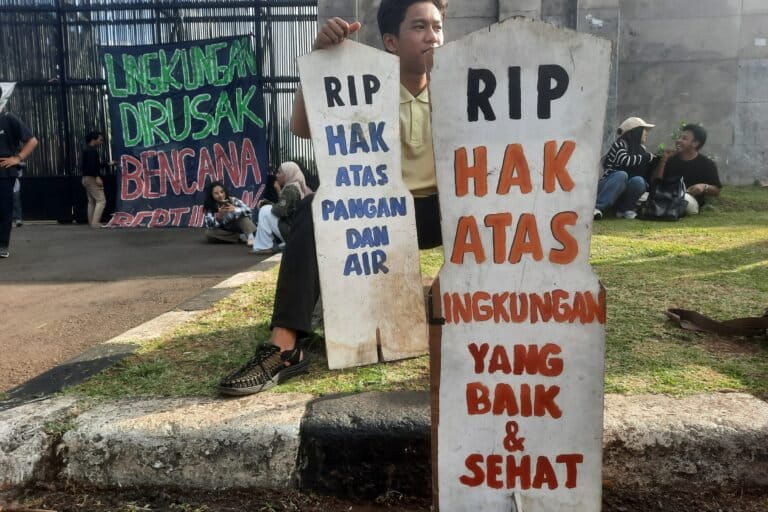
Iqbal specifically addressed the Minister of Forestry, Raja Juli Antoni, urging him to reconsider the ease with which land-use permits are granted. As an alumnus of the same university as the Minister, Iqbal’s plea was personal yet political, calling for a strengthening of Environmental Impact Assessments (AMDAL) and a halt to the "arbitrary" conversion of forest land into industrial concessions. This demand touches on a broader national debate regarding Indonesia’s commitment to its "Net Sink 2030" goals, which require a drastic reduction in deforestation to meet international climate pledges under the Paris Agreement.
The grievances extended beyond rising temperatures to the critical issue of food sovereignty. Annisa Innayatullah, an activist from Ambon, raised concerns regarding the government’s ambitious "food estate" programs. While the state frames these projects as essential for national food security, Annisa argued they often represent a form of "ecological colonialism." She pointed to the forced implementation of rice cultivation in Papua, a region where the local diet has traditionally centered on sago and tubers. This "rice-ification"—a term harking back to the policies of the New Order era—threatens to erase local food diversity and leave indigenous communities more vulnerable to market fluctuations and crop failures. "From the upstream to the downstream, even to the food on our plates, we are being colonized," she remarked, emphasizing that true food security should be built on local wisdom rather than centralized industrial farming.
The geographical breadth of the protest was further emphasized by Syafiq, who demanded government accountability for ecological disasters in Sumatra. He linked the recurring floods and landslides in Aceh to the activities of corporations that have been granted large-scale concessions in protected or sensitive forest areas. According to data from environmental NGOs, Sumatra has seen a significant reduction in its primary forest cover over the last decade, leading to a loss of natural water absorption capacity. When disasters strike, Syafiq noted, the government’s response is often superficial, failing to address the root cause: the systematic destruction of the ecosystem for profit.
The Push for Legislative Correction
Central to the protest was a demand for the total overhaul of several controversial laws. Sandi Saputra Pulungan from the Indonesian Forum for the Environment (Walhi) National executive stated that the current legal framework in Indonesia effectively provides a "red carpet" for corporate interests at the expense of environmental integrity. Specifically, the activists called for the correction or repeal of provisions within the Omnibus Law on Job Creation, the Mining Law (UU Minerba), and the Forestry Law.
Environmental legal experts have long argued that the Omnibus Law weakened environmental oversight by limiting the public’s ability to challenge Environmental Impact Assessments and by centralizing the permit process. The youth activists believe these regulations have legalized the acceleration of deforestation and exacerbated the climate crisis. "The government must revoke policies that accelerate environmental destruction and ecological disasters," Sandi asserted. He argued that the state should prioritize the rights of local communities and indigenous peoples, who have historically proven to be more effective guardians of the forest than private corporations.
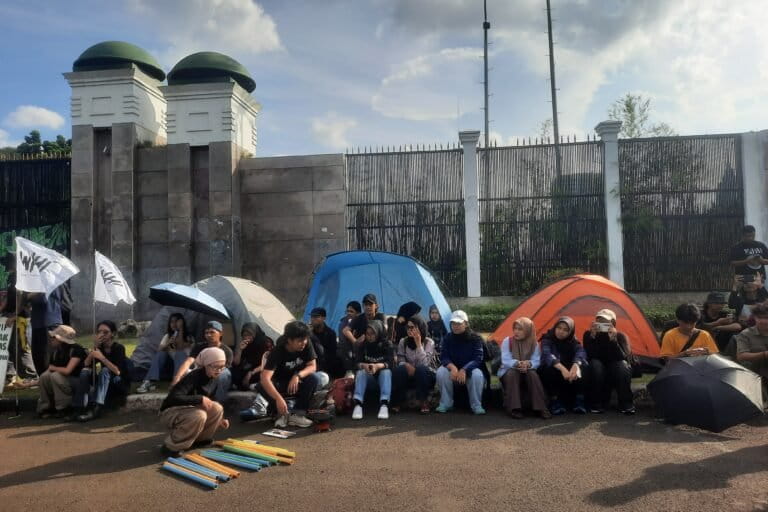
In a striking visual display, the protesters set up camping tents in front of the DPR building. Sandi explained that this was a symbolic message: the youth are terrified that in the near future, there will be no forests left in which to camp. The act represented a longing for basic environmental rights—the ability to breathe clean air, observe wildlife, and access clean water—which they feel are being traded away for short-term economic gain. The message to the legislators inside was clear: the youth do not require a meeting or a photo opportunity; they require legislative action that reflects a commitment to their future survival.
The Youth Declaration and Future Implications
As the sun began to set over Jakarta at 5:30 PM, the group gathered to read the "Youth Declaration," a document outlining their vision for a climate-just Indonesia. Read by Feby Nur Evitasari, the declaration served as a formal record of the group’s demands. It highlighted that the climate crisis is not a future threat but a present reality, manifesting in sinking coastal villages, scorched forests, and failing harvests across the archipelago.
The declaration put forward several concrete policy demands:
- The Passing of the Climate Justice Bill (RUU Keadilan Iklim): The activists urged the DPR to prioritize this bill to provide a legal foundation for protecting vulnerable groups, including small-scale farmers, traditional fishermen, indigenous peoples, women, and the disabled.
- Institutional Reform: The creation of a specialized, high-level agency tasked with synchronizing climate policies across various sectors to eliminate the current "sectoral ego" that leads to overlapping and contradictory regulations.
- GEDSI Integration: The mandatory application of Gender, Disability, and Social Inclusion (GEDSI) standards in all strategic climate and environmental decisions to ensure that the transition to a green economy does not leave marginalized groups behind.
- Law Enforcement and Restoration: A demand for rigorous legal action against environmental criminals and a comprehensive plan for the restoration of degraded ecosystems.
The declaration emphasized that while the youth are the ones who will bear the heaviest burden of the climate crisis, they are the least responsible for the historical emissions and policy decisions that led to this point. This concept of "intergenerational equity" is becoming a central pillar of climate litigation and activism globally, and the Jakarta protest shows that Indonesian youth are now firmly part of this international movement.
The protest concluded peacefully as the activists packed their tents and cleared the area before nightfall. However, the organizers stressed that Earth Day is not a one-day ceremony but the start of a sustained campaign. The event underscores a significant shift in the Indonesian political landscape: a growing, informed, and organized youth constituency that views environmental protection as inseparable from human rights and social justice.
From a broader perspective, the protest at the DPR highlights the tension between Indonesia’s economic ambitions—such as becoming a global hub for electric vehicle battery production through nickel mining—and its environmental obligations. As the country prepares for future leadership transitions and continues to navigate the complexities of "downstreaming" its natural resources, the voices of these young activists serve as a reminder that economic growth measured solely by GDP may come at an unacceptable cost to the ecological systems that sustain life. The "tombstones" left at the gates of Parliament are a stark warning that without a fundamental shift toward climate justice, the rights of future generations may indeed be laid to rest.