Eko Sulistyo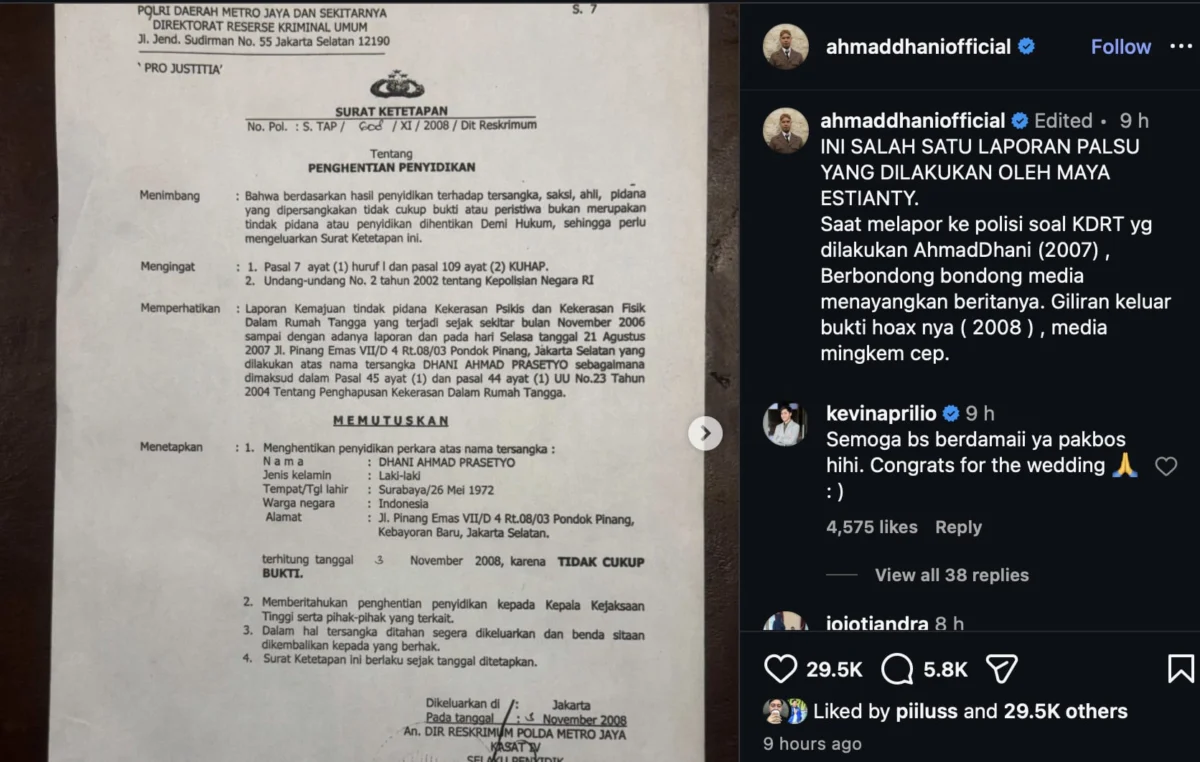
The long-standing conflict between Indonesian music mogul Ahmad Dhani and his former wife, Maia Estianty, has reached a new and intensified chapter, capturing the nation’s attention once again. After years of relative calm and occasional public displays of professional civility, the friction between the two icons of the Indonesian music industry has reignited with significant legal and personal undertones. On Wednesday, May 6, 2026, Ahmad Dhani, the leader of the legendary rock band Dewa 19, utilized his social media presence to reopen a dark chapter from their shared past, specifically regarding allegations of domestic violence (KDRT) that surfaced nearly two decades ago.
In a move that has sparked widespread debate across digital platforms, Dhani uploaded three pages of official legal documentation to his Instagram account. These documents are identified as the Surat Ketetapan Penghentian Penyidikan (SP3), or the Order to Terminate Investigation, issued by the Jakarta Metropolitan Regional Police (Polda Metro Jaya). The documents pertain to a report filed by Maia Estianty in 2007, in which she accused Dhani of domestic violence during the peak of their highly publicized marital breakdown.
The SP3, dated November 3, 2008, explicitly states that the investigation into the allegations against Dhani was halted due to a lack of sufficient evidence. By bringing these documents back into the public eye, Dhani aims to challenge the narrative that has surrounded his reputation for nearly twenty years. In his caption, Dhani was blunt, labeling the 2007 report a "false accusation" and criticizing the media for what he perceives as a double standard in their reporting practices.
The Chronology of a Resurfacing Feud
To understand the gravity of Dhani’s recent actions, one must look back at the timeline of events that led to the initial report and the subsequent legal resolution. The year 2007 was a period of intense domestic turmoil for the couple, who were then considered the "royal family" of Indonesian pop-rock. Amidst rumors of infidelity and professional rivalry, Maia Estianty filed a police report alleging physical and psychological abuse.
At the time, the news dominated national headlines for months. The media coverage was exhaustive, often painting a picture of a victimized wife against a powerful husband. However, as the legal process unfolded, the authorities found that the claims could not be substantiated to the level required for a criminal trial. The issuance of the SP3 in late 2008 effectively cleared Dhani of the charges in the eyes of the law, but the "court of public opinion" had already formed a lasting impression.
Dhani’s decision to revisit this history in May 2026 was not a random act of nostalgia. It appears to be a calculated response to a series of events that began in April 2026, during the wedding festivities of their second son, El Rumi. While the wedding was intended to be a celebratory union, the underlying tensions between the divorced parents became palpable during the traditional "siraman" (ritual bathing) ceremony.
Observers noted that the atmosphere was strained, particularly when Shafeea Ahmad, Dhani’s daughter from his second marriage to Mulan Jameela, was seen crying during the event. This emotional moment became a catalyst for renewed public scrutiny. In the days following the wedding, Dhani began making a series of provocative statements on social media and in interviews, at one point dismissively referring to Maia’s public displays of emotion as "crocodile tears" and re-litigating the reasons behind their 2008 divorce.
Legal Implications and the Concept of SP3
The document shared by Dhani, the SP3, is a critical tool in the Indonesian criminal justice system. Under the Indonesian Criminal Procedure Code (KUHAP), an investigation can be terminated if there is insufficient evidence, if the act is determined not to be a criminal offense, or if the investigation is stopped for the sake of law (such as the death of the suspect or the expiration of the statute of limitations).
In Dhani’s case, the termination was based on a lack of evidence. From a legal standpoint, this means that the allegations did not meet the threshold of proof necessary to proceed to court. By publishing these documents, Dhani is asserting his legal innocence. However, legal experts often note that an SP3 does not necessarily mean the incident never occurred; rather, it means it could not be proven beyond a reasonable doubt in a legal setting. For Dhani, this distinction is irrelevant to his primary goal: reclaiming his reputation from what he describes as "hoax" news that has followed him for eighteen years.
Dhani’s critique of the media’s role is central to his current campaign. He argued that when the accusations were first made in 2007, the media was quick to broadcast them, but when the case was dropped in 2008, the coverage was minimal or non-existent. This "asymmetry of information," as some analysts call it, is a common grievance among public figures who feel they have been unfairly maligned by sensationalist journalism.

Public Reaction and the Resurgence of Digital Archives
The digital age has ensured that nothing is ever truly forgotten. In response to Dhani’s Instagram post, netizens did not simply take his word at face value. Instead, the "social media detectives" began digging into old court records and divorce decrees from 2008. Many users began circulating excerpts from the North Jakarta Religious Court’s divorce ruling, which provided a different perspective on the end of the marriage.
These archived documents often detail the "constant disputes" and "irreconcilable differences" that led to the divorce. Some users pointed out that while the criminal case for KDRT may have been dropped, the civil court’s findings during the divorce proceedings painted a complex picture of the household environment. The result has been a polarized online environment, with "Team Maia" and "Team Dhani" supporters engaging in heated debates over who holds the "true" version of history.
This phenomenon highlights the power of the digital footprint. In 2007, information was controlled by major television networks and print tabloids. In 2026, the power has shifted to the individuals themselves and their followers, who can fact-check, archive, and redistribute information instantaneously. Dhani’s attempt to control the narrative by posting the SP3 was met with an equal and opposite force of public archival research.
The Impact on the Second Generation
One of the most concerning aspects of this renewed conflict is its impact on the children involved. Al Ghazali, El Rumi, and Dul Jaelani—the three sons of Dhani and Maia—have spent the better part of their lives navigating the public feud between their parents. All three have successful careers in the entertainment industry and have often acted as mediators or bridges between their mother and father.
The timing of this flare-up, coinciding with El Rumi’s wedding, is particularly poignant. Events that should serve as milestones for family unity have instead become battlegrounds for old grievances. Furthermore, the involvement of Shafeea Ahmad, who belongs to a younger generation, indicates that the trauma of the parents’ past is being passed down to the children of the present.
Psychological experts suggest that publicizing such sensitive family documents can have long-term effects on family dynamics. By re-opening the KDRT case, Dhani is not just attacking Maia; he is forcing his children to relive a period of their childhood that was characterized by instability and legal battles.
Analysis: Why Now?
The question remains: why did Ahmad Dhani choose this specific moment, nearly two decades later, to bring up the SP3? Several factors may be at play:
- Defensive Posturing: Following the criticism he received after the wedding in April 2026, Dhani may have felt the need to go on the offensive to protect his ego and public image. By painting himself as a victim of a "false report," he shifts the focus from his current controversial behavior to Maia’s past actions.
- Narrative Correction: As Dhani grows older, he may be increasingly concerned with his legacy. He does not want to be remembered as a man who was accused of domestic violence, even if the charges were dropped.
- Media Saturation: In an era where "content is king," resurfacing a decades-old scandal is a guaranteed way to stay relevant in the news cycle. The engagement levels on his Instagram posts during this period have been significantly higher than his standard promotional content.
Broader Implications for Celebrity Culture and Law
This incident serves as a case study for several broader issues in Indonesian society. First, it highlights the ongoing struggle between privacy and the public’s "right to know" when it comes to celebrity lives. Second, it demonstrates the limitations of the legal system in providing "closure" for personal conflicts; a legal document like an SP3 can stop a trial, but it cannot stop a narrative.
Finally, the situation underscores the need for media literacy. Dhani’s point about the media’s tendency to prioritize accusations over exonerations is a valid critique of sensationalist journalism. However, his use of social media to "attack" his former wife also raises questions about the ethical use of digital platforms by influential figures.
As of May 2026, Maia Estianty has not issued a formal legal response to Dhani’s latest posts, though her social media activity suggests a preference for remaining above the fray, focusing instead on her business ventures and her relationship with her husband, Irwan Mussry. Whether this will lead to a new round of legal battles or eventually fade back into the archives remains to be seen. What is certain is that the saga of Ahmad Dhani and Maia Estianty continues to be one of the most enduring and complex narratives in the history of Indonesian entertainment.