
 Bambang Pamungkas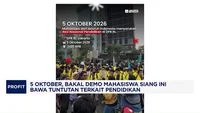
Jakarta, Indonesia — The political landscape of Indonesia’s capital is bracing for another wave of mass mobilization as the Indonesian Student Executive Board Alliances (BEM SI) prepares to stage a large-scale demonstration on Monday, October 5, 2026. The focal point of the mass action will be the legislative complex of the House of Representatives of the Republic of Indonesia (DPR RI) in Central Jakarta, where thousands of students from various universities across the archipelago are expected to converge starting at approximately 1:00 PM Western Indonesia Time (WIB).
The primary catalyst for this high-stakes demonstration is a comprehensive set of demands centered on the state of national education, structural funding discrepancies, accessibility barriers, and ongoing policy debates surrounding higher education governance. As labor unions, civil society organizations, and student movements increasingly vocalize their discontent over socioeconomic pressures, Monday’s rally underscores persistent tensions between student movements and the legislative branch regarding public service delivery and governmental accountability.
Main Facts and Core Demands of the Mobilization
The planned demonstration is officially framed as a national education action, mobilizing academic communities to press the government and parliament for systemic reforms. According to preliminary advisory notices circulated by student coordinators, the core grievances extend far beyond immediate campus concerns, touching upon broader macroeconomic pressures that directly impact students and working-class families alike.
Among the central demands raised by BEM SI are the re-evaluation of escalating tuition fees across state universities, increased state budgetary allocation for the education sector to meet constitutional mandates, and greater transparency in the disbursement of educational subsidies. Student leaders argue that despite constitutional guarantees stipulating a mandatory 20% allocation of the state budget (APBN) toward education, bureaucratic inefficiencies, indirect spending loopholes, and regional disparities continue to dilute the tangible impact of these funds on the ground.
Furthermore, the demonstrators are expected to voice strong opposition to commercialization trends within public tertiary institutions, which they claim increasingly marginalize prospective students from low-income socioeconomic backgrounds. The transformation of state universities into legally autonomous entities—known locally as PTN-BH (Perguruan Tinggi Negeri Badan Hukum)—has frequently been a flashpoint for student activism, with critics arguing that institutional autonomy often translates into aggressive tuition hikes and over-reliance on commercial revenue streams.
Chronology of Escalating Tensions Leading to the October 2026 Protest
The road to the October 5 demonstration has been paved by months of mounting dissatisfaction and localized campus dialogues that failed to yield satisfactory policy adjustments from federal authorities. Understanding the chronology of this movement provides essential context for the gravity of Monday’s planned mobilization.
The grievances began crystalizing in early 2026, following the release of the revised national education budget projections, which student watchdogs argued failed to address post-inflationary cost-of-living adjustments for campus facilities and operational expenses. Throughout July and August 2026, localized campus forums, academic symposia, and small-scale rallies were held in major academic hubs including Yogyakarta, Bandung, Surabaya, and Jakarta.
By mid-September 2026, inter-university consolidation meetings facilitated by BEM SI concluded that decentralized advocacy efforts had exhausted their efficacy. Consequently, student leaders issued a series of formal policy ultimatums to the Ministry of Education, Culture, Research, and Technology, as well as to Commission X of the DPR RI, which oversees education, youth, sports, tourism, arts, and culture.
When formal dialogues failed to materialize or produce binding commitments to review the disputed policies, BEM SI formally announced plans for a synchronized nationwide mobilization. Coordinators designated October 5, 2026, as the D-day for a direct confrontation of ideas and demands at the national legislature, utilizing Jakarta as the central stage for maximum visibility.
Supporting Data: The State of Indonesian Higher Education and Budgetary Pressures
To contextualize the demands of the student alliance, it is critical to examine the broader empirical data governing Indonesia’s educational landscape. While macroeconomic indicators show steady national growth, the microeconomic reality for students and academic institutions reveals persistent structural vulnerabilities.
According to data compiled by the Central Statistics Agency (BPS) and independent education think tanks, the Gross Enrolment Ratio (GER) for tertiary education in Indonesia remains significantly lower than that of several neighboring ASEAN economies, hovering around moderate thresholds that restrict upward social mobility. Financial constraints continue to be cited as the primary reason for high school graduates failing to pursue higher education, with tuition costs—known as Uang Kuliah Tunggal (UKT)—surging across multiple state and private institutions over the preceding three academic cycles.
While the national budget consistently allocates the mandatory 20% minimum to education, analytical breakdowns indicate that a substantial portion of this expenditure is absorbed by civil servant salaries, teacher certifications, and cross-ministerial transfers rather than direct infrastructure development, laboratory modernization, or need-based scholarship expansion. Consequently, public universities have increasingly turned to commercial partnerships and tiered tuition structures to bridge operational funding gaps, alienating vulnerable student cohorts in the process.
Official Responses and Legislative Preparedness
In anticipation of the large-scale mobilization, security apparatuses and legislative authorities have implemented precautionary measures to maintain public order while facilitating the constitutional right to peaceful assembly. The Jakarta Metropolitan Police (Polda Metro Jaya) announced the deployment of thousands of personnel drawn from mobile brigade units, traffic divisions, and regional security forces stationed strategically around the DPR/MPR RI complex and vital national installations.
Traffic management directorates have prepared comprehensive diversion scenarios along major thoroughfares surrounding Senayan, including Jalan Gatot Subroto and the inner-city toll roads, advising motorists to seek alternative routes to mitigate anticipated gridlock during peak afternoon transit hours. Authorities have continuously urged both student coordinators and security personnel to exercise restraint, adhere to peaceful protocols, and prevent opportunistic elements from infiltrating the demonstration to instigate civil unrest.
From the legislative side, representatives from Commission X of the DPR RI have signaled openness to receiving a formal delegation of student representatives. Several lawmakers have emphasized that parliamentary channels remain open for constructive dialogue, noting that budgetary allocations and educational statutes are subject to ongoing legislative review. However, legislative spokespersons have also reiterated that sweeping fiscal policy changes require multi-stakeholder deliberations involving the executive branch, fiscal planning agencies, and regional governments, precluding immediate unilateral decisions made under the pressure of mass street protests.
Broader Socioeconomic Impact and Policy Implications
The October 5 demonstration carries significant implications that extend well beyond the immediate perimeter of the parliamentary complex. Academics and political analysts point out that student-led movements in Indonesia have historically served as crucial barometers of public sentiment and catalysts for major political shifts.
The immediate economic impact of the protest is primarily localized, involving temporary traffic disruptions, commercial slowdowns in the Senayan and commercial districts of Central Jakarta, and heightened logistical planning for commuter transport networks. However, the political resonance of the protest is far more consequential. By focusing national attention on educational equity, BEM SI is effectively challenging the current administration’s human capital development agenda—a cornerstone of Indonesia’s long-term national vision.
If the government and legislative bodies respond to the demonstration with substantive policy engagements, transparent budgetary audits, and genuine structural reforms regarding tuition affordability, the protests could serve to bridge the trust deficit between the state and the nation’s youth demographic. Conversely, an inflexible administrative response or an escalation of security tensions risks hardening student opposition, potentially catalyzing broader coalition-building with labor unions and urban civil society groups in the subsequent legislative cycles.
As Monday afternoon approaches, all eyes remain focused on the legislative complex in Senayan. The success of the demonstration will be measured not merely by the scale of the turnout or the visibility of the banners, but by whether the voices of thousands of students can successfully translate into durable, constructive policy reforms within the halls of Indonesian governance.








