Bambang Pamungkas
Jakarta, CNBC Indonesia — The National Transportation Safety Committee (Komite Nasional Keselamatan Transportasi, or KNKT) has officially released a comprehensive set of rigorous safety recommendations directed at state-owned railway operator PT Kereta Api Indonesia (Persero) and commuter rail subsidiary PT Kereta Commuter Indonesia (KCI). This regulatory intervention follows a high-profile railway accident on April 27, 2026, when long-distance passenger train KA Argo Bromo Anggrek (operating under train number KA 4B) collided with a KRL Commuterline electric multiple unit (TM6000 operating as KA 5568A) at Bekasi Timur Station in West Java.
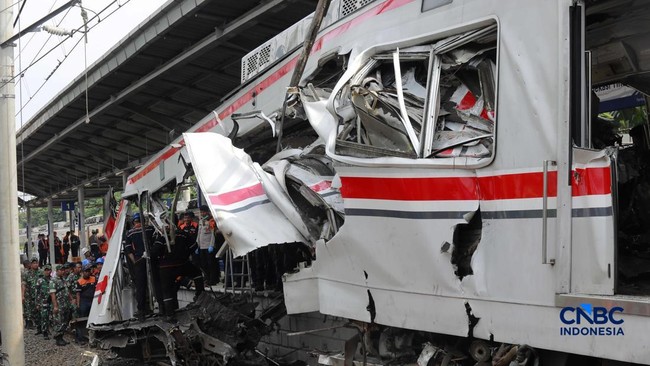
The collision, which prompted swift emergency responses and extensive joint-agency evacuation efforts of twisted metal and wreckage spanning the tracks, underscored critical vulnerabilities in railway operational coordination, communication protocols, and high-speed emergency response mechanisms. In its official investigative report published on Monday, October 5, 2026, KNKT emphasized that these binding recommendations are designed to fundamentally overhaul systemic safety gaps, eliminate operational blind spots, and drastically elevate passenger security standards across Indonesia’s bustling rail networks to prevent catastrophic recurrences.
Chronology and Background of the Bekasi Timur Incident
The fateful morning of April 27, 2026, began routinely for thousands of commuters traversing the high-density Greater Jakarta transit corridors. However, operations were upended at Bekasi Timur Station when KA Argo Bromo Anggrek, one of KAI’s premier executive-class services connecting major trunk lines, collided with the stationary or slowly maneuvering KRL TM6000 commuter train. The impact sent shockwaves through the national transportation sector, instantly triggering an emergency deployment of joint rescue teams, medical personnel, and technical units.
By the following day, Tuesday, April 28, 2026, heavy machinery and tactical response teams were still hard at work clearing debris, repairing damaged signaling infrastructure, and restoring normal catenary power lines. While immediate investigative measures focused on preliminary factors such as signaling clarity and line-of-sight visibility, deeper inquiries by KNKT unraveled complex operational failures extending far beyond simple human error. The investigation exposed vulnerabilities nested within cabin communication procedures, windshield design ergonomics, emergency braking physics on curved rail alignments, and the immense cognitive workloads placed on operational controllers during high-stress scenarios.
Comprehensive Directives for PT Kereta Api Indonesia (KAI)
To address the multifaceted root causes identified during the months-long investigation, KNKT has outlined several stringent corrective mandates for PT Kereta Api Indonesia (Persero). These directives span physical equipment maintenance, operational policy redesign, and human resource development:
First, KNKT demands an immediate, thorough re-evaluation of communication device usage protocols inside locomotive cabins. Operators must strictly adhere to the manufacturer-specified operational guidelines for every communication hardware unit installed in the cab to avoid misinterpretations during critical transits.
Second, KAI must significantly upgrade its professional development curricula. The agency is instructed to enhance targeted training programs for Train Drivers (ASP – Awak Sarana Perkeretaapian) and Train Operation Control Center personnel (PPKP – Pusat Pengendalian Perjalanan Kereta Api) focusing explicitly on safety-critical communication under emergency conditions.
Third, the physical integrity and design ergonomics of locomotive windshields—specifically those fitted to the heavy-duty CC206 locomotives utilized by flagship services like KA Argo Bromo Anggrek—have been flagged as a critical safety parameter. KNKT’s report explicitly states that operators must "ensure the condition of the windshield on locomotives always meets the aspects of ergonomics and train operation safety through routine inspections, maintenance, and periodic replacements." Clear, unobstructed visibility remains a frontline defense against collisions, making glass maintenance a non-negotiable priority.
Fourth, KAI is instructed to draft definitive standard operating procedures (SOPs) governing emergency braking maneuvers executed at high speeds along curved rail sections (jalan rel lengkung). Operating a heavy locomotive at high velocities while navigating a curve introduces severe lateral forces; the new guidelines must establish precise decision-making frameworks, tactical braking methodologies, and rigorous risk assessments concerning structural stability and passenger safety.
Fifth, KNKT has mandated a comprehensive workload assessment of PPKP personnel stationed at the Daop 1 Jakarta Railway Control Center. The study must focus on the operational burden generated by the specific communication tools deployed and the sheer breadth of the geographical control boundaries managed by individual controllers.
Concluding its directives for the primary mainline operator, KNKT underscored that KAI must systematically "increase the capability and understanding of personnel in recognizing potential hazards and safety risks that may arise" during daily operations.
Operational Standardizations Mandated for PT Kereta Commuter Indonesia (KCI)
While KAI manages long-distance trunk lines, its urban commuter subsidiary, PT Kereta Commuter Indonesia (KCI), faces parallel scrutiny due to the shared infrastructure nature of the Jabodetabek rail network. KNKT has issued distinct, mandatory operational reforms tailored to commuter rail systems:
Foremost among KCI’s requirements is the establishment of a standardized master time reference across all operational units. Discrepancies in timekeeping—even by a matter of seconds—can prove catastrophic in tightly scheduled multi-train corridors. A unified master time system ensures that every signaling log, control log, and driver’s timepiece operates in absolute synchronization.
Furthermore, KCI must formulate rigorous standard phraseologies and structured communication protocols dedicated to train journey control and management. Standardized phrasing is universally recognized in modern transport safety as a vital tool to boost accuracy, operational effectiveness, and time efficiency during high-pressure safety-critical communications.
Finally, KCI is required to overhaul and refine its training modules for ASP and PPKP personnel. The upgraded curriculum must heavily emphasize emergency communication efficiency, guaranteeing that vital safety information is transmitted with absolute precision within the shortest possible duration to mitigate unfolding crises.
Broader Industry Implications and the Path Forward
The release of these detailed KNKT recommendations serves as a stark reminder of the delicate equilibrium required to maintain safety across Indonesia’s modernizing rail transit networks. As passenger volumes continue to surge—driven by urban density, economic expansion, and the ongoing integration of mass rapid transit systems—the margin for operational error narrows considerably.
The incident at Bekasi Timur Station on April 27, 2026, has forced railway authorities to confront the realities of high-density dispatching, where human fatigue, complex signaling topologies, and high-speed momentum intersect. By compelling both KAI and KCI to re-engineer their safety communication protocols, modernize maintenance schedules for critical components like windshields, and scientifically evaluate controller workloads, regulatory bodies aim to construct a resilient, fail-safe operational framework.
Industry analysts note that while implementing these sweeping directives will demand substantial capital investments, rigorous staff retraining, and temporary operational adjustments, the long-term dividend in public trust and passenger safety is immeasurable. As both corporate entities begin drafting their compliance roadmaps in response to the October 2026 KNKT report, commuters and transport observers alike will be watching closely to ensure that these hard-learned lessons translate into permanent, tangible improvements across the national railway network.