
 Azin Asro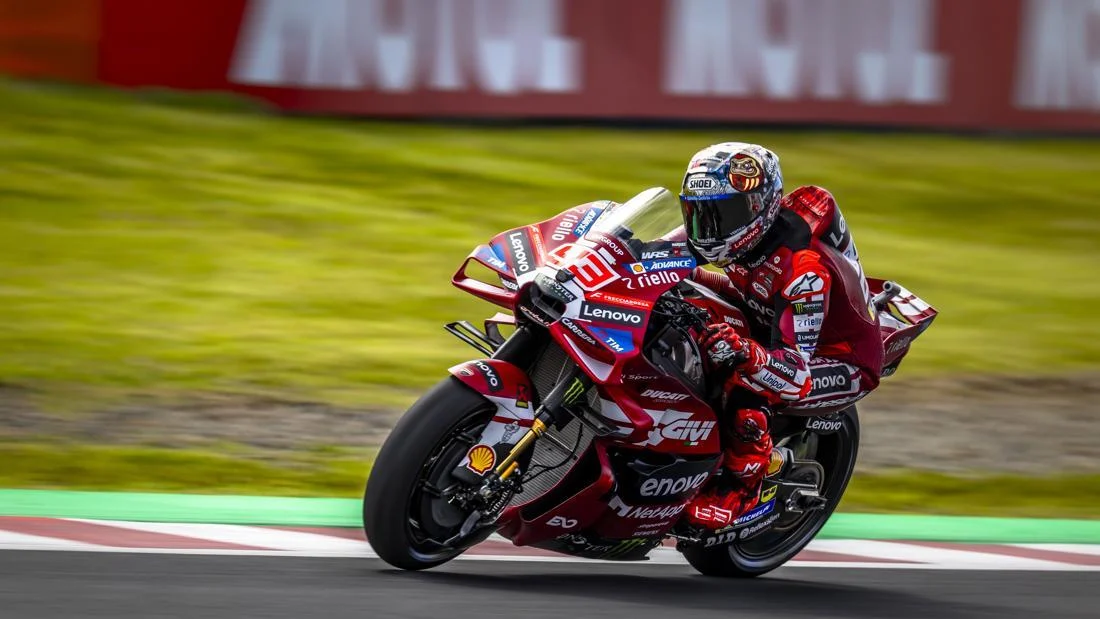
The 2026 season of the FIM MotoGP World Championship delivered another unforgettable chapter at the Mobility Resort Motegi, where Ducati Lenovo Team rider Marc Marquez etched his name into the winners’ list once more. Following a dominant performance in the Saturday Sprint Race, the seasoned Spanish champion mastered the full-distance Grand Prix on Sunday, October 4, 2026, executing a calculated tire strategy and a brilliant mid-race overtake on rival Jorge Martin. The victory not only cemented Marquez’s exceptional form at the historic Japanese circuit but also narrowed the championship gap to a razor-thin margin of just two points, setting up a ferocious title fight with only a handful of rounds remaining in the 2026 calendar.
The main event at Motegi unfolded under intense scrutiny regarding tire management, casting a strategic shadow over the entire paddock. Michelin, the official tire supplier for the premier class, faced mounting concerns following severe degradation and blistering issues witnessed during the preceding Sprint Race. The severity of the wear prompted race organizers and Michelin to take the unprecedented precautionary step of withdrawing the soft compound rear tire option entirely from the allocation for the Grand Prix. Consequently, riders and their respective crew chiefs were forced to re-evaluate their setups and race strategies, pivoting primarily toward medium and hard compound rear configurations.
Marc Marquez’s selection of the hard rear compound proved to be a masterstroke of engineering foresight and tactical execution. While the tire required careful management during the initial laps, it provided the structural endurance necessary to maintain elite pace as the race entered its crucial second half.
Starting Grid and Early-Race Tactical Maneuvers
When the red lights went out to signal the start of the 2026 Japanese Grand Prix, the grid immediately ignited into action. Jorge Martin, launching brilliantly from pole position, secured the crucial holeshot into Turn 1, dictating the tempo from the front. Marc Marquez slotted cleanly into second position, applying immediate pressure, while Marco Bezzecchi and Alex Marquez slotted into third and fourth, respectively, forming a formidable leading quartet.
As the pack completed the opening lap, the top ten established a competitive hierarchy featuring Martin, Marc Marquez, Bezzecchi, Alex Marquez, rookie sensation Pedro Acosta, Enea Bastianini, Raul Fernandez, local hero Ai Ogura, reigning champion Francesco Bagnaia, and Diogo Moreira.
Midfield battles quickly materialized, most notably between the KTM Factory Racing machines and the Trackhouse Racing contingent. Bastianini, Acosta, Fernandez, and Ogura engaged in a fierce, multi-lap chess match, swapping positions repeatedly as they fought for supremacy within the lead group. For Ai Ogura, the race carried immense national significance. Carrying the hopes of the Japanese motorsport faithful, Ogura bore the weight of a statistical drought: no Japanese rider had won a premier-class home Grand Prix since Makoto Tamada accomplished the feat in 2004.
Compounding the early-race drama, Alex Marquez was forced to serve a double Long Lap Penalty stemming from an infraction committed during the Saturday Sprint. The younger Marquez brother served his first penalty on the fifth lap; fortunately, a comfortable gap to the chasing pack meant he conceded only a single position, keeping his points-scoring aspirations alive temporarily.
The Turning Point: Tire Longevity and Decisive Overtakes
As the race progressed past the quarter mark, the race began to tilt in favor of riders who had conserved their equipment. By the eighth lap, Marc Marquez visibly elevated his pace, harnessing the superior durability of his hard rear tire to carve out a tactical advantage over the polesitter.
The race experienced its first major casualty on lap nine when Diogo Moreira crashed out at Turn 9. The Honda rider had stunned the paddock with a sensational second-place finish in the Sprint Race, but his ambitious push in the Grand Prix ended prematurely in the gravel trap.
By the eleventh lap, both Martin and Marc Marquez had established a blistering rhythm, posting matching fastest laps and pulling more than two seconds clear of Bezzecchi in third place. Seizing a momentary opening in the early sector of the Motegi layout, Marc executed a decisive, textbook maneuver on Martin, snatching the race lead and drawing enthusiastic applause from the Ducati garage.
Once in clear air, the eight-time world champion methodically increased his advantage. By lap 15, Marquez had stretched his gap over Martin to nearly a full second, effectively breaking the tow and dictating the remainder of the contest.
Further down the order, the fierce intra-factory rivalries continued unabated. On lap 16, Pedro Acosta successfully outmaneuvered Ai Ogura, though the duel between the KTM Factory and Trackhouse stables persisted well into the dying stages of the race.
Late-Race Drama and Final Standings
Motegi’s unforgiving layout exacted a heavy toll in the closing laps. On lap 20, disaster struck for Alex Marquez at Turn 10. Following contact with Pramac Racing’s Jack Miller, the Gresini-linked rider crashed heavily, bringing a premature and frustrating end to a race already compromised by his earlier long lap penalties.
With four laps remaining, Raul Fernandez and Ai Ogura launched a coordinated resurgence, successfully passing Acosta to claim valuable positions for the Trackhouse squad. However, at the absolute front of the field, Marc Marquez remained untouchable. Despite persistent pressure from Martin throughout the weekend, the Ducati Lenovo rider managed his tires, fuel, and gap flawlessly, crossing the finish line to take the checkered flag and seal maximum championship points.
Jorge Martin secured a hard-fought second place, limiting the damage to his title defense, while Marco Bezzecchi completed the podium steps, finishing 2.260 seconds behind the race winner to round out a competitive top three.
Championship Implications and the Road to Mandalika
The repercussions of the Japanese Grand Prix on the 2026 MotoGP World Championship standings are profound. Entering the weekend at Mobility Resort Motegi, Marc Marquez trailed Jorge Martin by seven vital points in the overall classification.
By securing the 25 points for the Grand Prix victory—supplemented by his earlier Sprint success—Marquez elevated his seasonal tally to 331 points. Meanwhile, Martin’s consistent runner-up finish keeps him at the summit with 333 points. The mathematical gap between the two Spanish protagonists has thus been compressed to an astonishing two points with several rounds remaining.
Paddock analysts and team principals have noted that the psychological momentum has decisively swung toward Marquez, whose technical adaptability and tire management proved superior under Motegi’s demanding thermal constraints. However, Martin’s raw qualifying speed and resilience ensure that the title fight remains wide open.
Attention now shifts swiftly to Southeast Asia, as the MotoGP paddock packs its freight for the upcoming Indonesian Grand Prix at the Pertamina Mandalika International Street Circuit. Scheduled for the following weekend, the Mandalika round promises blistering temperatures, demanding track layouts, and a continuation of the intense tactical warfare between Marquez and Martin as they battle for the ultimate prize in motorcycle road racing.








