Nila Kartika Wati
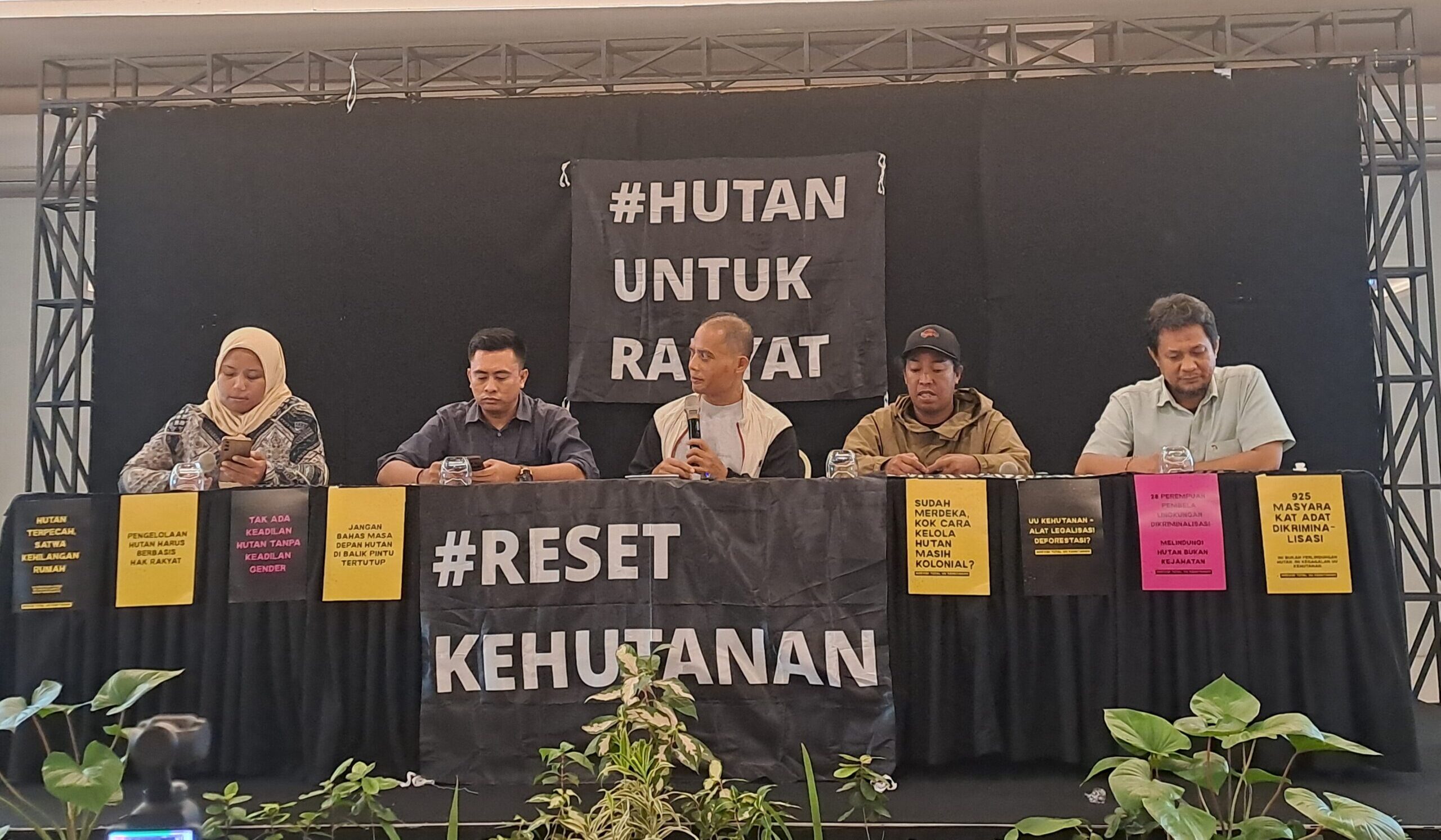
In a decisive move to address the systemic failures of Indonesia’s environmental governance, the Sumatran Regional Coalition has formally urged the national government and the House of Representatives (DPR) to completely dismantle and rewrite Law No. 41 of 1999 concerning Forestry. The coalition, representing a broad spectrum of civil society organizations and local communities, argues that the current legal framework is fundamentally ill-equipped to handle the modern realities of climate change, persistent land tenure disputes, and the urgent need for ecosystem restoration. The demand was articulated during the "Declaration of Input for the Revision of the Forestry Law," held in Padang, West Sumatra, on Monday, June 29, 2026.
The coalition’s stance is that the proposed revisions to the Forestry Law must go beyond mere technical adjustments. Instead, they are calling for a substantive paradigm shift that prioritizes the recognition of indigenous and local community rights and the rehabilitation of degraded ecosystems over extractive industrial interests. According to the coalition, the recurring ecological disasters across the Sumatran landscape serve as a grim testament to the failure of the existing law to protect both the environment and the lives of the people who depend on it.
A Legacy of Disaster: The Catalyst for Reform
The urgency behind this declaration is rooted in a catastrophic ecological event that occurred in late 2025. A series of massive floods and landslides across Sumatra resulted in the deaths of more than 1,190 people and the displacement of approximately 131,500 residents. The Sumatran Regional Coalition asserts that these events were not merely "natural" disasters but were the direct consequence of decades of environmental mismanagement and the erosion of the island’s ecological carrying capacity.

Nora Hidayati, the Advocacy Manager for People’s Law at the HuMa Indonesia Association (Perkumpulan HuMa), emphasized that the damage caused by forest degradation does not respect the boundaries of corporate concessions. "The ecological disasters in Sumatra reveal a painful truth: forest destruction does not stop at the edge of a concession. It manifests as floods, landslides, crop failures, the loss of livelihoods, and a legacy of conflict passed down to the community," Hidayati stated during the declaration.
Data compiled by the coalition highlights a staggering loss of forest cover over the last three decades. In the provinces of Aceh, North Sumatra, and West Sumatra alone, approximately 1.2 million hectares of forest have vanished. Crucially, about 690,777 hectares of this lost forest were converted into monoculture oil palm plantations. This data suggests that the forestry crisis is an accumulated result of development policies that have consistently prioritized mining, industrial forestry, and large-scale agricultural expansion over the safety of citizens and the preservation of vital ecological functions.
The Failure of Law No. 41 of 1999
While Law No. 41 of 1999 was born during the early years of Indonesia’s Reformation era, critics argue it never truly broke free from the colonial-era mindset of state-controlled forestry. The "Reset Forestry Coalition," working alongside the Sumatran groups, has identified five fundamental weaknesses in the current law that necessitate its replacement:
- Distortion of State Authority: The "Right of the State to Control" (Hak Menguasai Negara or HMN) has, in practice, been misinterpreted as state ownership. This allows the government to claim indigenous lands as state forests, often ignoring centuries of community management.
- Burdensome Recognition of Indigenous Forests: Currently, the law places the burden of proof on indigenous communities. They must navigate complex administrative hurdles to prove their existence and rights, while the state maintains the ultimate power to grant or deny recognition.
- Extractive and Production Bias: The law is heavily weighted toward forest production, licenses, and corporate concessions, treating the forest primarily as a source of economic revenue rather than a living ecosystem.
- Absence of Conflict Resolution Mechanisms: There is a glaring lack of robust legal frameworks to resolve long-standing tenure conflicts between communities and companies or the state.
- Weak Focus on Restoration: The current law provides little mandate or incentive for the active restoration of ecosystems, focusing instead on "management" that often equates to exploitation.
The coalition further notes that the legal landscape has become "patchwork" due to various amendments, including the controversial Job Creation Law (Omnibus Law) of 2023. Furthermore, while the Constitutional Court (MK) has issued several landmark rulings—such as Decision MK 35/PUU-X/2012, which declared that customary forests are not state forests—the text of Law No. 41 has not been updated to reflect these changes. This creates a legal vacuum where government regulations (PP) and ministerial decrees (Permen) can interpret the law in ways that circumvent the spirit of the court’s rulings.

Colonial Roots and Modern Challenges
The coalition’s Academic Paper (Naskah Akademik), which serves as a counter-proposal to the government’s draft, argues that the current forestry regime is still influenced by the Boschordonantie of 1927 and the Domein Verklaring (Domain Declaration) of the Dutch colonial era. These colonial laws were designed to facilitate the extraction of timber for European markets by centralizing control in the hands of the colonial administration.
Nora Hidayati argues that the term "control" in the Indonesian Constitution should be interpreted as a mandate for the state to regulate and oversee for the prosperity of the people, not as a license for the state to act as a landlord. "For centuries, community-based forest management has existed without formal state recognition. This model should be the pillar of our forestry policy, not an exception that requires a complex legal struggle to validate," she said.
Furthermore, the 1999 law was drafted before the global community fully grasped the scale of the climate crisis. Today, Indonesia faces intense international pressure regarding deforestation (such as the EU Deforestation Regulation or EUDR) and is attempting to position itself in the global carbon market. The coalition argues that a law designed in the late 90s cannot possibly provide the framework needed for modern carbon governance, climate adaptation, or the protection of biodiversity in the face of rapid warming.
The Eight Pillars of Reform
To address these systemic issues, the Sumatran Regional Coalition has proposed eight fundamental pillars for a new Forestry Law:
- Redefining Forests: Forests must be defined as living ecosystems with ecological, cultural, and spiritual dimensions, rather than just technical-administrative categories or timber stocks.
- Clarifying State Authority: The law must explicitly state that the government’s role is to manage and oversee the forest for the public good, rather than possessing it as an owner.
- Equivalence for Indigenous Forests: Customary forests (Hutan Adat) and non-state management models must be recognized as legal categories equal to state forests.
- Strengthening Community Management: Social forestry and community-managed areas should be granted permanent management rights rather than temporary access permits.
- Decentralized Governance: Forestry management should be brought closer to the "tapak" (field level) through empowered Forest Management Units (KPH) that can respond quickly to local conflicts and ecological needs.
- Mandatory Public Participation: The principle of Free, Prior, and Informed Consent (FPIC or Padiatapa) must be a legal requirement for any policy or concession that impacts local communities.
- Proactive State Recognition: Instead of waiting for communities to apply for recognition, the state must take an active role in identifying and protecting indigenous territories.
- Protection of Small Islands: Forests on small islands must be granted special protected status due to their extreme vulnerability. Existing extraction licenses on these islands should be evaluated and revoked if they threaten the ecosystem.
Analysis of Implications
The push for a new Forestry Law comes at a time of significant political and economic tension in Indonesia. On one hand, the government is eager to attract foreign investment in the mining and plantation sectors to fuel economic growth. On the other hand, the increasing frequency of "hydrometeorological disasters"—a term the government often uses for floods and landslides—is placing an immense financial and social burden on the state.
If the coalition’s demands are met, it would represent the most significant shift in Indonesian land policy since the end of the Dutch occupation. It would effectively decentralize power and provide a legal shield for millions of people living in and around forest areas. However, such a move is expected to face stiff resistance from industrial lobbies and certain government sectors that view community rights as an obstacle to "National Strategic Projects."
Rifai, a spokesperson for the Sumatran Regional Coalition, concluded the declaration by emphasizing that the group is looking for long-term sustainability, not pragmatic political fixes. "We are not interested in a law that simply rearranges the chairs on the deck. We need a new foundation that recognizes the forest as the life-support system for our island and our nation," Rifai stated.
The consolidation of the coalition in Padang, which lasted from June 29 to July 1, 2026, brought together legal experts, environmental activists, and community leaders from across Sumatra. Their collective voice serves as a warning that the status quo is no longer tenable. As Sumatra continues to reel from the aftermath of the 2025 disasters, the demand for a "Reset" of Indonesia’s forestry laws has moved from the fringes of activism to the center of the national policy debate. The outcome of this struggle will determine not only the future of Sumatra’s remaining rainforests but also the safety and sovereignty of the millions who call them home.