Eko Sulistyo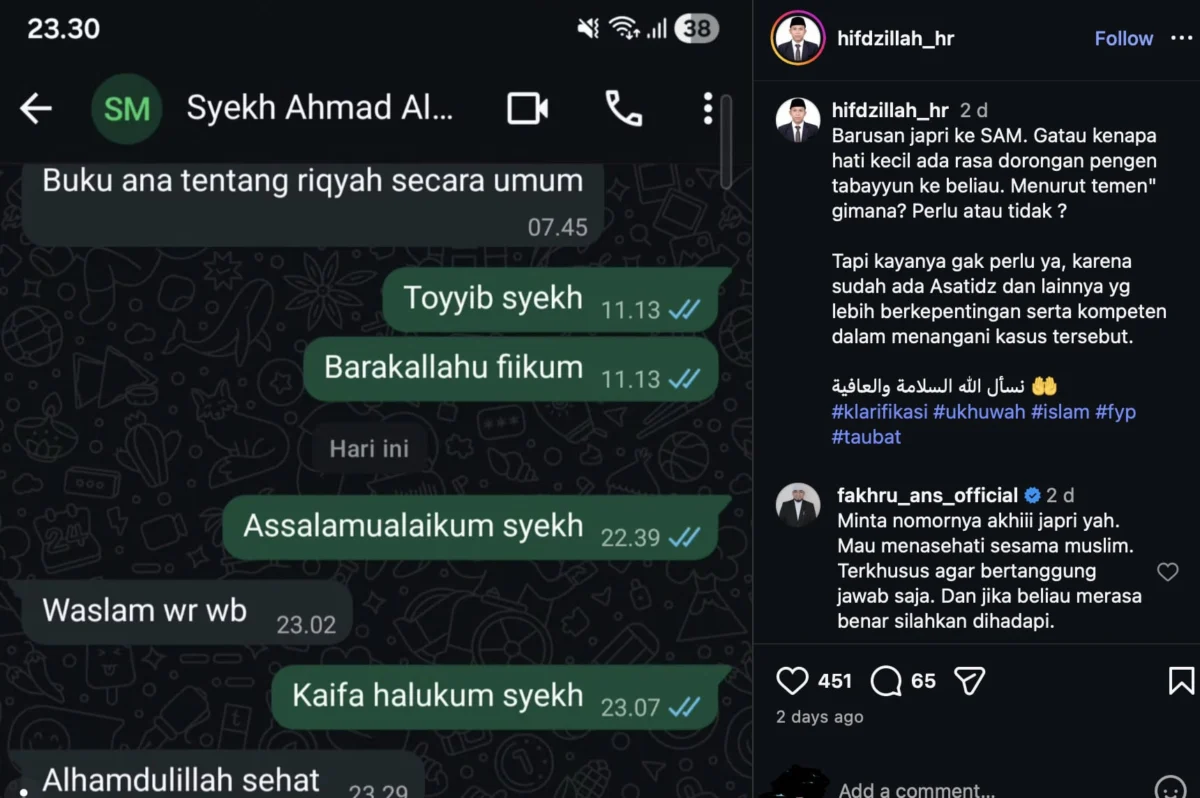
The legal saga involving Syekh Ahmad Al Misry, a prominent religious figure frequently appearing in Indonesian media, has entered a new and complex phase following his designation as a suspect in a high-profile harassment case. Public discourse surrounding the case was recently reignited after an unexpected digital interaction between the cleric and another religious teacher, Ustaz Ahmad Hifzhillah, surfaced on social media. This development has sparked a wave of curiosity and skepticism, particularly as several other religious figures and legal representatives had previously claimed that the suspect was unreachable following the official commencement of police investigations.
The controversy reached a new peak when Ahmad Hifzhillah shared a screenshot of a private WhatsApp conversation with Syekh Ahmad Al Misry (SAM) via his personal Instagram account. Hifzhillah’s post, dated Wednesday, April 29, 2026, revealed that he had reached out to the suspect out of a personal impulse to perform "tabayyun"—an Islamic principle of seeking clarification and verifying the truth before forming a judgment. In his caption, Hifzhillah admitted that his heart felt a sudden urge to contact the cleric directly to understand the situation from his perspective, though he later questioned the necessity of his own intervention given that more competent authorities and senior religious scholars were already handling the matter.
The WhatsApp Exchange and Public Reaction
The digital interaction, though brief, has become a focal point for public scrutiny. Hifzhillah’s message was a standard greeting and an inquiry into the cleric’s well-being. To the surprise of many, SAM responded promptly, stating that he was in good health. This seemingly mundane exchange stands in stark contrast to reports from other members of the Indonesian clerical community, many of whom have expressed frustration over their inability to contact SAM since the allegations first gained national traction.
The revelation of this active communication channel prompted immediate reactions from the digital community. One social media user pointed out the inconsistency, questioning why SAM would respond to a casual inquiry from Hifzhillah while reportedly ignoring attempts at communication from other "Asatidz" (teachers) who held more direct interests in the case. This sentiment was echoed by Ustaz Muhammad Fakhrurrazi Anshar, who commented on the post requesting SAM’s contact information. Anshar expressed a desire to provide religious counsel, emphasizing the importance of accountability and urging the suspect to face the legal process if he maintains his innocence.
The significance of this interaction extends beyond mere curiosity. In the context of a criminal investigation where the suspect is located abroad, any evidence of active communication can be relevant to authorities tracking the suspect’s accessibility and willingness to cooperate with the legal system.
Chronology of the Legal Case and Suspect Designation
The legal pressure on Syekh Ahmad Al Misry intensified significantly on Friday, April 24, 2026, when the Criminal Investigation Department of the Indonesian National Police (Bareskrim Polri) officially named him a suspect. This decision followed a series of preliminary investigations, witness testimonies, and the gathering of digital evidence related to allegations of harassment. The case has sent shockwaves through the Indonesian religious community, where SAM was previously held in high regard for his televised sermons and social media presence.
The timeline of the case suggests a strategic departure by the suspect. Reports indicate that SAM left Indonesia for Egypt on March 15, 2026, several weeks before the police formally elevated his status to that of a suspect. This timing has led to widespread speculation regarding whether his departure was a calculated move to avoid the reach of Indonesian law enforcement. However, SAM and his legal representatives have consistently maintained that his travel to Egypt was pre-planned and strictly for personal reasons—specifically to accompany his mother during a critical surgical procedure.
From his current location in Egypt, SAM has issued a firm denial of all charges. He has characterized the allegations as "cruel slander" (fitnah kejam) designed to tarnish his reputation and undermine his religious work. Despite these denials, Bareskrim Polri has indicated that the legal process will continue regardless of the suspect’s physical location, raising the possibility of international legal cooperation.
Legal Framework and Challenges of International Jurisdiction
The case against Syekh Ahmad Al Misry is being viewed through the lens of Indonesia’s Law No. 12 of 2022 on Sexual Violence Crimes (TPKS Law). This landmark legislation was designed to provide a more robust framework for prosecuting sexual violence and harassment, offering better protection for victims and more stringent penalties for perpetrators. The application of the TPKS Law in a case involving a high-profile religious figure is seen as a test of the law’s efficacy and the judicial system’s impartiality.
However, the fact that SAM is currently in Egypt presents significant procedural hurdles for Indonesian authorities. Under international law, bringing a suspect back to face trial requires a formal extradition process or the issuance of an Interpol Red Notice. While Indonesia and Egypt maintain friendly diplomatic relations, extradition processes are notoriously lengthy and involve complex legal reviews in both the requesting and the requested countries.

Legal analysts suggest that Bareskrim Polri will likely exhaust all avenues for voluntary cooperation before escalating to international warrants. The recent WhatsApp activity suggests that the suspect is not entirely "off the grid," which may provide investigators with leverage to negotiate his return to Indonesia for questioning.
The Role of the Clerical Community and "Tabayyun"
In Indonesia, the role of the "Ulama" (scholars) and "Asatidz" extends beyond the pulpit; they often serve as moral arbiters in societal disputes. The involvement of figures like Ahmad Hifzhillah and Muhammad Fakhrurrazi Anshar highlights the internal dynamics of the religious community when one of its own faces serious criminal allegations.
The concept of tabayyun is central to this dynamic. In Islamic jurisprudence, tabayyun is a mandatory ethical step to prevent the spread of false information and to protect an individual’s honor. However, as the SAM case moves into the realm of criminal law, the limits of tabayyun are being tested. Many scholars argue that while spiritual and social clarification is important, it cannot supersede the formal legal process conducted by the state.
The divide within the community is palpable. Some followers remain steadfast in their support of SAM, viewing the charges as a trial of faith or a targeted campaign. Others, including several prominent clerics, have called for full transparency and have urged the suspect to respect the Indonesian legal system by returning to the country. The sentiment expressed by Ustaz Anshar—that a person who feels they are in the right should have no fear in facing the law—reflects a growing demand for accountability within religious circles.
Broader Implications for Religious Institutions and Public Trust
The Syekh Ahmad Al Misry case is more than a singular legal battle; it is a watershed moment for the intersection of religion, celebrity, and law in Indonesia. For decades, religious figures have enjoyed a high degree of social deference. However, the rise of social media and the enactment of the TPKS Law have empowered victims to come forward and the public to demand higher standards of conduct from those in positions of moral authority.
If the case proceeds to trial, it could set a major precedent for how harassment allegations are handled within religious institutions. It emphasizes the necessity for these institutions to implement internal safeguarding mechanisms and to ensure that religious status does not serve as a shield against legal accountability.
Furthermore, the case highlights the power of digital footprints in modern investigations. The fact that a simple WhatsApp message could trigger a national conversation about a suspect’s accessibility demonstrates how social media platforms have become parallel arenas for justice. While these platforms can facilitate "tabayyun," they also risk creating a "trial by social media," which can complicate official judicial proceedings.
Conclusion and Future Outlook
As of late April 2026, the Indonesian public remains focused on the next steps taken by Bareskrim Polri. The core of the investigation remains the evidence gathered regarding the alleged harassment, but the narrative is now inextricably linked to the suspect’s presence in Egypt and his selective communication with peers in Indonesia.
The police are expected to provide further updates regarding the potential for an international summons if SAM does not return voluntarily following the completion of his mother’s medical care. Meanwhile, the religious community continues to grapple with the fallout, seeking a balance between the presumption of innocence and the pursuit of justice for the alleged victims.
The Syekh Ahmad Al Misry case serves as a reminder that in the modern era, the reach of the law is increasingly global, and the scrutiny of the public is ever-present. Whether through formal legal channels or the informal networks of digital communication, the demand for clarity and accountability remains the driving force behind this developing story. The resolution of this case will likely have lasting impacts on the trust between the public and religious leadership, as well as the implementation of sexual violence laws in Indonesia.