Nila Kartika Wati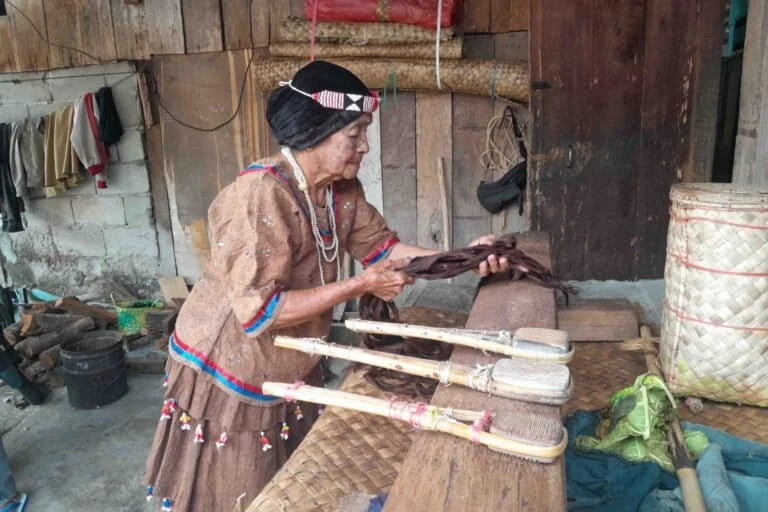
In the quiet village of Mataue, nestled within the Kulawi District of Sigi Regency, Central Sulawesi, the rhythmic sound of a wooden mallet striking bark echoes daily from behind a modest home. Here, 86-year-old Tobani Tiku meticulously transforms the bark of the banyan tree into kumu nunu, an ancient textile that once served as the primary attire for the indigenous Kulawi people. As the sole remaining practitioner in the region who commands the entire production process, Tobani’s work represents a critical intersection between ancestral wisdom, ecological sustainability, and the urgent need for cultural preservation in modern Indonesia.
The evolution of kumu nunu reflects the broader history of the Kulawi community. Historically, this fabric was indispensable, serving as everything from durable workwear for rice paddy labor to insulating blankets for cold mountain nights. However, with the influx of mass-produced synthetic textiles and the shifting economic realities of the 21st century, the craft has faded into near-obscurity. Today, the cloth is primarily reserved for sacred indigenous ceremonies, marking it as a rare cultural artifact that risks vanishing if the mantle of knowledge is not passed to a new generation.
The Sacred Science of Sourcing and Selection
The production of kumu nunu is not merely a manufacturing process but a highly regulated practice deeply intertwined with nature. Tobani utilizes two varieties of banyan: nunu lero (red banyan) and nunu bula (white banyan), with the former being her preferred material. The procurement of these materials, managed by her son, Syafrudin, follows strict indigenous protocols that prioritize the quality of the fiber.
The extraction of raw materials is strictly timed to the lunar cycle. Ranting and branches are harvested exclusively during the full moon, a practice rooted in the belief that the tree’s vitality and sap content are at their peak during this phase. Furthermore, the orientation of the branch matters; only limbs growing toward the sky or extending horizontally are deemed suitable. Branches that grow downward are rejected, as they produce thinner, inferior bark with weak fibers. This traditional knowledge suggests a sophisticated understanding of botanical physiology and resource management, ensuring that the harvested material yields the highest possible durability for the finished textile.
A Labor-Intensive Craft: From Bark to Fabric
The journey from a raw branch to a finished garment is a multi-stage process that demands extreme patience and physical stamina. Once harvested, the branches—ranging between one and 1.5 meters in length—are debarked, cleaned, and submerged in water for a mandatory three-day softening period.
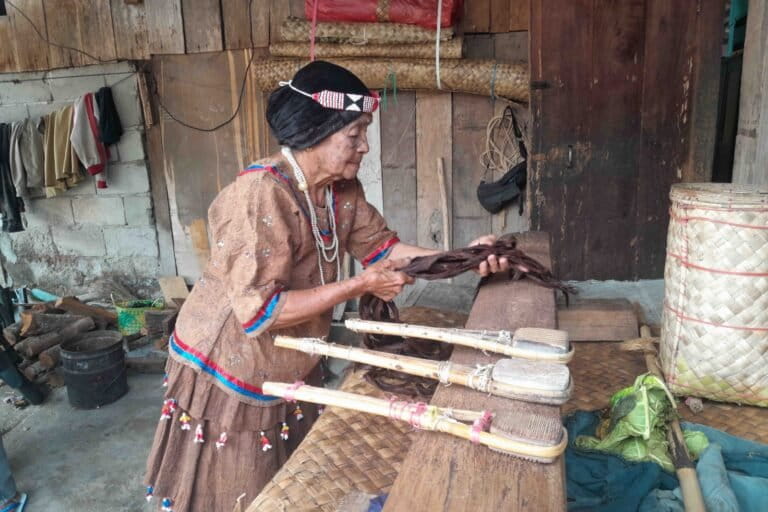
Following this, the bark undergoes a transformation through rhythmic, repetitive beating. Tobani employs a specialized set of four traditional mallets, used in a specific, sequential order: pola, ike tinahi, ike tiva, and ike pogea. The latter three instruments are crafted from stones sourced specifically from Towulu Village, a testament to the inter-village interdependence that sustained this craft for centuries. These stone tools, some of which are family heirlooms passed down to Tobani from her mother and grandmother, remain remarkably durable, highlighting the superior craftsmanship of the ancestors.
The aesthetic and functional qualities of the cloth are further enhanced by natural dyes and preservatives. Tobani incorporates local botanical extracts, such as linuro and ulakau, which not only provide the fabric with its distinct earthy hues but also act as organic agents to prevent decay. A single set of clothing, comprising an upper garment and a lower piece, requires at least one week of intensive labor. Given that production is limited by the lunar-based harvest of roughly 30 branches per month, the output is inherently constrained, reinforcing the exclusivity and high value of the finished products. Currently, individual pieces are priced between Rp200,000 and Rp300,000 per meter, with a complete outfit commanding approximately Rp1.5 million.
Institutional Recognition and Cultural Significance
The significance of Tobani’s work has garnered national attention, elevating her from a local artisan to a national cultural figure. In 2022, her lifelong dedication was recognized with the prestigious Ratna Award. This was followed by a significant accolade in 2025, when the Indonesian Ministry of Culture named her a "Maestro of Bark Cloth" during the Anugerah Kebudayaan Indonesia (Indonesian Cultural Awards).
These awards serve as more than just personal honors; they represent official institutional acknowledgment of the importance of indigenous knowledge systems. The Ministry of Culture’s recognition highlights the government’s growing focus on safeguarding intangible cultural heritage—a move that experts argue is essential to prevent the erosion of identity in rural communities.
Bridging the Knowledge Gap: Training the Next Generation
Recognizing the fragility of her craft, Tobani has actively sought to dismantle the barriers to entry. She has opened her home to those interested in learning, moving beyond the traditional constraints that might have previously limited the spread of such specialized knowledge.
Her efforts have been bolstered by collaborative initiatives. In 2022, she participated in a mentoring program for the women of Mataue Village, organized by the Perkumpulan Imunitas Sulawesi Tengah (Central Sulawesi Immunity Association). This program was designed to cover the entire value chain of the craft, from sustainable raw material extraction to modern marketing strategies. By teaching participants specific roles—such as the berpotong (cutting), berkupas (peeling), and the extraction of the inner bark—Tobani is ensuring that the technical skills remain alive. To date, at least two groups of 10 women have undergone this training, signaling a modest but hopeful revival of the craft.
Implications for Rural Economic Development
The preservation of kumu nunu offers more than cultural value; it presents a viable, albeit niche, economic model for the people of Kulawi. As global interest in sustainable, slow-fashion, and ethically sourced textiles grows, there is significant potential for high-quality bark cloth to reach broader markets.
However, challenges remain. The reliance on specific lunar cycles and labor-intensive, hand-crafted techniques limits scalability. Furthermore, the supply chain is vulnerable to environmental changes affecting the banyan forests. Policy experts suggest that for this craft to be sustainable in the long term, there must be a concerted effort to link artisans with design experts who can integrate kumu nunu into modern fashion contexts without compromising its cultural integrity.
The efforts of the Perkumpulan Imunitas Sulawesi Tengah and the Ministry of Culture provide a framework for such integration. By focusing on marketing and business development, these programs aim to transform the craft from a dying tradition into a sustainable livelihood for local women, potentially curbing migration to urban centers and keeping the community rooted in its ancestral lands.
Conclusion: A Living Legacy
For Tobani Tiku, the loom-like beat of the mallet is not just a job; it is a manifestation of her identity and a tangible link to her ancestors. She views kumu nunu as a repository of knowledge about the forest, the seasons, and the social fabric of the Kulawi people.
As she enters her late 80s, Tobani remains committed to her craft. Her openness to teaching represents a turning point in the history of the kumu nunu. While she acknowledges that the path to mastery is long and demanding, her willingness to pass on the techniques offers a roadmap for the survival of this ancient art. The future of the Kulawi bark cloth now rests in the hands of the women of Mataue, who, under the watchful eye of their maestro, are learning to balance the demands of the modern world with the rhythms of the moon and the wisdom of the banyan tree.
The story of Tobani Tiku is a testament to the resilience of indigenous knowledge. It underscores the reality that cultural heritage is not a static object in a museum, but a living practice that, when nurtured, can continue to provide meaning, identity, and economic sustenance for generations to come. Through the continued support of the community and the state, the tradition of kumu nunu may yet find its place in the modern Indonesian narrative, reminding the nation of the deep, enduring connection between its people and the natural world.