Tyo Susilo
The Indonesian cycling community is experiencing a robust resurgence, mirrored by a significant surge in outdoor and indoor cycling activities recorded across the archipelago. According to recent data compiled through Garmin Connect Indonesia, total recorded cycling activities witnessed an extraordinary year-on-year growth of 51% throughout the first three quarters of January to September 2026. This impressive metric reached a cumulative 899,224 tracked activities, marking a steep ascent from the 595,609 activities logged during the exact corresponding period in the previous year.
This substantial expansion of the cycling demographic has prompted global wearable and sports technology giant Garmin to strategically introduce two flagship hardware releases tailored specifically to the evolving demands of modern cyclists. Addressing both the outdoor road enthusiast and the dedicated indoor training athlete, Garmin has officially unveiled the Garmin Edge 1060 premium cycling computer alongside the advanced Tacx Nära smart indoor trainer. These hardware additions arrive at a crucial juncture when cyclists are increasingly demanding granular data analytics, enhanced safety ecosystems, and seamless connectivity regardless of external environmental conditions.
The Post-Pandemic Evolution and Surging Data of Indonesian Cycling
To understand the weight of Garmin’s recent product deployment, one must examine the trajectory of cycling culture in Indonesia over recent years. While the initial boom was heavily catalyzed by pandemic-era lifestyle shifts, the market has since matured from a passing recreational fad into a deeply integrated discipline focused on performance, endurance, health tracking, and community sport.

The 51% surge in Garmin Connect engagement underscores a structural shift. Indonesian cyclists are no longer just casual weekend riders; they are data-driven athletes who systematically record their rides, monitor training loads, track recovery metrics, and engage in virtual communities. However, this growth has not been without its logistical and environmental hurdles. Urban congestion, increasingly unpredictable tropical weather patterns, and fluctuating air quality indexes in major metropolitan areas like Jakarta and Surabaya frequently disrupt outdoor training schedules.
Recognizing these pain points, Garmin’s product strategy for the region has pivoted toward offering comprehensive dual-ecosystem solutions: high-end tools that optimize outdoor safety and navigation, paired with ultra-realistic indoor simulation hardware that ensures uninterrupted training cycles.
Garmin Edge 1060: Redefining Road Cycling with Voice Control and Hybrid Design
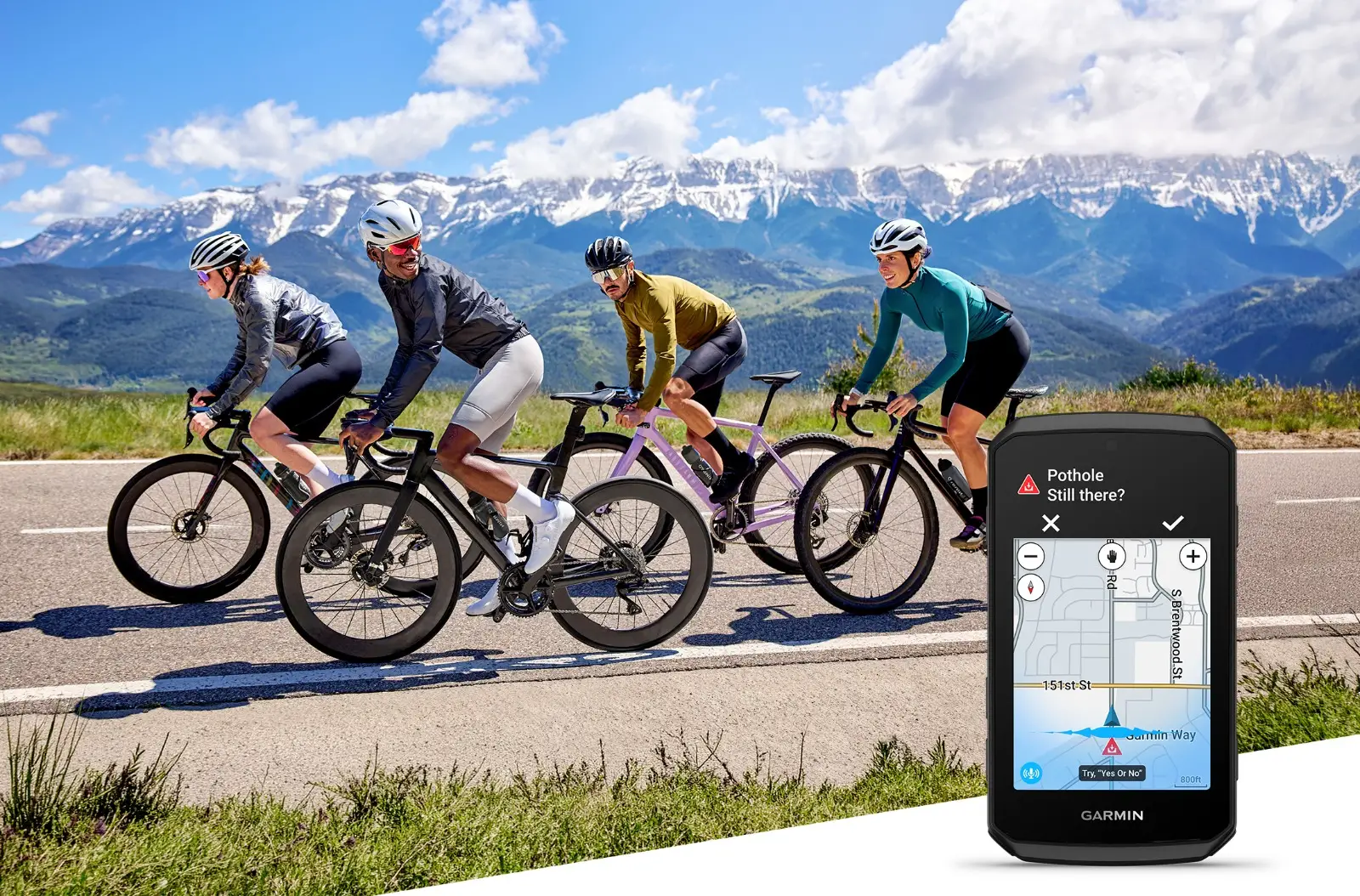
At the forefront of Garmin’s outdoor lineup is the newly announced Garmin Edge 1060, a premium cycling computer engineered to push the boundaries of handlebar technology. Moving beyond traditional touch-only interfaces, the Edge 1060 introduces an integrated microphone and speaker system designed to minimize distractions and maximize rider safety.
By utilizing simple, intuitive voice commands initiated with the phrase "Okay, Garmin," riders can execute a multitude of functions without ever needing to take their hands off the handlebars or their eyes off the tarmac. This includes checking vital performance statistics, searching for dynamic routes on the fly, and transmitting voice messages via the Garmin Messenger platform.

Understanding the frustrations cyclists face when operating capacitive touchscreens under heavy rainfall or while wearing full-finger winter and wet-weather gloves, Garmin has engineered a hybrid input system. The Edge 1060 successfully combines a responsive touchscreen interface with tactile, glove-friendly physical buttons, ensuring uncompromised control in adverse weather conditions.
Advanced Navigation, Group Connectivity, and Exceptional Battery Endurance
Navigation capabilities on the Edge 1060 have received a comprehensive overhaul. The device provides intelligent route planning tailored explicitly to specific bicycle categories—such as road, gravel, or mountain—while factoring in elevation preferences. Cyclists receive real-time updates regarding estimated journey times, exact mileage, live traffic congestion warnings, and community-reported road hazards. Furthermore, the inclusion of Free Flow Routing assists riders in identifying alternative paths characterized by lower vehicular traffic and fewer navigational bottlenecks.
For collective riding, the device features the enhanced GroupRide function. This allows members of a cycling peloton to share their live locations, exchange real-time text messages, receive automated incident detection alerts, and participate in friendly on-the-road challenges. For holistic health monitoring, the Edge 1060 bridges the gap between performance cycling and daily wellness by pairing effortlessly with Garmin smartwatches or CIRQA Smart Bands to continuously assess post-ride recovery status and overall physiological readiness.
Battery anxiety, a historically persistent challenge for endurance cyclists utilizing power-hungry GPS units, has been heavily mitigated in the Edge 1060. The device boasts an operational lifespan of up to 20 hours under extreme, high-demand usage scenarios—such as continuous navigation with multiple sensor connections active—and stretches up to an impressive 60 hours when operating in its specialized battery-saver mode. Garmin has confirmed that the Edge 1060 is slated for official retail availability across Indonesia starting December 9, 2026.

Tacx Nära: Bringing Outdoor Realism Indoors
Complementing the outdoor Edge 1060 is the Tacx Nära, Garmin’s answer to the surging demand for high-end indoor training solutions. Designed explicitly for cyclists seeking to maintain peak physical condition regardless of torrential downpours, extreme heat, or hazardous urban air quality, the Tacx Nära redefines the indoor riding experience.
The smart indoor trainer delivers industry-leading precision, boasting power and cadence measurement accuracy within an impressive 1% margin. Performance-oriented cyclists can push their limits against simulated climbs reaching up to 20% gradient inclines, alongside robust sprint resistance capabilities supporting up to 2,200 watts.
To bridge the gap between static indoor stationary riding and dynamic road behavior, the Tacx Nära incorporates a built-in Motion Pod system. This hardware feature permits subtle physical movement in forward, backward, and lateral directions, successfully replicating the natural swaying and rocking motions of a bicycle frame during intense climbing and sprinting efforts. Additionally, the unit fully supports virtual shifting protocols, allowing users to engage seamlessly in competitive virtual races on platforms like Zwift without requiring physical cassette modifications.
For elite athletes seeking absolute immersion, pairing the Tacx Nära with the optional Tacx Alpine accessory further expands the hardware’s simulation capabilities, escalating maximum incline simulation to 25% and downward descents to -10%. The Tacx Nära is scheduled to make its official market debut in Indonesia in January 2027.

Strategic Product Rollout and Regional Implications
While Garmin’s global product announcements frequently encompass a broad spectrum of regional variants—such as the international introduction of the Edge Explore 3 and Edge Explore 3 Plus tailored specifically for touring and bikepacking enthusiasts—the company maintains a highly curated distribution strategy for the Indonesian market. Garmin has confirmed that the Edge Explore series will not see an official domestic release, directing local consumers toward its high-performance mainstays, which include the Edge 540, Edge 840, and the newly inducted Edge 1060.
Industry analysts suggest that Garmin’s targeted dual-product strategy for Indonesia is a calculated response to the maturing domestic sports economy. By addressing the dual realities of Indonesian cycling—the adventurous road warrior navigating challenging infrastructural terrains and the data-obsessed indoor trainer mitigating environmental constraints—Garmin is uniquely positioned to cement its market dominance.
As infrastructural investments in bike lanes grow across major Indonesian cities, and as health-conscious demographics increasingly prioritize quantifiable fitness metrics, the integration of voice-controlled navigation, advanced group safety networks, and hyper-realistic indoor simulators signals a new chapter for the nation’s cycling ecosystem.