Nila Kartika Wati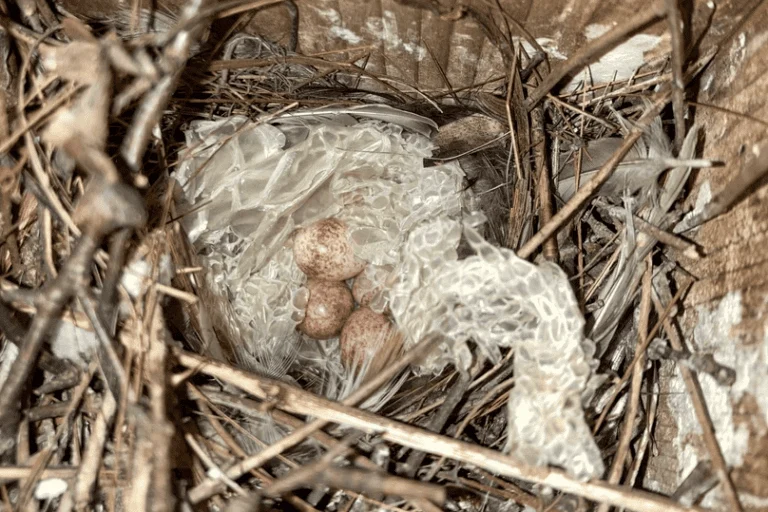
For more than a century, naturalists and ornithologists have been perplexed by a recurring phenomenon found within the intricate structures of bird nests: the presence of shed snakeskin. While a casual observer might dismiss these translucent, papery fragments as accidental debris picked up during the frantic search for nesting material, the scientific community has long suspected a deeper, more calculated purpose. Recent research spearheaded by experts at Cornell University has finally provided a definitive explanation for this behavior, revealing that for certain species, the inclusion of snakeskin is not a matter of aesthetic preference or structural necessity, but a sophisticated tactical maneuver designed to safeguard the next generation from the relentless pressures of predation.
The study, led by Vanya Rohwer, a curator at the Cornell University Museum of Vertebrates, and published in the prestigious journal The American Naturalist, marks a significant milestone in our understanding of avian behavioral ecology. For decades, the question of why birds would expend precious energy searching for a specific, often rare, material like snakeskin remained unanswered. Snakeskin offers no thermal insulation and little in the way of cushioning for fragile eggs. Yet, the persistence of this trait across various lineages suggested an evolutionary advantage that outweighed the costs of acquisition.
A Century of Scientific Inquiry
The mystery of snakeskin in nests is not a new fascination. Since the late 19th century, naturalists have documented the presence of these reptilian remains in the nests of species such as the Great Crested Flycatcher (Myiarchus crinitus) and the House Wren (Troglodytes aedon). Early theories ranged from the mundane—that the skin was simply a soft lining—to the more speculative, suggesting it might camouflage the nest or even provide some form of chemical protection against parasites. However, empirical evidence remained elusive, and experimental results were often contradictory.
A pivotal moment in this investigative timeline occurred in 2006, when a study published in The Condor suggested that snakeskin significantly reduced predation in the nests of Great Crested Flycatchers. Conversely, a 2011 study focusing on Great Reed Warblers found no such benefit. These conflicting data points created a schism in the scientific narrative until Rohwer’s team identified the missing variable: nest architecture. The team posited that the effectiveness of snakeskin as a deterrent is entirely dependent on the type of nest a bird builds and the specific predators it faces.
The Methodology: Bridging History and Modern Experimentation
To resolve the long-standing debate, the research team adopted a dual-pronged approach, combining historical data analysis with rigorous field experiments. The historical component involved delving into a unique and often overlooked resource: 19th-century "egg cards." During the Victorian era and into the early 20th century, oology—the study and collection of bird eggs—was a widespread hobby. Collectors meticulously documented the contents and materials of the nests they encountered, providing a vast, untapped database of avian behavior from a century ago.
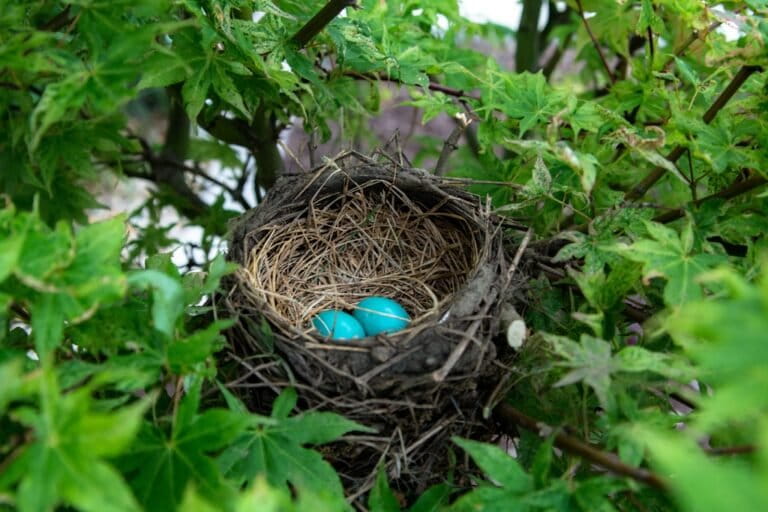
By analyzing records from 78 different bird species, the researchers discovered a striking pattern. Birds that nested in cavities—such as hollowed-out trees or man-made nest boxes—were 6.5 times more likely to incorporate snakeskin into their nests than species that built open-cup nests in the branches of trees or bushes. This correlation provided the first major clue that the snakeskin strategy was specifically tailored to the unique vulnerabilities of cavity-dwelling birds.
Following the historical analysis, the researchers moved into the field to conduct a controlled experiment. They deployed a total of 147 artificial nests across various habitats: 63 were designed to simulate tree cavities (using nest boxes), and 84 were fashioned as open-cup nests. To test the deterrent effect, the team placed pieces of shed snakeskin in half of each nest type, while the other half served as a control group. Each nest was stocked with quail eggs to simulate a real clutch.
The Results: A Tale of Two Environments
The results of the 14-day field experiment were both stark and illuminating. In the open-cup nests, the presence of snakeskin had virtually no impact on survival rates. Predators—primarily larger birds like Blue Jays and crows—attacked both the "skinned" and "unskinned" nests with equal frequency. These avian predators, hunting from above and possessing high cognitive abilities, appeared entirely unfazed by the presence of a dry, discarded piece of reptile skin.
However, the data from the cavity nests told a completely different story. In the control group (nest boxes without snakeskin), only 38 percent of the nests survived the two-week period without being raided. In sharp contrast, nearly 75 percent of the nest boxes containing snakeskin remained untouched. The presence of the skin more than doubled the survival probability of the eggs within the cavity.
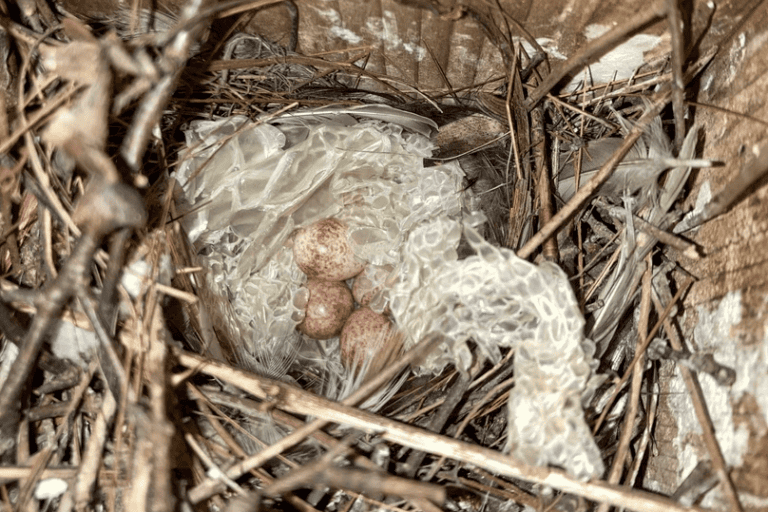
To understand why the deterrent worked so effectively in one environment but not the other, the researchers utilized trail cameras to identify the culprits. The footage revealed that the primary threats to cavity nests were small mammals, specifically flying squirrels and American red squirrels. These mammals are the perfect size to enter the narrow openings of tree cavities, where they frequently consume eggs and nestlings. Crucially, these same small mammals are also the primary prey of many snake species.
The Psychology of the "Landscape of Fear"
The effectiveness of the snakeskin strategy relies on a biological concept known as the "landscape of fear." For a small rodent, entering a dark, confined space like a tree cavity is a high-risk activity. In the wild, a snake inside a cavity represents a lethal, inescapable trap. When a squirrel encounters the scent or texture of snakeskin at the entrance or inside a nest, its ancient, hard-wired survival instincts take over.
Even though the snakeskin is inanimate and harmless, it serves as a powerful "biological signpost" indicating the potential presence of a predator. The squirrel does not stay to investigate whether the snake is still there or if the skin is merely a discarded husk; the risk of a fatal encounter is too high. In the cramped quarters of a cavity, the squirrel’s flight-or-fight response is heavily weighted toward flight.
This explains why the strategy fails for open-cup nests. A Blue Jay or a crow does not face the same level of risk from a snake while foraging in the open canopy. Furthermore, these birds rely more heavily on visual cues and are capable of recognizing that a piece of dry skin does not pose a threat. The strategy is, therefore, a highly specialized tool used by cavity nesters to exploit the specific phobias of their most dangerous predators.
Evolutionary Implications and Avian Intelligence
The findings of the Cornell study elevate our perception of avian intelligence. The act of seeking out snakeskin suggests that birds are capable of complex environmental assessments. They must not only recognize the material but also associate it with the concept of safety and predator avoidance. This is not a random collection of materials; it is a targeted defensive application.
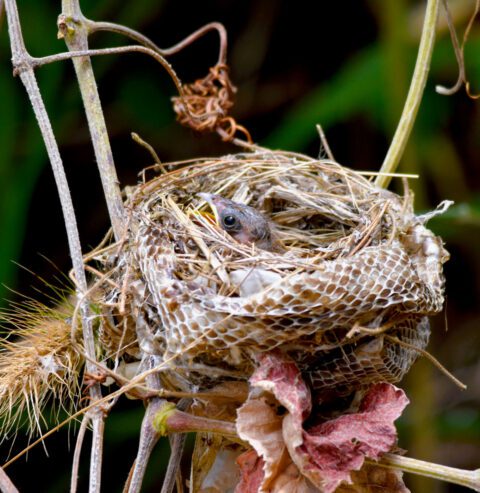
Furthermore, this behavior aligns with other fascinating "mimicry" or "scare tactic" behaviors observed in the avian world. For example, several species of cavity-nesting birds, such as the Great Tit or the Northern Wryneck, are known to emit a loud, snake-like hissing sound when a predator approaches the nest entrance. By combining auditory mimicry (hissing) with visual and olfactory cues (snakeskin), these birds create a multi-sensory illusion of a reptilian presence, effectively turning their homes into "no-go zones" for mammalian intruders.
This research also highlights the importance of "extended phenotypes"—the idea that an animal’s influence extends beyond its physical body to the structures it builds. The nest is not just a container; it is a functional tool that interacts with the surrounding ecosystem to manipulate the behavior of other species.
Broader Impact and Future Conservation
The implications of this study extend beyond pure ornithology. It provides a vivid example of how species co-evolve in a complex web of interactions. It also underscores the importance of maintaining biodiversity. For these birds to protect their nests, they require a healthy population of snakes in the vicinity to provide the necessary "sheds." As snake populations decline due to habitat loss and human persecution, the birds that rely on their skins for defense may find themselves increasingly vulnerable to nest predation.
As we move forward, researchers are interested in exploring whether birds show a preference for specific types of snakeskin. Do they prefer the skins of venomous species over non-venomous ones? Do they seek out fresher skins that might carry a stronger scent? These questions remain the next frontier in the study of avian defensive architecture.
In conclusion, the presence of snakeskin in a bird’s nest is far from a coincidence. It is a testament to millions of years of evolutionary refinement—a brilliant, low-cost, high-reward strategy that allows a small bird to use the ghost of a predator to protect its lineage. By bridging the gap between historical observations and modern experimental science, we have finally unraveled one of nature’s most enduring mysteries, revealing the hidden tactical genius of the birds that live among us.