Nila Kartika Wati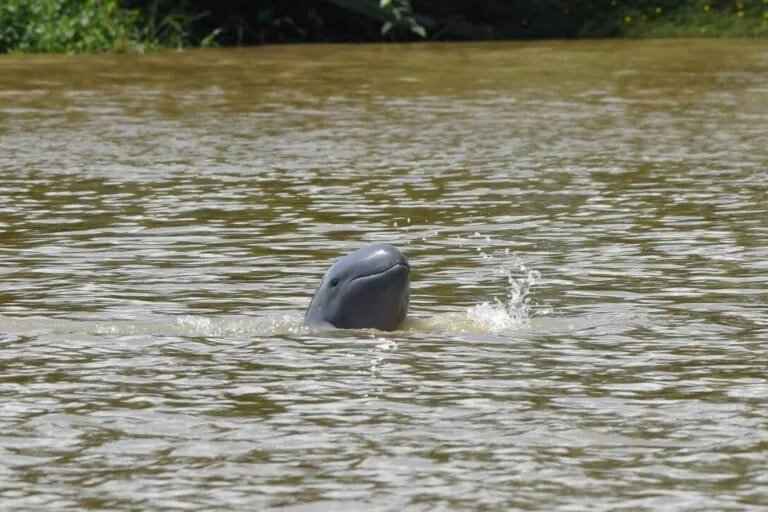
Deep beneath the silt-laden surface of the Mahakam River in East Kalimantan, Indonesia, resides one of the world’s most enigmatic and critically endangered freshwater cetaceans. The Mahakam dolphin, locally known as Pesut Mahakam (Orcaella brevirostris), serves as more than just a regional mascot for the province; it is a biological masterpiece, possessing a suite of specialized adaptations that allow it to navigate one of Southeast Asia’s most complex river systems. However, as industrialization and human activity encroach upon its remaining habitat, this ancient sentinel of the river faces a precarious future, with its survival now measured in a dwindling count of individuals.
The Mammalian Mastery of a River Dweller
While they inhabit the murky depths alongside various fish species, the Pesut Mahakam is fundamentally different from its gill-breathing neighbors. As a mammal, it possesses lungs, gives birth to live young, and nurses its offspring. The biological journey of a Pesut begins with a remarkable evolutionary safeguard: the birth process. Unlike most terrestrial mammals, Pesut calves are born tail-first. This specific orientation is a critical survival mechanism, ensuring that the calf does not attempt to take its first breath of water before its head has cleared the mother’s body and reached the surface.
In their infancy, these dolphins exhibit another clear marker of their mammalian lineage. Newborn calves possess fine, vestigial hairs around their snouts. While these hairs disappear as the dolphin matures, they serve as a fleeting reminder of the species’ evolutionary history. Post-birth, the bond between mother and calf is maintained through nursing. The mother possesses mammary glands located near the abdominal area, providing nutrient-rich milk that allows the calf to grow rapidly in an environment where predators and physical obstacles are numerous.
One of the most striking physical distinctions of the Pesut Mahakam, compared to its oceanic cousins like the bottlenose dolphin, is its neck. Most dolphins have fused neck vertebrae to provide stability during high-speed swimming in the open ocean. In contrast, the Pesut has a highly flexible neck, allowing it to turn its head independently of its body. This anatomical flexibility is an essential adaptation for life in a river, where the water is often shallow, filled with submerged timber, and characterized by narrow, winding tributaries. This "swivel-neck" capability allows the Pesut to maneuver through tight spaces and scan for prey in the dense, opaque environment of the Mahakam.
Advanced Sensory Systems and Hunting Strategies
Visibility in the Mahakam River is often near zero due to high sediment loads from upstream erosion and industrial runoff. Consequently, the Pesut has evolved to rely on a sophisticated biological sonar system, or echolocation, rather than sight. By emitting high-frequency ultrasonic clicks through a specialized organ in the forehead known as the "melon," the dolphin can "see" its surroundings through sound. These sound waves bounce off objects—whether they are schools of fish, submerged logs, or riverbanks—and return to the dolphin, providing a high-resolution mental map of the environment.
Beyond navigation, these acoustic abilities are central to their social structure. While high-frequency sounds are used for hunting and spatial awareness, lower-frequency vocalizations are employed for communication within the pod. This complex language allows them to coordinate movements and maintain social bonds in waters where they are often invisible to one another.
The intelligence of the Pesut Mahakam is perhaps most evident in its hunting tactics. Observations have revealed that these dolphins utilize a unique "water-spitting" behavior. By forcefully ejecting a stream of water from their mouths, they can disorient or startle schools of fish or prawns, making them easier to catch. This behavior is not limited to hunting; it is also observed during social play and interaction, suggesting a high level of cognitive function and behavioral plasticity.
Even their rest cycles are a marvel of evolutionary engineering. The Pesut Mahakam never fully sleeps in the way terrestrial mammals do. They practice unihemispheric slow-wave sleep, where one half of the brain remains active while the other rests. This allows the dolphin to remain conscious enough to control its breathing and periodically rise to the surface for air, preventing drowning during sleep.
An Evolutionary Journey Through Half a Million Years
The Pesut Mahakam is not merely a displaced sea creature; it is a distinct evolutionary lineage. Genetic research and DNA analysis suggest that the Mahakam population diverged from their coastal and marine Irrawaddy dolphin relatives approximately 500,000 years ago. Over these half-million years, the Mahakam population became geographically isolated, adapting specifically to the freshwater chemistry and ecological demands of the river system.
This long-term isolation has resulted in a population that is now physiologically incapable of returning to a marine environment. They are true residents of the river, their fate inextricably linked to the health of the Mahakam. This evolutionary specialization, while successful for millennia, has now become a vulnerability as their specific habitat undergoes rapid and destructive changes.

The Demographic Crisis: A Population on the Brink
The current status of the Pesut Mahakam is categorized as "Critically Endangered" by the International Union for Conservation of Nature (IUCN). Historical records indicate that these dolphins once roamed the entire length of the Mahakam, from the upstream reaches down to the delta near the provincial capital of Samarinda. Today, however, their range has contracted significantly. Approximately 90 percent of the remaining population is now concentrated within the Kutai Kartanegara Regency.
The numbers are sobering. Current estimates suggest that only 60 to 80 individuals remain in the wild. This tiny population faces a demographic "bottleneck" exacerbated by their slow reproductive cycle. A female Pesut has a gestation period of approximately 14 months—longer than that of a human. Furthermore, they do not reach sexual maturity until about nine years of age and typically produce only one calf every two to five years. In a population this small, the loss of even a single breeding-age female can have a catastrophic impact on the species’ long-term viability.
Anthropogenic Pressures and the Toll of Modernity
The decline of the Pesut Mahakam is almost entirely attributed to human activity. Data indicates that approximately 70 percent of recorded dolphin deaths are the result of entanglement in gillnets, known locally as rengge. These nets, used by local fishermen to catch fish and prawns, are often invisible to the dolphins’ sonar or are encountered in areas where the dolphins are distracted while foraging. Once entangled, the air-breathing mammals are unable to reach the surface and eventually drown.
Beyond the immediate threat of nets, the Mahakam River has become a busy industrial corridor. The river is a primary artery for the transport of coal and timber, leading to high levels of vessel traffic. This results in two major threats: direct ship strikes and extreme noise pollution. The constant drone of large vessel engines interferes with the dolphins’ echolocation, effectively "blinding" them and disrupting their ability to hunt and communicate.
Environmental degradation further compounds these issues. Upstream mining and deforestation lead to increased sedimentation, altering the river’s depth and flow. Chemical runoff from plantations and heavy metals from mining activities accumulate in the river’s food chain, a process known as bioaccumulation. As apex predators, Pesut Mahakam absorb high concentrations of these toxins, which can lead to reproductive failure and weakened immune systems. Recent studies have even identified the presence of microplastics within the river ecosystem, adding yet another layer of physiological stress to the population.
Conservation Strategies: A Glimmer of Hope
Despite the dire statistics, a concerted effort by scientists, local communities, and the government is underway to pull the species back from the edge. One of the most successful interventions has been the introduction of "banana pingers." These small, battery-operated acoustic devices are attached to fishermen’s nets. They emit a low-intensity sound that warns the dolphins of the net’s presence without scaring away the fish that the fishermen rely on for their livelihoods. To date, 158 fishermen have integrated these devices into their gear. Remarkably, in areas where the pingers are consistently used, dolphin mortality due to entanglement has dropped to zero.
Conservation efforts have also moved toward structural protections. Zoned conservation areas have been established to limit industrial activity in critical dolphin habitats. These zones are monitored using both visual surveys and underwater acoustic sensors, providing real-time data on dolphin movements and habitat health. Furthermore, initiatives to restore riverbank vegetation are helping to stabilize the soil, reduce sedimentation, and maintain the natural nurseries for the fish species that the Pesut depends on for food.
The role of the Conservation Foundation for Rare Aquatic Mammals of Indonesia (RASI) has been pivotal in these efforts. By working directly with riverside communities, they have fostered a sense of pride and stewardship among the local population. The Pesut is no longer seen just as a competitor for fish, but as a vital component of a healthy river ecosystem that supports the human economy.
The Broader Implications of Extinction
The struggle of the Pesut Mahakam is a microcosm of the global freshwater biodiversity crisis. Rivers are among the most threatened ecosystems on the planet, and the loss of an apex predator like the Mahakam dolphin would signal a total collapse of the river’s ecological integrity.
From an analytical perspective, the survival of the Pesut is a barometer for the sustainability of East Kalimantan’s development. If the river can no longer support its most iconic inhabitant, it raises serious questions about the long-term viability of the water source for the millions of people who live along its banks. The preservation of the Pesut Mahakam, therefore, is not merely an act of biological altruism; it is a necessary component of regional environmental security.
As the province moves forward with the development of Indonesia’s new capital city nearby, the pressure on the Mahakam watershed will only increase. The coming decade will be the ultimate test of whether human progress and the survival of an ancient, intelligent species can coexist. For now, the silent clicks of the Pesut still echo through the murky depths—a rhythmic reminder that while they are on the brink, they are not yet gone.