Nasution Nanang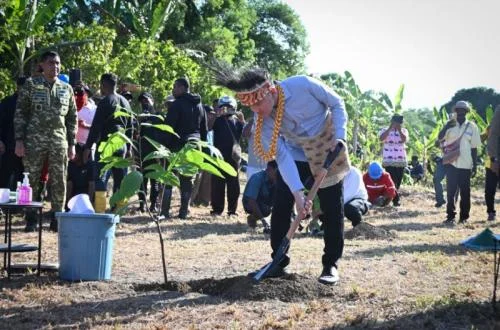
Manokwari Selatan, Papua Barat – Vice President Gibran Rakabuming Rakabuming on Saturday, June 20, inaugurated a significant national cocoa rehabilitation effort by participating in the ceremonial planting of superior cocoa seedlings at the PT Ebier Suth Cokran plantation in Manokwari Selatan Regency, West Papua. This pivotal event underscores the Indonesian government’s robust commitment to revitalizing its agricultural sector, specifically aiming to enhance cocoa cultivation potential and accelerate the national cocoa rehabilitation agenda across the strategically vital region of Papua Barat. The initiative is poised to position Indonesia as a formidable global player in the cocoa industry, driven by sustainable practices and improved productivity.
The Vice President’s visit to the remote yet agriculturally rich landscape of Manokwari Selatan was more than a symbolic gesture; it represented a tangible commitment to fostering a productive and sustainable national cocoa industry. Febri Sumbung, Director of Marketing Management and Communication for PT Ebier Suth Cokran, emphasized the profound significance of this high-level governmental engagement. "The Vice President’s presence highlights the government’s unwavering dedication to propelling Indonesia’s cocoa sector forward," Sumbung stated, as quoted from the official release by the Vice Presidential Secretariat for Press, Media, and Information (BPMI) in Jakarta on Sunday. Sumbung further elaborated on Vice President Gibran’s vision, noting his insistence that Indonesia possesses immense potential to ascend as a leading global cocoa producer. This aspiration, however, hinges critically on a multi-pronged strategy encompassing enhanced productivity, superior quality, robust downstream processing (hilirisasi), and environmentally sound farm management practices.
A core tenet of the Vice President’s address was the imperative for cocoa industry development to transcend mere production volume increases. Gibran explicitly called for a holistic approach that meticulously integrates environmental sustainability and the welfare of indigenous communities. He paid particular attention to the ongoing rehabilitation efforts, advocating for the widespread adoption of dynamic agroforestry systems and the strategic planting of shade trees. This emphasis on agroforestry, a land-use management system in which trees or shrubs are grown around or among crops or pastureland, reflects a modern understanding of sustainable agriculture. It promises ecological benefits such such as soil conservation, biodiversity enhancement, carbon sequestration, and improved microclimates, all while potentially diversifying farmers’ income streams.
Beyond environmental considerations, Vice President Gibran stressed the urgent need for comprehensive capacity building among cocoa farmers. This empowerment is deemed essential for Indonesia’s cocoa industry to effectively compete in an increasingly demanding global market, where sustainability credentials and product traceability are no longer mere advantages but critical prerequisites. This strategic strengthening of farmer capabilities is also aligned with President Prabowo Subianto’s directive to consolidate Papua Barat’s position as a prominent national cocoa hub, thereby contributing significantly to the national economy and regional development.
Chronology of the Visit and Superior Cultivars
Upon his arrival at the plantation site, Vice President Gibran received a detailed briefing on the cocoa plantation rehabilitation program meticulously managed by PT Ebier Suth Cokran, an entity proudly owned by the Koperasi Ebier Suth Cokran (Ebier Suth Cokran Cooperative). This presentation elucidated the cooperative’s comprehensive strategy, encompassing everything from seedling propagation to cultivation techniques, harvest management, and post-harvest processing, all executed with a strong emphasis on sustainability and local community involvement. Following the briefing, the Vice President proceeded to the designated planting area, where he participated in the symbolic ceremony alongside a diverse group of stakeholders, including local farmers, eager students, and representatives from regional government bodies.
The planting of the cocoa seedlings was a synchronized event, signifying collective commitment. Joining Vice President Gibran were notable dignitaries such as Deputy Minister of Home Affairs Ribka Haluk, West Papua Governor Dominggus Mandacan, Manokwari Selatan Regent Bernard Mandacan, and student representatives, symbolizing a multi-sectoral endorsement of the initiative. The specific cocoa varieties chosen for this critical planting operation were premium Trinitario clones, known for their superior genetic characteristics. These included CKR-40, CKR-13, CKR-14, and CKR-12. Trinitario cocoa is highly prized for its robust flavor profile, combining the hardiness of Forastero beans with the fine flavor notes of Criollo. The CKR series clones, developed through extensive research, are specifically selected for their high yield potential, disease resistance (particularly against pests like Cocoa Pod Borer and diseases such as Vascular Streak Dieback), and adaptability to local environmental conditions, promising enhanced productivity and resilience for local farmers.
This significant event serves as a powerful catalyst and a tangible symbol for the accelerated implementation of the Ministry of Agriculture’s cocoa rehabilitation program slated for the 2026 fiscal year in Manokwari Selatan Regency. Under the auspices of this ambitious program, a substantial area of 2,000 hectares is earmarked for comprehensive cocoa development. This expansive land allocation is strategically divided, with 1,800 hectares designated for management by local cocoa farmers in Manokwari Selatan, directly empowering the grassroots agricultural community. The remaining 200 hectares will be managed by the Koperasi Ebier Suth Cokran, allowing for cooperative-led innovation and demonstration farms.
The vision for this developed land is to transform it into a sustainable, agroforestry-based cocoa plantation. The detailed land composition further illustrates this commitment to ecological balance: 1,200 hectares will be dedicated to cocoa cultivation, while a significant 800 hectares will be preserved as conservation areas. This integrated approach not only maximizes agricultural output but also ensures the preservation of local biodiversity and ecosystem services, reflecting a forward-thinking model for agricultural expansion. A testament to the local ownership and community empowerment inherent in this project, approximately 88 to 90 percent of PT Ebier Suth Cokran’s workforce is comprised of indigenous Papuan communities. These local residents are deeply involved across the entire production value chain, from meticulous seedling propagation and diligent cultivation to harvesting, critical post-harvest processing, and stringent quality control. Their deep traditional knowledge and connection to the land are invaluable assets to the program’s success.
Indonesia’s Cocoa Ambition: A Global Perspective
Indonesia holds a historic and significant position in the global cocoa market. For decades, it stood as one of the world’s top three cocoa producers, alongside Côte d’Ivoire and Ghana. However, in recent years, the country has faced formidable challenges that have led to a decline in both production volume and quality. These challenges include widespread aging cocoa trees, susceptibility to diseases and pests (such as the Cocoa Pod Borer, Conopomorpha cramerella, and various fungal diseases), declining soil fertility, and insufficient adoption of modern, sustainable farming practices. Low farmer income, often exacerbated by a lack of access to financing, quality seedlings, and proper agricultural extension services, has also contributed to a stagnation in productivity. The government’s current initiatives, spearheaded by high-level visits like that of Vice President Gibran, signify a renewed national resolve to address these systemic issues and reclaim Indonesia’s rightful place as a leading cocoa powerhouse.
The global cocoa market itself is undergoing a transformative period. Growing consumer awareness of ethical sourcing, environmental impact, and product traceability has created a strong demand for sustainably produced cocoa. Certification schemes (e.g., UTZ, Rainforest Alliance, Fairtrade) are becoming increasingly important for market access and premium pricing. Indonesia’s commitment to agroforestry and empowering indigenous communities through cooperatives like Koperasi Ebier Suth Cokran directly addresses these global market demands. By prioritizing sustainable practices, Indonesia can tap into niche markets that value environmentally friendly and socially responsible cocoa, potentially fetching higher prices for its farmers.
Strategic Implications and Broader Impact
The cocoa rehabilitation program in Manokwari Selatan carries multifaceted strategic implications for Indonesia.
Economic Revival and Farmer Empowerment:
The direct economic impact on Manokwari Selatan and Papua Barat is expected to be substantial. The cultivation of 2,000 hectares, particularly the 1,800 hectares managed by local farmers, promises increased yields and higher incomes for thousands of families. With an estimated 88-90% indigenous workforce, the project directly addresses issues of unemployment and underemployment in rural Papuan communities, fostering economic self-reliance. Improved farmer capacity through training in modern cultivation techniques, disease management, and post-harvest processing will lead to better quality beans, which can command higher prices. The emphasis on downstream processing, or hilirisasi, implies a future where Indonesia exports not just raw cocoa beans but also value-added products like cocoa liquor, butter, powder, or even finished chocolate, thereby capturing a larger share of the global cocoa value chain.
Environmental Stewardship and Climate Resilience:
The adoption of an agroforestry model, with 800 hectares designated for conservation within the 2,000-hectare development, is a critical environmental commitment. Agroforestry systems mimic natural forest ecosystems, promoting biodiversity, preventing soil erosion, enhancing water retention, and contributing to carbon sequestration, which is vital for climate change mitigation. This approach aligns with Indonesia’s national commitments to sustainable development and reducing deforestation. The planting of shade trees, as advocated by Vice President Gibran, also creates a more resilient cocoa farming system, protecting young plants from harsh sun and reducing heat stress, which is increasingly important in the face of changing climate patterns.
Social Equity and Indigenous Community Development:
The strong involvement of indigenous Papuan communities, from ownership through the Koperasi Ebier Suth Cokran to direct employment across the value chain, is a powerful model for inclusive development. It ensures that the benefits of agricultural growth are directly channeled back into the local population, respecting traditional land rights and knowledge. This participatory approach is crucial for the long-term sustainability and social acceptance of large-scale agricultural projects in sensitive regions like Papua. The cooperative model itself empowers communities to collectively manage resources, share knowledge, and negotiate better terms in the market.
Strengthening Papua Barat as a National Cocoa Hub:
President Prabowo Subianto’s directive to establish Papua Barat as a national cocoa center underscores the region’s strategic importance. Papua Barat, with its fertile lands and suitable climate, holds immense untapped potential. This initiative is part of a broader national strategy to diversify agricultural production centers and reduce reliance on a few concentrated areas. By investing in infrastructure, farmer capacity, and sustainable practices in Papua Barat, the government aims to create a robust and resilient cocoa supply chain, contributing to national food security and export revenues.
Challenges and the Path Forward
Despite the ambitious vision and significant governmental backing, the successful implementation of this program will not be without its challenges. These include ensuring consistent funding, overcoming logistical hurdles in remote areas, effectively transferring modern agricultural knowledge to a diverse farming community, and continuously monitoring for pests and diseases. Market access and ensuring fair prices for farmers will also be crucial for long-term success and farmer retention in the program.
However, the comprehensive nature of the Manokwari Selatan initiative, integrating high-yielding clones, sustainable agroforestry, strong local cooperative involvement, and high-level political commitment, provides a robust framework for overcoming these obstacles. The program’s focus on quality, sustainability, and downstream processing positions Indonesia not just to recover its past glory in cocoa production but to set a new standard for ethical and environmentally responsible cocoa cultivation globally. As the seedlings planted by Vice President Gibran begin to take root, they symbolize a hopeful future for Indonesia’s cocoa industry, promising economic prosperity for its farmers and a sustainable legacy for its rich natural heritage.