Nila Kartika Wati
For billions of people across the globe, the day does not truly begin until the first sip of coffee provides its familiar caffeine-driven clarity. This morning ritual, fueled by an industry that spans continents, relies on a delicate biological dance involving millions of farmers who begin their labor at dawn to tend to plants that require a precise balance of temperature, rainfall, and humidity. However, this environmental equilibrium is rapidly disintegrating under the pressure of the global climate crisis. Emerging data and field reports suggest that the future of coffee is no longer guaranteed, with the impact being felt acutely in Indonesia, one of the world’s most significant coffee-producing nations, as well as across the broader global "coffee belt."
Recent scientific projections paint a sobering picture for the next quarter-century. Research indicates that within the next 25 years, approximately 80% of the world’s Arabica coffee production—the variety prized for its complex flavors and high market value—will be significantly compromised by shifting climate patterns. The crisis is not limited to Arabica; the productivity of both Arabica and the hardier Robusta species is projected to plummet by up to 50% as the amount of land suitable for their cultivation shrinks. Some wild coffee species, which serve as critical genetic reservoirs for breeding climate-resilient varieties, are at risk of extinction because they cannot adapt to the sheer pace of environmental change.
The Disconnect Between Expansion and Yield: Evidence from Enrekang
The theoretical warnings of climate scientists are already manifesting as harsh realities for farmers on the ground. In the Enrekang Regency of South Sulawesi, a region historically celebrated for its high-quality coffee, the data reveals a troubling paradox. Between 2021 and 2023, coffee production in the region saw a significant decline of 8.8%. What makes this statistic particularly alarming is that it occurred during a period when the total area of coffee plantations in the regency actually increased by approximately 6.7%.
This trend underscores a critical lesson of the climate era: expanding the footprint of agriculture no longer guarantees an increase in harvest. If the environmental conditions—specifically temperature and water availability—are not met, the land becomes a "sunk cost" for the farmer. During the same 2021-2023 window, Enrekang recorded a drastic reduction in annual rainfall, leading to water stress that stunted the development of coffee cherries.
Coffee is a "Goldilocks" crop; it requires conditions that are "just right." Arabica coffee typically thrives in temperatures between 18°C and 21°C. Even a slight increase in the average ambient temperature can accelerate the ripening process of the fruit, leading to a loss of quality, or worse, causing the tree to shed its blossoms before they can even set fruit. Furthermore, the warming atmosphere alters the behavior of pests. The coffee berry borer, a devastating insect pest, thrives in warmer conditions, moving to higher altitudes that were previously too cold for its survival, thereby invading "virgin" coffee territories.
Diversifying Threats: From Drought to Saltwater Intrusion
While the farmers in the highlands of Sulawesi grapple with drought and heat, those in other parts of the Indonesian archipelago face entirely different manifestations of the climate crisis. In Jambi, Sumatra, the cultivation of Liberika coffee—a variety known for its resilience in peatlands and coastal areas—is under threat from rising sea levels.
Coastal coffee plantations are increasingly reporting "saltwater intrusion," where seawater seeps into the groundwater and soil. This increases the salinity of the earth to levels that the coffee plants cannot tolerate. Farmers have observed their once-hardy Liberika trees wilting and dying slowly as the salt chokes the root systems. This phenomenon represents a multifaceted threat: it is not just the air temperature that is changing, but the very chemistry of the land and the stability of the water table. The loss of Liberika is particularly significant as it is often seen as a "bridge" crop for areas where Arabica and Robusta cannot grow, yet even this resilient variety is finding its limits.
The Socio-Economic Toll and Gender Vulnerability
The threat to coffee is not merely an environmental or culinary concern; it is a profound humanitarian issue. On a global scale, an estimated 125 million people depend on the coffee value chain for their livelihoods. This includes smallholder farmers, seasonal pickers, processors, and exporters. In Indonesia alone, the industry supports millions of families, many of whom live on the edge of poverty.
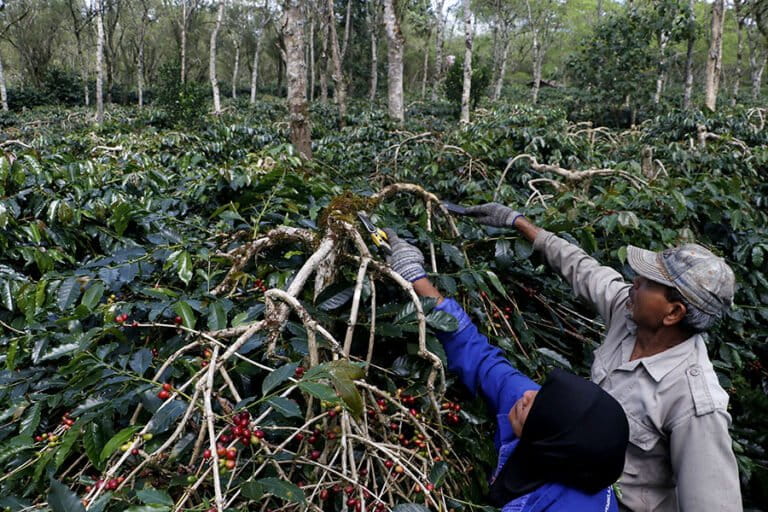
A critical, often overlooked aspect of this industry is the role of women. Approximately 70% of the labor in the global coffee sector is provided by women, who handle everything from planting and weeding to the meticulous task of hand-picking ripe cherries. Despite their central role in production, women face systemic inequality; only about 20% to 30% of women have the opportunity to own or lead coffee plantations.
As climate change drives down yields and increases the cost of cultivation, it is these vulnerable groups who bear the brunt of the economic shock. When a harvest fails, the loss of income often leads to food insecurity and the inability to pay for education or healthcare. The gender gap in land ownership and financial access means that women farmers have fewer resources to invest in climate-adaptation technologies, such as irrigation systems or shade-grown canopy trees, creating a cycle of vulnerability.
Human Narratives: From the Farm to the Cafe
The statistics are reflected in the lived experiences of individuals across the supply chain. Agus, a coffee farmer in Enrekang, reports that his recent harvests have dropped by as much as 50%. For a smallholder farmer, such a decline is catastrophic, often meaning the difference between solvency and debt. Similarly, Nursam Arifuddin, who specializes in Robusta, notes that the traditional "calendar" of farming has been rendered obsolete. In the past, farmers could predict the onset of the rainy season with near-certainty, allowing them to time their pruning and fertilizing perfectly. Now, the weather is erratic, with "dry" months seeing torrential downpours and "wet" seasons experiencing prolonged heatwaves.
This volatility at the source creates a ripple effect that reaches the urban consumer. Agil Valentino, the owner of a specialty coffee shop in Makassar, has begun to feel the squeeze. He notes that obtaining a consistent supply of Enrekang beans—a favorite among his regular clientele—has become increasingly difficult. As productivity drops, competition for the remaining high-quality beans intensifies, driving up prices at the wholesale level. While the consumer might pay an extra dollar for their latte, the farmer rarely sees a proportional increase in their earnings.
The Market Paradox: Falling Supply vs. Rising Demand
The global coffee market is currently defined by a stark and unsustainable paradox. Data from the International Coffee Organization (ICO) shows that global coffee production has dipped by about 1.7% since 2020. Simultaneously, global demand for coffee is not slowing down; consumption is growing at a rate of 2% to 2.5% annually, driven by a burgeoning middle class in Asia and a continued passion for specialty brews in the West.
Despite this high demand, the economic structure of the industry remains skewed against the producer. Approximately 25 million smallholder farmers are responsible for 80% of the world’s coffee production. Yet, many of these farmers are living in "coffee poverty." In many regions, the price for half a kilogram of raw coffee beans remains below one US dollar. When adjusted for the rising costs of fertilizer, labor, and climate-mitigation efforts, many farmers are actually losing money. This economic reality is driving the younger generation away from the fields and toward cities, leading to an "aging farmer" crisis that further threatens the long-term viability of the industry.
Analysis of Implications and the Path Forward
The convergence of climate instability and economic inequity suggests that the coffee industry is approaching a breaking point. If current trends continue, coffee may shift from a daily commodity to a luxury item, accessible only to the wealthy, as production becomes increasingly localized to a few remaining viable "micro-climates."
To avert this future, a multi-pronged approach is required:
- Investment in R&D: There is an urgent need for the development of "Climate-Smart Coffee." This involves breeding varieties that are not only heat-tolerant but also resistant to the specific pests and diseases that thrive in a warmer world.
- Agroforestry and Biodiversity: Moving away from monoculture toward agroforestry—where coffee is grown under a canopy of diverse trees—can help regulate local temperatures, retain soil moisture, and provide farmers with alternative sources of income (such as fruit or timber).
- Fairer Pricing Mechanisms: The industry must move toward a model where the "climate risk" is shared across the supply chain. Consumers and roasters may need to pay more to ensure that farmers have the capital necessary to implement adaptation strategies.
- Policy Intervention: Governments in producing nations like Indonesia must prioritize infrastructure, such as improved water management systems and weather-forecasting technology tailored for smallholders.
The story of coffee in the age of climate change is a cautionary tale for all of global agriculture. It highlights how a beloved global commodity, rooted in centuries of tradition, can be destabilized by the invisible hand of atmospheric carbon. As the world warms, the "bitter" notes in our morning cup may soon have less to do with the roast and more to do with the struggle of the millions of people fighting to keep the industry alive. The transition from 2021 to 2023 has shown that the crisis is no longer a distant threat—it is a present-day emergency that requires immediate, systemic change.