Nila Kartika Wati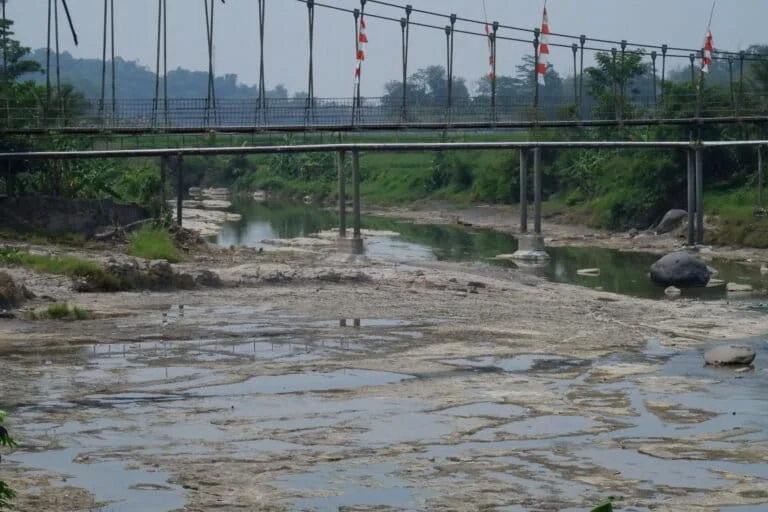
The once-thriving river systems of Bogor, West Java, are currently facing an unprecedented hydrological collapse. Major arteries such as the Ciliwung, Cipamingkis, and Ciherang rivers have seen their water levels plummet to critical lows, with some sections completely drying up. This crisis is not merely a seasonal phenomenon but a stark manifestation of long-term ecological degradation that now threatens the water security of millions of residents in the Greater Jakarta area, or Jabodetabek. As the region grapples with the dual pressures of a prolonged El Niño-induced drought and decades of unsustainable land-use changes, the fragility of Indonesia’s water management system has been laid bare.
The Human Cost of Vanishing Waterways
For residents like Rosmiati, a resident of Kampung Katulampa, the drought has transformed daily life into a logistical struggle. With local groundwater levels receding, domestic wells have failed, forcing her to rely on the diminished flow of the Kali Baru—an irrigation channel fed by the Ciliwung River—to meet the basic sanitary needs of her family. Her story is mirrored across the region, where households are increasingly reliant on manually transporting water via plastic containers for laundry, cleaning, and basic hygiene.
The severity of the situation is quantified by the state of the Katulampa Dam, a critical water monitoring station for the region. In recent weeks, the water level at the dam has repeatedly touched zero centimeters, marking a historic low that underscores the cessation of natural flow. Similar conditions are reported in Pulo Geulis, where the riverbeds have become barren landscapes of stone and debris. The impact extends directly to public utility services, most notably the Perumda Tirta Pakuan, which manages the water supply for over 35,000 customers in North and East Bogor. The Katulampa Water Treatment Plant, typically capable of processing 307.14 liters of water per second, is operating at a fraction of its capacity, leaving tens of thousands of households in a state of chronic water insecurity.
A Chronology of Ecological Decline
While the current drought has been exacerbated by the El Niño weather pattern, experts argue that the crisis is the culmination of a decade-long trajectory of environmental mismanagement. The timeline of this disaster dates back to the early 2000s, characterized by rapid urbanization and the conversion of upstream forested areas into high-density residential and commercial zones.
By 2015, environmental monitoring groups began documenting a steady decline in the base flow of the Ciliwung River, correlating with the rapid development of the Puncak area. The period from 2019 to 2023 saw a marked increase in the frequency of "zero-flow" days at the Katulampa gate during the dry season. This year, the onset of the dry season was sharper and more persistent, leading to the current state of emergency where even auxiliary water sources like the Cipamingkis and Ciherang rivers are failing. In Sukamakmur, the flow of the Cipamingkis has been diverted entirely into emergency irrigation channels to prevent the complete loss of local agricultural yields, leaving the main riverbed dry.
The Science Behind the Drought
The current water crisis is a complex interplay between meteorological phenomena and anthropogenic factors. Meteorologically, the extended dry spell is driven by the positive Indian Ocean Dipole and El Niño, which have suppressed rainfall across Java. However, climatologists emphasize that the lack of rain is only the trigger, not the underlying cause.
The primary driver of the current crisis is the degradation of the "catchment area." In a healthy ecosystem, forests act as sponges, absorbing rainfall and releasing it slowly into the soil, which in turn feeds the groundwater and maintains river flow during the dry season. In the Bogor region, the transformation of these sponges into concrete surfaces—due to villas, hotels, and urban sprawl—has drastically reduced the infiltration capacity of the soil. When it rains, the water is lost to surface runoff, causing flash floods during the wet season and leaving the rivers parched during the dry season.
Analytical Perspective: The Groundwater Trap
A significant concern for urban planners and environmentalists is the "groundwater trap." As surface water sources dry up, both residents and industrial players increasingly turn to deep-well extraction. This practice is unsustainable. Over-extraction of groundwater leads to land subsidence—the gradual sinking of the earth’s surface—and the irreversible destruction of aquifers.

Wahyu Eka Styawan, a campaigner for Urban Justice at the National WALHI (Friends of the Earth Indonesia), posits that the current drought is merely a diagnostic tool that reveals a pre-existing chronic condition. "We have treated our rivers as isolated, infinite pipes," says Styawan. "We fail to acknowledge that the health of these waterways is entirely dependent on the integrity of the upstream catchments. By allowing land-use violations and the destruction of protected forest zones, we have effectively dismantled the natural plumbing system of the region."
Official Responses and Mitigation Strategies
In response to the crisis, local governments have deployed water tanker trucks to provide emergency relief to the most severely affected neighborhoods. While this provides a temporary lifeline, it is widely recognized by policymakers and civil society alike as a "band-aid solution" that fails to address the structural deficiencies of water governance.
The regional administration faces immense pressure to implement a comprehensive, long-term water security strategy. Key recommendations from environmental stakeholders include:
- Enforcement of Zoning Laws: Immediate cessation of illegal construction in protected upland zones and the demolition of structures that violate environmental buffer zones near riverbanks.
- Reforestation and Bio-engineering: Large-scale restoration of vegetation in the Puncak and surrounding highlands to increase the water-retention capacity of the soil.
- Regulation of Groundwater: Stricter permitting and monitoring for deep-well extraction, particularly by large commercial enterprises, to prevent further depletion of the water table.
- Waste Management Reform: With lower water levels, the concentration of pollutants from domestic and industrial waste has reached toxic levels. Enhanced monitoring and stricter enforcement of waste disposal regulations are essential to prevent the contamination of the remaining water supply.
Implications for Jabodetabek
The water crisis in Bogor is a precursor to a larger regional emergency. Since the Ciliwung River serves as a primary source of water for the capital city of Jakarta, the depletion of upstream resources threatens to paralyze critical infrastructure, industries, and the daily lives of millions. If the current trajectory of land-use change continues, the reliability of the public water supply will continue to oscillate between catastrophic flooding and extreme scarcity.
Furthermore, the economic implications are profound. Agriculture in the outskirts of Bogor is already suffering, with rice paddies showing signs of yellowing and soil cracking—a precursor to crop failure that threatens local food security. As water costs rise and availability falls, the cost of living for low-income residents is expected to climb, potentially deepening existing socio-economic inequalities.
Conclusion: A Call for Proactive Governance
The message from experts and affected citizens is unequivocal: the crisis of water scarcity is not a matter of "if" but "how much." The prevailing approach of reacting to drought through emergency distribution must be replaced by a proactive strategy that prioritizes the conservation of water sources before they disappear.
"We cannot wait until the rivers are empty to care about the environment," says Styawan. The restoration of the Bogor catchment area is a national priority that requires inter-regional cooperation between the Bogor Regency, the City of Bogor, and the Provincial Government of West Java, in coordination with the central government. Without a radical shift in how the region balances economic development with ecological limits, the current drought will serve as the opening chapter of a much more permanent and devastating water crisis for the millions who rely on these rivers for their survival.
The drying of the Ciliwung is not just an environmental headline; it is a warning. The infrastructure of the past is failing to meet the demands of a changing climate and a growing population. Whether authorities will take the necessary steps to preserve these vital resources remains the defining question for the future of the Jabodetabek region.