Nila Kartika Wati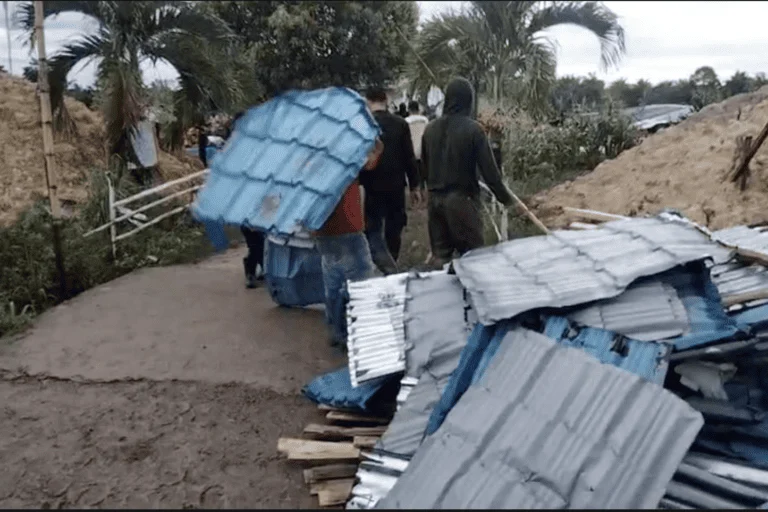
The long-standing agrarian dispute in Padang Halaban, North Labuhanbatu Regency, North Sumatra, reached a violent tipping point on Thursday, April 9, 2026, as a forced eviction operation led by security personnel and plantation workers resulted in multiple injuries and the alleged kidnapping of two local farmers. The confrontation involved PT Sinar Mas Agro Resources and Technology (SMART) and the Padang Halaban Farmers Group (KTPH), a community of residents who have inhabited and cultivated the land for several decades. The incident has drawn sharp criticism from human rights organizations and government bodies, highlighting the persistent volatility of land tenure issues in Indonesia’s plantation sector.
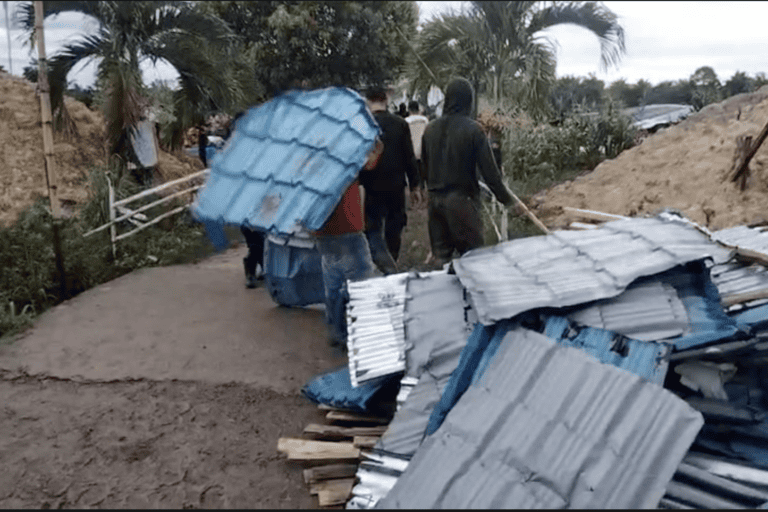
The escalation began at approximately 08:00 AM local time when hundreds of security guards and plantation laborers entered the residential area where farmers had recently rebuilt their modest dwellings. According to eyewitness accounts, the arrival of the enforcement team was sudden, catching many families off guard. Children and elderly residents were reportedly still asleep when the walls of their homes were forcibly dismantled. The sound of collapsing structures triggered a panic, with children fleeing into the surrounding fields in tears.
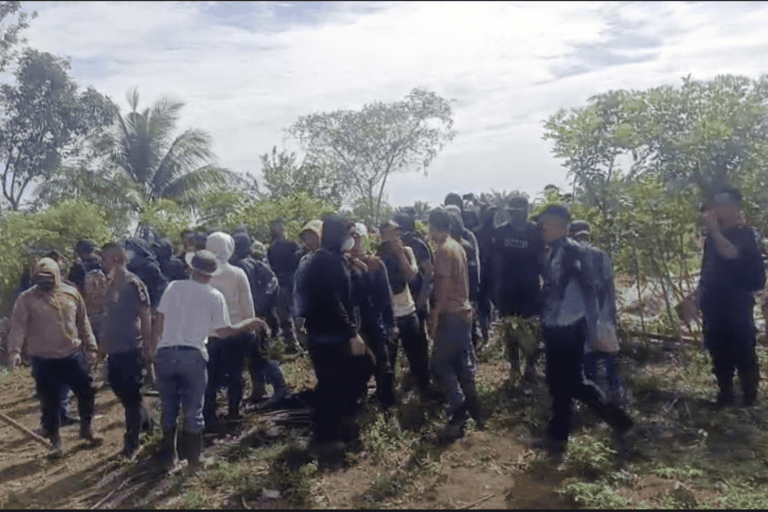
Resistance from the farmers led to a tense standoff in front of the remaining huts. What began as a verbal altercation quickly devolved into physical violence. Farmers reported being shoved, kicked, and struck in the face, abdomen, and back as they attempted to form a human shield to protect their property. The clash lasted roughly 45 minutes, during which the security forces successfully overwhelmed the farmers’ defenses and demolished the settlement.
The Disappearance and Discovery of Harry Prantoko and Benny Kumala
In the immediate aftermath of the violence, the community realized that two of their members, Harry Prantoko and Benny Kumala, were missing. The Indonesian Association of Families of the Disappeared (IKOHI) for North Sumatra began documenting the casualties, noting that at least 12 farmers—the majority of whom were women—sustained physical injuries. However, the whereabouts of Prantoko and Kumala remained unknown for several hours, leading to fears of extrajudicial abduction.
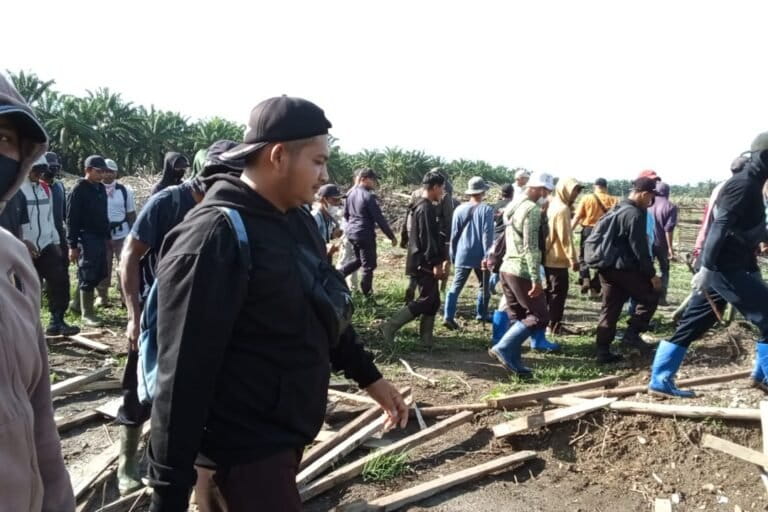
Witnesses reported seeing security personnel dragging the two men away while subjecting them to physical assault. Suardi, the Chairman of IKOHI North Sumatra, characterized the incident as a serious legal violation. Following the confrontation, KTPH members and local residents organized search parties, scouring the surrounding villages and major transit routes across North Labuhanbatu and Labuhanbatu Selatan, extending their search toward the Riau border and the Trans-Sumatra Highway toward Medan.
The search ended late Thursday evening at the Labuhanbatu Police Station. Farmers who had gone to the station to file criminal reports regarding the assault discovered that Prantoko and Kumala were being held in custody. Observers described the two men as appearing traumatized, with visible bruising and swelling on their faces and torn clothing. The circumstances of their transfer from company security to police custody remain a subject of intense scrutiny, with advocates demanding a transparent investigation into the legality of their detention.
Historical Context and the 83-Hectare Dispute
The roots of the Padang Halaban conflict stretch back decades, centering on a contested 83-hectare plot of land. The farmers of KTPH maintain that they have a legitimate right to the land, while PT SMART claims the area falls within its Right to Cultivate (HGU) concession. This specific friction point has been the subject of numerous mediation attempts and government interventions that have largely failed to produce a lasting resolution.
In 2014, the National Commission on Human Rights (Komnas HAM) issued a formal recommendation suggesting that the concession be revised to exclude the 83 hectares occupied by the farmers. This recommendation was intended to provide a "win-win" solution that would respect the community’s livelihood while allowing the company to continue its operations elsewhere. However, Saurlin Siagian, a Commissioner at Komnas HAM, noted that the recommendation was largely ignored by the relevant authorities and the corporation.
Adding another layer of legal complexity is the status of PT SMART’s land permits. Data cited by the North Sumatra regional office of the Ministry of Human Rights indicates that the company’s HGU for the area may have expired on April 20, 2024. If verified, this would raise significant questions regarding the company’s authority to conduct enforcement actions on the land. During the eviction, Yusrizal, a member of KTPH, reported that company representatives shouted that the farmers had no legal standing and that Commission XIII of the House of Representatives (DPR) had not ruled in their favor.
Corporate Defense and the Legal Standpoint of PT SMART
In response to the allegations of violence and kidnapping, PT SMART has maintained that its actions were grounded in legal precedent. Ananta Wisesa, Head of Corporate Communications for Sinar Mas Agribusiness and Food, stated that a Supreme Court decision with permanent legal force (inkracht) affirmed that the land occupied by KTPH is part of the company’s valid concession.
Wisesa emphasized that the company had attempted persuasive measures prior to the eviction, including the offering of "tali asih" (compassionate payments) to encourage residents to vacate the land voluntarily. He further asserted that the company operates under strict Standard Operating Procedures (SOPs) that prohibit the use of weapons or repressive tactics during asset security operations.
"Any individual found violating these protocols faces severe sanctions, including termination of employment," Wisesa said. Regarding the injuries and the detention of the two farmers, the company suggested that the presence of a large crowd made it difficult to identify the perpetrators of violence. Wisesa denied that a "kidnapping" took place, suggesting instead that the matter was now in the hands of law enforcement for proper investigation. He maintained that the company’s internal findings did not indicate that their workers were responsible for the reported physical abuse.
Human Rights Implications and Government Reaction
The incident has triggered a response from the newly established Ministry of Human Rights. Flora Nainggolan, Head of the Ministry’s North Sumatra Regional Office, issued a formal letter (Number KWH.2-HA.01.03-1163) seeking clarification from both PT SMART and the Labuhanbatu Police. The Ministry’s inquiry focuses on two primary concerns: the reported physical violence and the status of the 83-hectare land claim in light of the alleged HGU expiration.
Human rights advocates argue that the state’s failure to resolve the dispute constitutes a "violation by omission." Suardi of IKOHI pointed out that under the United Nations Guiding Principles on Business and Human Rights (UNGPs), corporations have a responsibility to respect human rights, while the state has a duty to protect citizens from abuses by third parties.
"Human rights violations are not just about direct actions; allowing a horizontal conflict to persist without resolution is a form of omission," Suardi explained. He called on the government to ensure that the rule of law is applied equally to both corporate entities and marginalized farmers.
Komnas HAM has expressed similar frustrations. Saurlin Siagian condemned the violence and announced that the commission is conducting a deep-dive investigation into the latest developments. He warned that if the 2014 recommendations had been followed, the current crisis could have been avoided. The commission plans to summon representatives from PT SMART for further questioning.
Broader Implications for Agrarian Reform in Indonesia
The Padang Halaban case is emblematic of a broader trend of agrarian conflict in Indonesia, particularly in North Sumatra, which remains a hotspot for land disputes between communities and large-scale plantation companies. According to data from the Consortium for Agrarian Reform (KPA), North Sumatra consistently ranks among the provinces with the highest number of land conflicts and victims of criminalization.
These conflicts often stem from overlapping land claims, lack of transparency in the issuance of HGU permits, and the slow implementation of the government’s agrarian reform agenda. While President Joko Widodo’s administration made agrarian reform a cornerstone of its domestic policy, critics argue that the focus has remained largely on land titling (giving certificates to existing owners) rather than land redistribution (resolving structural inequality and contested claims).
The silence of key officials, such as the Minister of Agrarian Affairs and Spatial Planning (ATR/BPN) and the Labuhanbatu Police Chief, following the April 9 incident, highlights the difficulty farmers face in seeking institutional protection. The lack of a clear response regarding the expiration of the HGU further complicates the situation, as legal uncertainty often provides a vacuum in which physical force becomes the primary tool for land control.
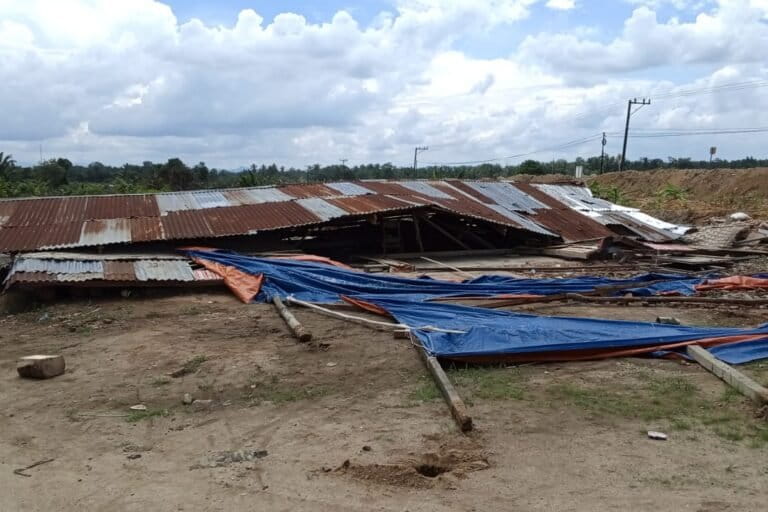
As the legal proceedings for Harry Prantoko and Benny Kumala continue, the community in Padang Halaban remains in a state of precariousness. With their homes destroyed and the threat of further enforcement actions looming, the case serves as a stark reminder of the human cost of unresolved land disputes. The involvement of the Ministry of Human Rights and Komnas HAM may offer a path toward accountability, but for the farmers of North Labuhanbatu, the struggle for land remains a struggle for survival.