Nila Kartika Wati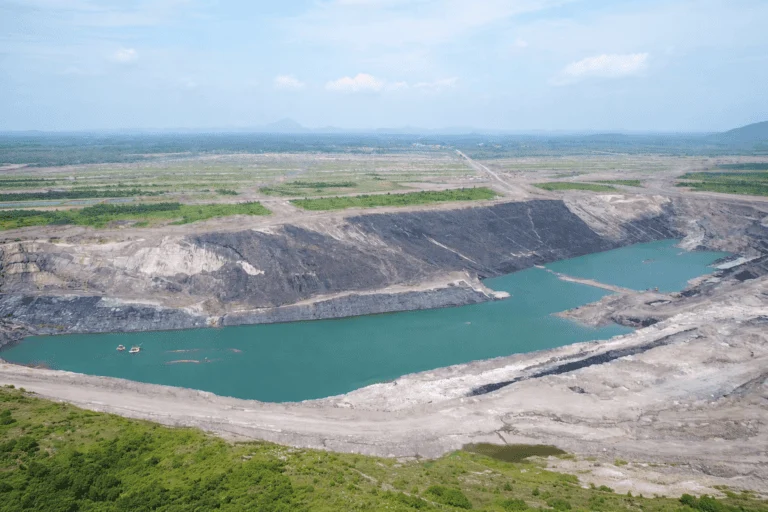
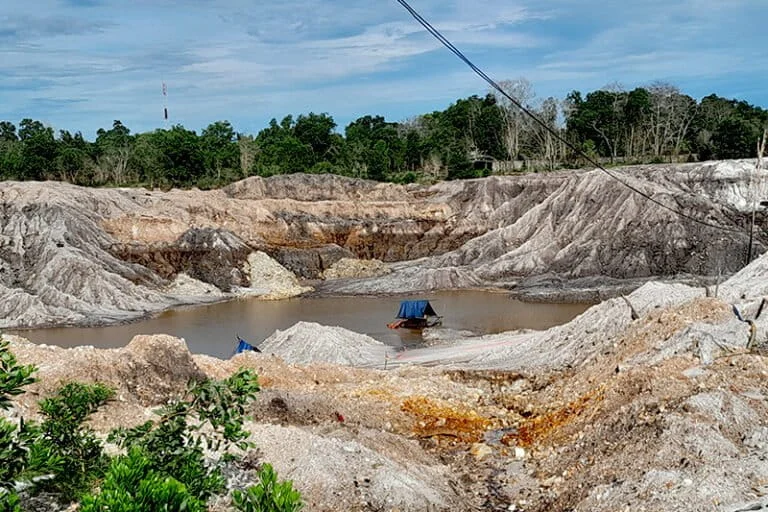
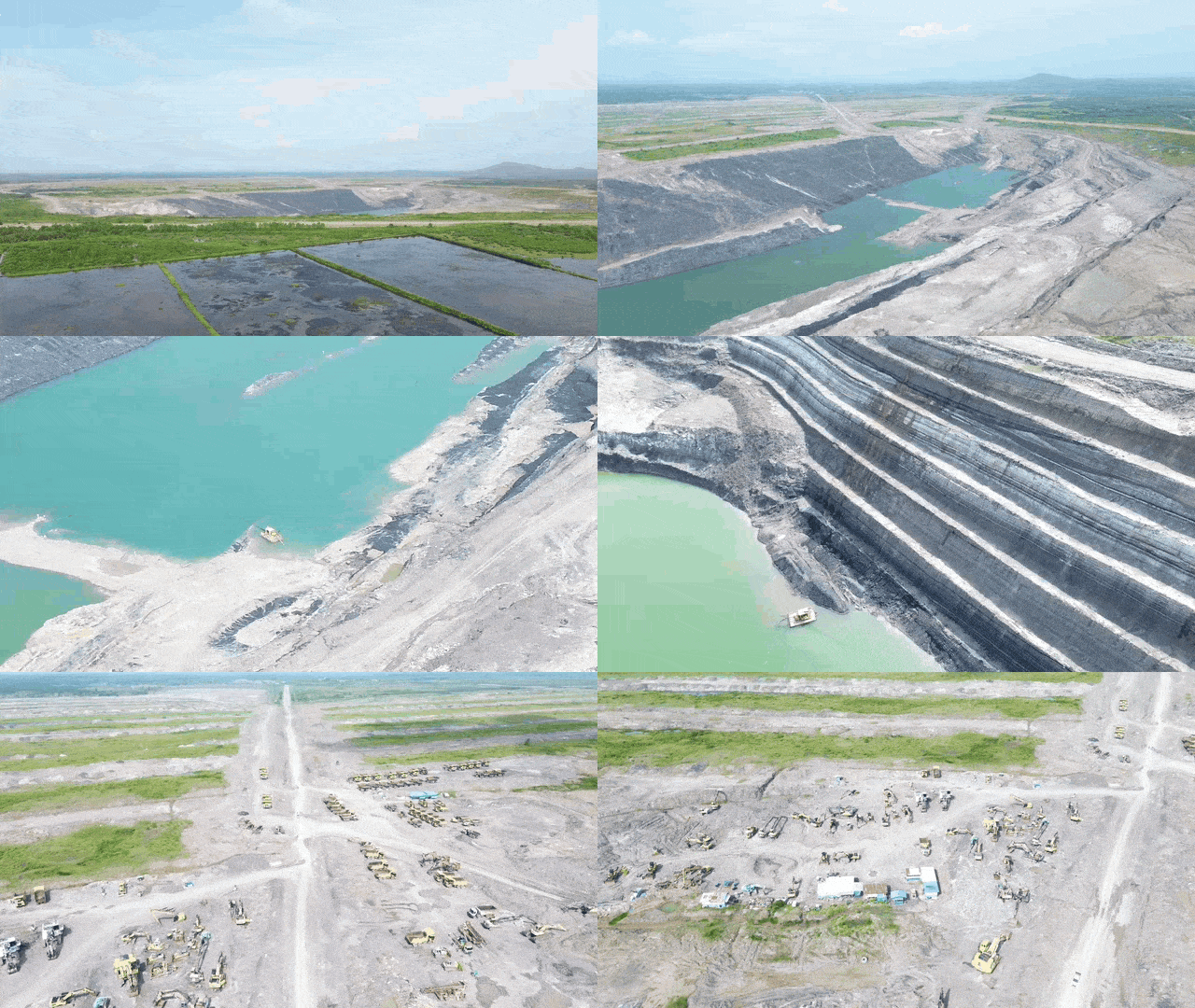
Chandra, a resident of Rawa Indah in Bekambit Village, Kotabaru Regency, South Kalimantan, recently stood at the edge of a massive coal mining pit that, according to official satellite imagery, should not exist. Located at coordinates -3.510633, 116.239397, the site was once designated as a brackish water fish pond and agricultural land for transmigrant families. However, drone footage captured in mid-March 2026 reveals a starkly different reality: a multi-layered excavation site operated by PT Sebuku Sejaka Coal (SSC) that has effectively swallowed the landscape.
The discovery has sent shockwaves through the local community, many of whom hold valid Land Ownership Certificates (SHM) for the area. The dispute highlights a profound systemic failure in land management and corporate oversight in South Kalimantan, where the interests of heavy industry frequently collide with the legal rights of small-scale farmers and transmigrants. As of early 2026, the Ministry of Energy and Mineral Resources (ESDM) has officially frozen PT SSC’s mining permits, citing the unresolved land disputes, leaving hundreds of pieces of heavy machinery idle around the yawning pits.
A Legacy of Land Rights and Unilateral Revocations
The roots of the conflict trace back to the late 1980s, when the Indonesian government settled families in the Rawa Indah area as part of the national transmigration program. These families were granted three types of land: a residential plot (pekarangan), "Lahan Usaha I" (primary agricultural land), and "Lahan Usaha II" (secondary land for long-term economic support). For decades, these plots were the backbone of the local economy, supporting aquaculture and palm oil cultivation.
The legal "entanglement," as local activists describe it, began to tighten in 2019. Reports indicate that the Regional Office of the National Land Agency (ATR/BPN) in South Kalimantan unilaterally revoked the land rights of several transmigrants. This administrative move cleared a path for mining concessions to overlap with private property. Despite this, many residents like Chandra continued to hold their 2020 land management documents from the Department of Manpower and Transmigration, which clearly showed their plots located within the Land Use Rights (HPL) zone.
Suherman, another transmigrant descendant, recounted seeing eight dump trucks parked directly on land inherited from his grandfather. He noted that dozens of other pieces of heavy equipment were stationed across neighbors’ plots. "The heirs have never received a single cent in compensation, yet the land has already been converted into a company parking lot and hauling road," Suherman stated. His observations are supported by data from the BUMI ATR/BPN application, a digital land monitoring tool. Interestingly, on April 5, 2026, Suherman noticed that several community land parcels began reappearing on the digital map, while the mining concession boundaries that previously dominated the Bekambit administrative area seemed to vanish from the system, suggesting a potential, albeit unconfirmed, restoration of community rights.
Environmental Degradation and Forest Loss
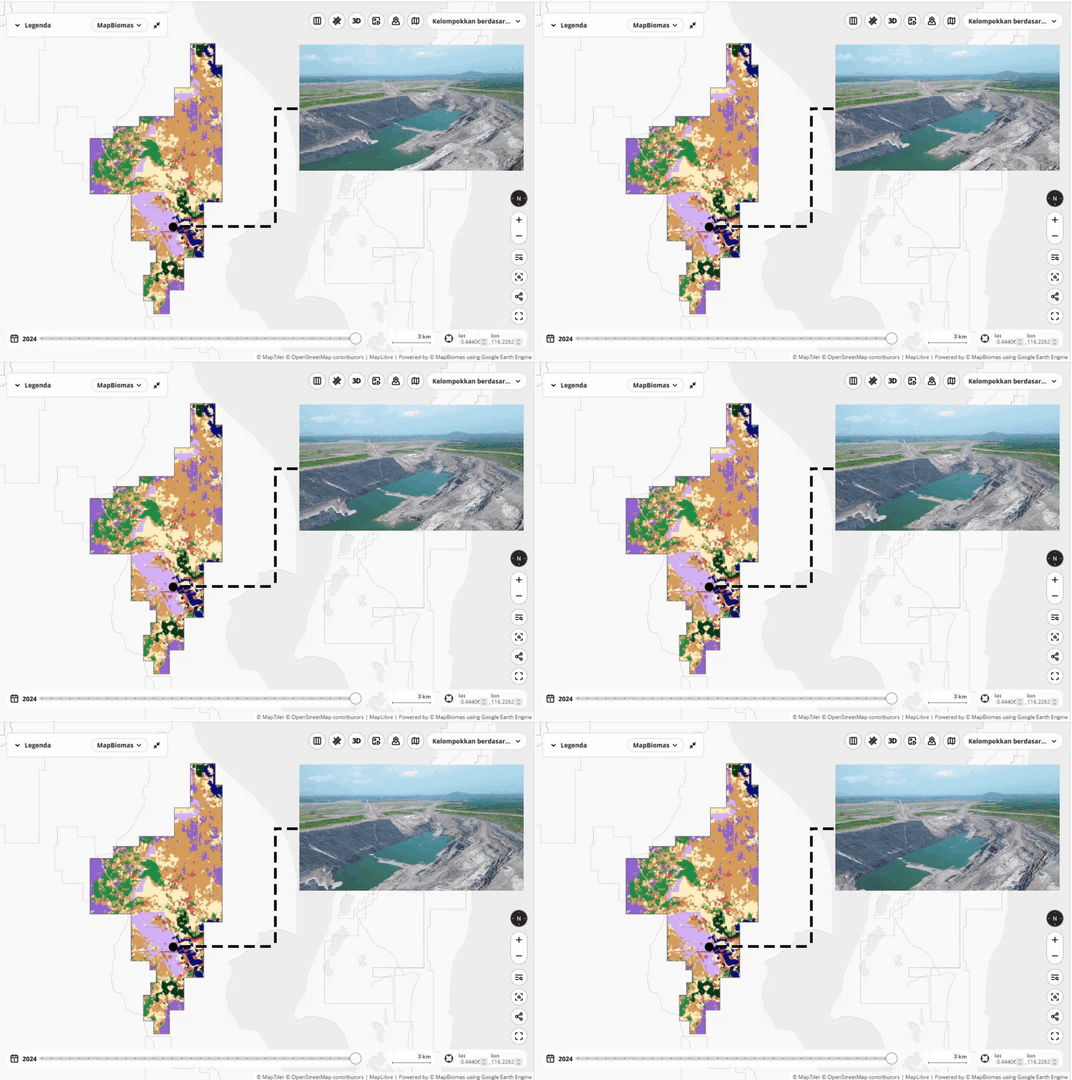
The environmental cost of the mining operation is as significant as the legal one. Data analyzed from Nusantara Atlas and MapBiomas Indonesia illustrates a rapid transformation of the Kotabaru landscape. In 2024, the area within the mining concession still retained significant forest cover, totaling approximately 1,095.7 hectares. This included 833.02 hectares of inland forest and 262.68 hectares of vital mangrove ecosystems.
By early 2026, the forest cover had plummeted to just 559 hectares. The loss of nearly 50% of the forest in just two years highlights the aggressive pace of PT SSC’s expansion. Mangroves, which provide a critical buffer against coastal erosion and serve as nurseries for the fish and shrimp that transmigrants once farmed, have been particularly hard hit. Satellite analysis confirms that the "fish ponds" visible on Google Maps have been replaced by the tiered, grey terraces of open-pit coal mines.
Raden Rafiq, Executive Director of Walhi (Friends of the Earth) South Kalimantan, described the situation as a "failure of the state" to protect its citizens. "The government, which should provide a sense of security and justice, instead appears to be facilitating corporate interests," Rafiq said. He emphasized that while the government has made verbal statements about returning land certificates to the people of Bekambit, no concrete Decree (SK) has been issued to provide legal certainty.
The Corporate Web: PT SSC and the Sebuku Coal Group
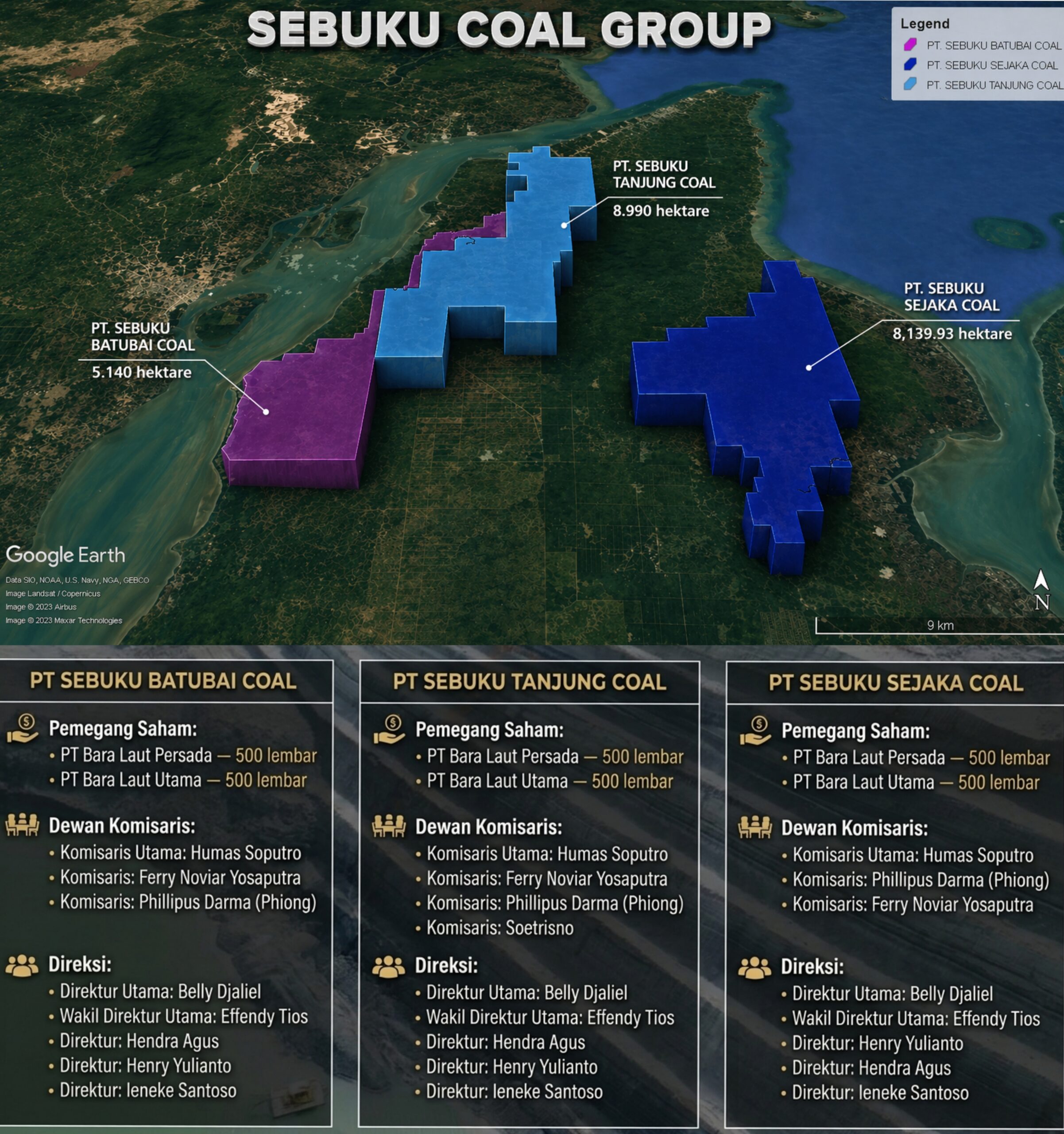
PT Sebuku Sejaka Coal is not an isolated entity; it is part of the larger Sebuku Coal Group (SCG), a conglomerate with deep ties to Indonesia’s industrial and political elite. The company’s coal concession in Kotabaru covers roughly 8,139 hectares, an area that partially overlaps with iron ore mining permits held by PT Banjar Asri.
A deep dive into the company’s legal documents (AHU) reveals a roster of "Politically Exposed Persons" (PEPs) and veteran industry figures. Among the key names is Effendy Tios, the CEO of the SILO Group (Sebuku Iron Lateritic Ores). Tios has been a dominant figure in South Kalimantan mining since 2004, managing thousands of hectares of iron ore concessions on Sebuku Island.
The company’s leadership also includes individuals linked to major Indonesian conglomerates and past legal controversies. For instance:
- Phiong Phillipus Darma: A senior executive from the Salim Group, one of Indonesia’s largest diversified conglomerates. He has served on the steering committee of various coal entities, including PT Ithaca Resources.
- Belly Djaliel: The current President Director, who is also a high-ranking executive within the Agung Sedayu Group, a major real estate developer. Djaliel’s name has previously surfaced in land disputes in Tangerang involving "Pagar Laut" (sea wall) projects.
- Soenarko Mohammad Dashar: A retired Major General and former commander of the Indonesian Army’s Special Forces (Kopassus), who previously served as the company’s President Director.
The involvement of such high-profile figures suggests that PT SSC possesses significant political capital, which activists argue makes it difficult for local residents to seek redress through standard legal channels. Furthermore, some former executives have been linked to broader national scandals. I Putu Gede Semadiyasa, a former commissioner, was also a commissioner at Millennium Capital Management, a firm entangled in the massive Jiwasraya and Asabri corruption cases that resulted in trillions of rupiah in state losses.
A Pattern of Conflict and Regulatory Friction
The dispute in Rawa Indah is part of a broader pattern of conflict involving the Sebuku Coal Group. A sister company, PT Sebuku Tanjung Coal (STC), is currently embroiled in an agrarian dispute in North Pulau Laut and Central Pulau Laut. In February 2026, a local farmer named Yoni Gunawan accused STC of destroying 350,000 porang (elephant yam) plants across 2.5 hectares of land without adequate compensation.
This is not the first time the group has faced regulatory pushback. During the administration of President Susilo Bambang Yudhoyono, the government investigated the permits of five related companies. Three permits, including those for PT Banjar Asri, were eventually revoked. More recently, the group faced a major setback when the Governor of South Kalimantan, Sahbirin Noor, revoked several mining permits following a land dispute with PT Multi Sarana Agro Mandiri (MSAM), a company owned by the influential tycoon Haji Isam.
Hilmy Abdullah, the CSR representative for PT SSC, stated that the company has chosen to halt operations following the ESDM’s decision to freeze their permits. "The impact of this freeze is substantial because there is no revenue coming in," Abdullah admitted. He maintained that the company is willing to follow government instructions and is open to community demands, provided they are based on clear ownership documentation. Abdullah claimed that land acquisition had been ongoing since 2020, and while some residents accepted compensation, others refused due to discrepancies in land valuation and a lack of formal SHM documents.
Implications and the Path Forward
The situation in Kotabaru serves as a litmus test for Indonesia’s commitment to agrarian reform and environmental protection. The Ministry of ATR/BPN, led by Minister Nusron Wahid, has been under pressure to resolve the "sengkarut" (mess) of overlapping permits. However, as of late April 2026, the Minister has not provided a public response to the specific allegations regarding the Rawa Indah transmigrant lands.
The implications of this conflict are three-fold:
- Legal Precedent: If PT SSC is allowed to continue mining on certified transmigrant land, it undermines the sanctity of the SHM (Sertifikat Hak Milik), the highest form of land ownership in Indonesia.
- Economic Displacement: The conversion of agricultural and aquaculture land into mining pits creates a "resource curse" for local communities, where the immediate wealth of coal extraction does not trickle down to those who lost their livelihoods.
- Environmental Irreversibility: Once mangroves are cleared and deep pits are excavated, the land cannot easily be returned to its former agricultural productivity. The "reclamation" promised by mining companies often falls short of restoring complex ecosystems.
For the residents of Rawa Indah, the fight is for more than just compensation; it is for the restoration of their history and their space. As Chandra and Suherman continue to monitor the BUMI application, they represent a new generation of "digital activists" using technology to hold powerful corporate interests accountable. Whether the government will follow through with formal decrees to return their land remains the defining question for the future of Bekambit Village.