Nila Kartika Wati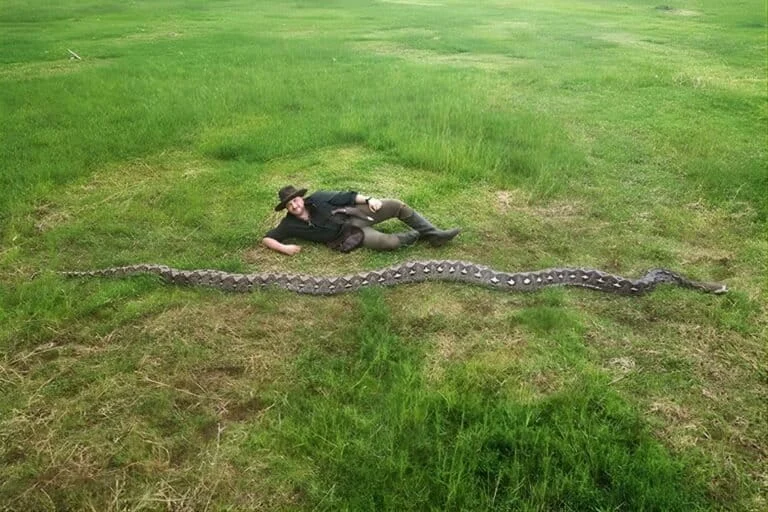
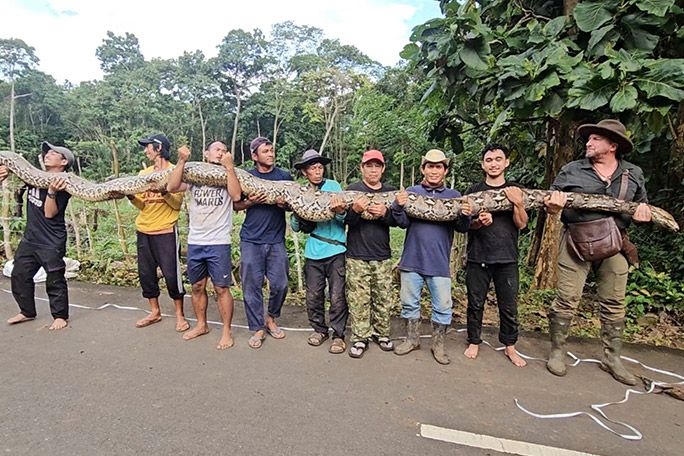
The natural world has a new reigning titan among its reptilian inhabitants as Guinness World Records officially confirmed on January 18, 2026, that a female reticulated python (Malayopython reticulatus) from Maros, South Sulawesi, has broken the world record for the longest wild snake ever scientifically measured. Named "Ibu Baron" by her caretakers, the colossal serpent reached a verified length of 7.22 meters (approximately 23 feet and 8 inches). This measurement, taken from the tip of the snout to the end of the tail using a standard survey measuring tape, places the snake in an elite category of megafauna. To provide a relatable scale for the general public, Ibu Baron’s length is a mere 10 centimeters shy of the width of a standard FIFA-regulated football goal, which stands at 7.32 meters.
The certification of this record marks a significant milestone in herpetology, as verified measurements of wild snakes exceeding seven meters are exceptionally rare. While anecdotal reports of "monster snakes" frequently circulate in rural regions of Southeast Asia, scientific validation requires rigorous protocols that few specimens meet. Ibu Baron’s entry into the record books provides researchers with concrete data on the upper limits of modern reptilian growth in the wild.
Rigorous Measurement Protocols and Physical Condition
The process of measuring Ibu Baron was a feat of both scientific precision and physical endurance. According to the strict protocols mandated by Guinness World Records, the snake had to be measured while conscious. The organization’s guidelines prohibit the use of anesthesia for record-breaking measurements unless required for urgent medical reasons or the immediate safety of the animal, ensuring that the dimensions recorded are as natural as possible.
Experts involved in the process noted that measuring a conscious python of this magnitude presents unique challenges. A snake’s body is highly elastic; when fully relaxed or under anesthesia, the vertebrae can stretch slightly, potentially increasing the total length by up to 10 percent. Because Ibu Baron was measured while alert and muscularly active, the 7.22-meter figure is considered a conservative "active" length.
At the time of the official weighing, Ibu Baron tipped the scales at 96.5 kilograms (212.7 pounds). It is important to note that this weight was recorded while the snake was in a post-digestive state, meaning her stomach was empty. Herpetologists estimate that after consuming a large prey item—such as a wild boar or a deer—her body mass could easily fluctuate by an additional 20 to 30 kilograms, pushing her total weight well beyond the 100-kilogram mark. Such dramatic shifts in mass are a hallmark of the reticulated python’s biology, allowing them to survive for months on a single massive meal.
The Rescue and Conservation Effort
The story of Ibu Baron’s rise to international fame began with a potential tragedy. She was discovered near a settlement in Maros, South Sulawesi, an area where human-wildlife conflict is an escalating concern. In many parts of Indonesia, large pythons found near villages are often killed out of fear for the safety of livestock and children. However, the intervention of Budi Purwanto, a local conservationist, ensured a different outcome.
Purwanto orchestrated a rapid evacuation of the snake to prevent a lethal confrontation with the local community. Recognizing the extraordinary size of the specimen, he contacted specialized wildlife handlers to conduct a formal assessment. The measurement team was led by Diaz Nugraha, a licensed wildlife rescuer and guide based in Kalimantan, and Radu Frentiu, an explorer and wildlife photographer residing in Bali. The duo traveled to Sulawesi specifically to document the snake after receiving reports of its extreme dimensions.
Currently, Ibu Baron remains under the professional care of Budi Purwanto in Maros. Her presence has become a focal point for local conservation education, illustrating the importance of relocating apex predators rather than exterminating them. The successful rescue and subsequent record-breaking verification highlight a growing shift in how local communities and conservationists manage encounters with Indonesia’s "megasnakes."
Biological Profile of the Reticulated Python
The reticulated python holds the title of the world’s longest snake species, native to the rainforests and woodlands of Southeast Asia. Their range is vast, spanning from the Nicobar Islands and Northeast India through the entirety of the Indonesian archipelago and the Philippines. Unlike the Green Anaconda of South America, which is typically heavier and thicker, the reticulated python is characterized by its incredible length and intricate, net-like (reticulated) skin patterns that provide camouflage on the forest floor.
In the wild, adult reticulated pythons generally average between 3 and 6 meters in length. Ibu Baron’s 7.22-meter stature places her in the extreme upper percentile of the species. Sexual dimorphism plays a significant role in these dimensions; females are almost always larger than males. This size advantage is an evolutionary necessity, as larger females can carry more eggs, thereby increasing the reproductive success of the lineage.
As non-venomous constrictors, these snakes rely on immense muscular power to subdue prey. They are ambush predators, often waiting near water sources or animal trails. Once a strike is initiated, the python wraps its body around the victim, exerting pressure that collapses the circulatory system and causes rapid heart failure in the prey. While they rarely view humans as prey, their size makes them formidable and potentially dangerous if provoked or if they feel threatened.
Historical Context: A Record 27 Years in the Making
The verification of Ibu Baron’s length brings an end to a long-standing record. Prior to this event, the longest wild snake ever scientifically measured was another reticulated python found in East Kalimantan in 1999. That specimen measured 6.95 meters, a record that stood unchallenged for 27 years.
The rarity of snakes exceeding seven meters in the modern era is attributed to several factors. Habitat loss, the depletion of large prey species, and direct human interference (hunting for skins or meat) often prevent wild snakes from reaching their full biological potential. For a snake to reach 7.22 meters, it requires an ideal environment, an abundant food supply, and decades of survival without human conflict.
The gap between the 1999 record and the 2026 record suggests that while the genetic potential for such giants remains, the ecological conditions required to produce them are becoming increasingly scarce. Ibu Baron is, in many ways, a biological anomaly and a remnant of an era when the Indonesian wilderness was more contiguous.
Comparison with the Prehistoric Titanoboa
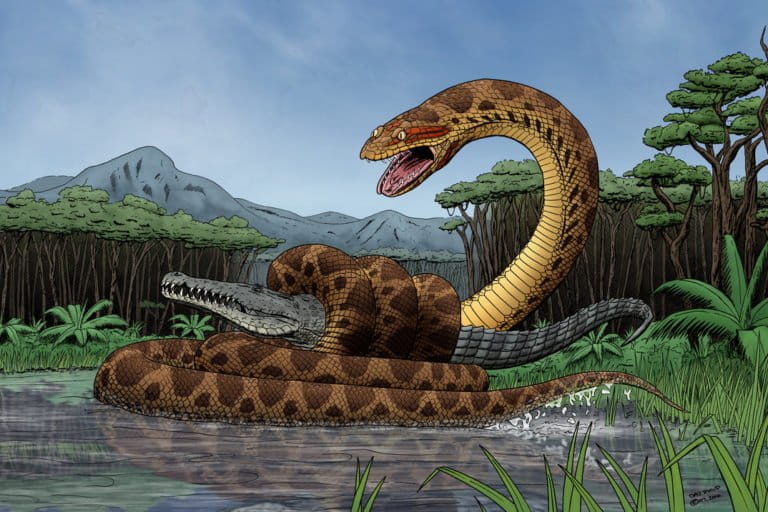
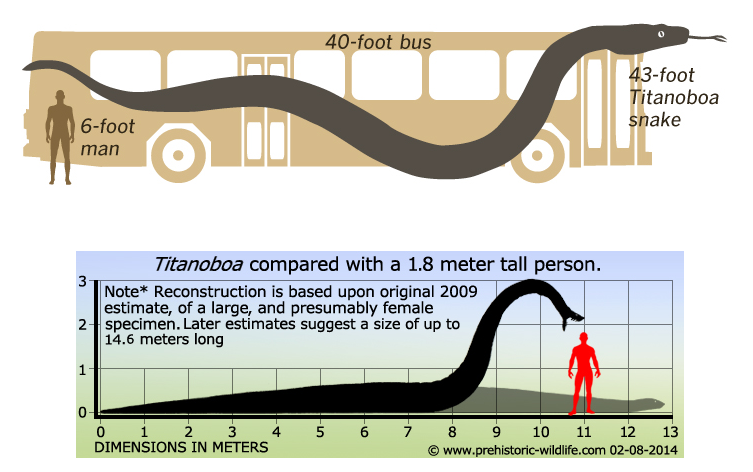
While Ibu Baron represents the pinnacle of modern snake size, she is a "pygmy" when compared to the giants of the deep geological past. The most famous point of comparison is Titanoboa cerrejonensis, an extinct genus of snake that lived approximately 58 to 60 million years ago during the Middle Paleocene epoch.
The discovery of Titanoboa was first published in the journal Nature in 2009 by an international team of researchers led by Jonathan Bloch of the Florida Museum of Natural History and David Polly of Indiana University. Fossilized vertebrae and skull fragments found in the Cerrejón coal mine in Colombia allowed scientists to reconstruct a creature of nightmare proportions.
Titanoboa is estimated to have reached a length of 13 meters (43 feet) and a weight of approximately 1,135 kilograms (2,500 pounds). This means that Titanoboa was nearly twice as long as Ibu Baron and more than ten times her weight. The difference in length alone—5.78 meters—is nearly equivalent to the entire body of a large adult modern python.
The Role of Climate in Gigantism
The staggering difference between the 7.22-meter Ibu Baron and the 13-meter Titanoboa is largely explained by the Earth’s climate history. Snakes are ectotherms, meaning their internal body temperature and metabolic rate are governed by the temperature of their environment.
The "Bergmann’s Rule" for ectotherms suggests a direct correlation between ambient temperature and maximum body size. During the Paleocene, the region of Cerrejón was a massive tropical swamp with average annual temperatures ranging between 30°C and 34°C. This is roughly 3°C to 5°C warmer than modern tropical rainforests. This extra heat provided Titanoboa with the metabolic energy required to maintain a massive body and process enormous quantities of food.
Furthermore, Titanoboa emerged in the wake of the Cretaceous-Paleogene extinction event, which wiped out the non-avian dinosaurs. With the large dinosaurian predators gone and large carnivorous mammals yet to evolve, Titanoboa occupied the role of the apex predator in its ecosystem, preying on giant lungfish and prehistoric crocodilians.
Implications for the Future and Climate Change
The study of Ibu Baron and the comparison with Titanoboa offers more than just trivia; it provides a window into the future of biodiversity. As global temperatures rise due to climate change, some scientists speculate that the environmental constraints on reptilian size may shift. While it is unlikely that we will see 13-meter snakes in our lifetime—as such evolutionary changes take millions of years—the presence of Ibu Baron suggests that tropical ecosystems still have the capacity to support massive ectotherms if they are protected from human encroachment.
However, the survival of giants like Ibu Baron is precarious. The primary threat to these record-breaking animals is not a lack of heat, but the loss of habitat and the fragmentation of the Indonesian jungle. If the "super-snakes" of the future are to exist, they require vast, undisturbed territories where they can grow for 30 or 40 years without being killed by humans.
Conclusion
The recognition of Ibu Baron as the world’s longest wild snake is a testament to the enduring mysteries of the Indonesian wilderness. Her 7.22-meter frame serves as a bridge between the legends of the past and the scientific realities of the present. By documenting her existence through rigorous scientific measurement, Guinness World Records and the Indonesian conservation community have provided a vital piece of data for the global understanding of biodiversity.
Beyond the record, Ibu Baron’s story is one of successful conservation. In a world where large predators are often feared and destroyed, her survival represents a triumph of education and professional wildlife management. As she continues her life under the care of Budi Purwanto, she remains a living monument to the raw power and scale of the natural world, reminding us that even in the 21st century, the earth still harbors giants.