Bambang Pamungkas
Beijing, China – In a highly anticipated two-day visit that underscored the intricate and often fraught relationship between the world’s two largest economies, U.S. President Donald Trump met with Chinese President Xi Jinping in Beijing on May 14, 2026. The summit, held at the majestic Great Hall of the People, unfolded against a backdrop of escalating global geopolitical volatility and persistent trade frictions, with President Xi explicitly calling for cooperation over competition to navigate what he termed "profound changes unseen in a century."
A Grand Welcome Amidst Global Crossroads
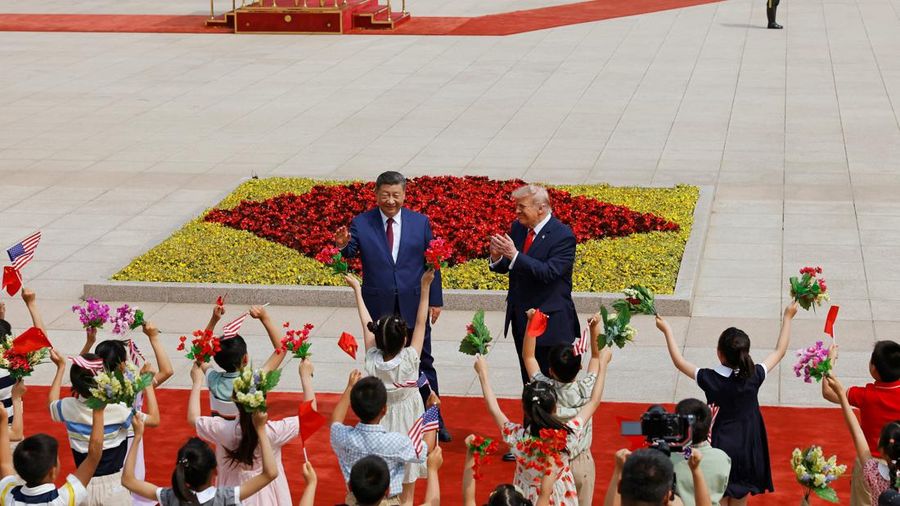
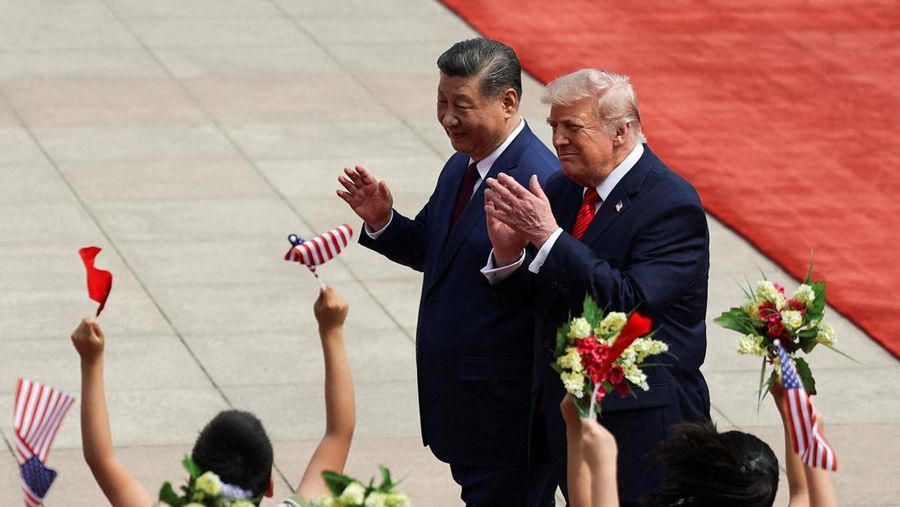
President Trump’s arrival in Beijing on Wednesday evening, May 13, aboard Air Force One, was met with the full pomp and circumstance typically reserved for state visits. A red carpet was unfurled, and a vibrant welcome ceremony featured hundreds of Chinese schoolchildren waving miniature American and Chinese flags, symbolizing a hopeful, if cautious, embrace of diplomacy. The American delegation included prominent figures from the U.S. tech industry, notably NVIDIA CEO Jensen Huang and Tesla CEO Elon Musk, whose presence signaled the critical role of technology and economic ties in the bilateral discussions.
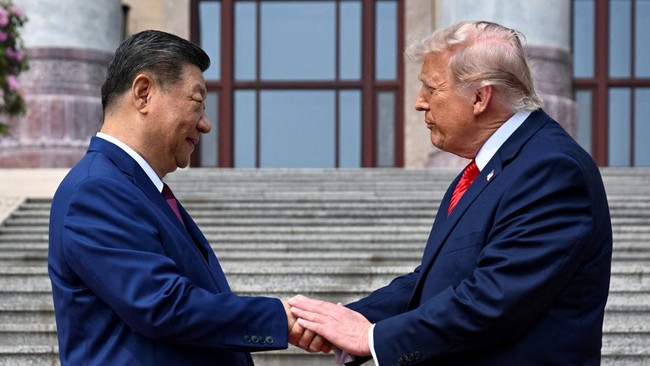
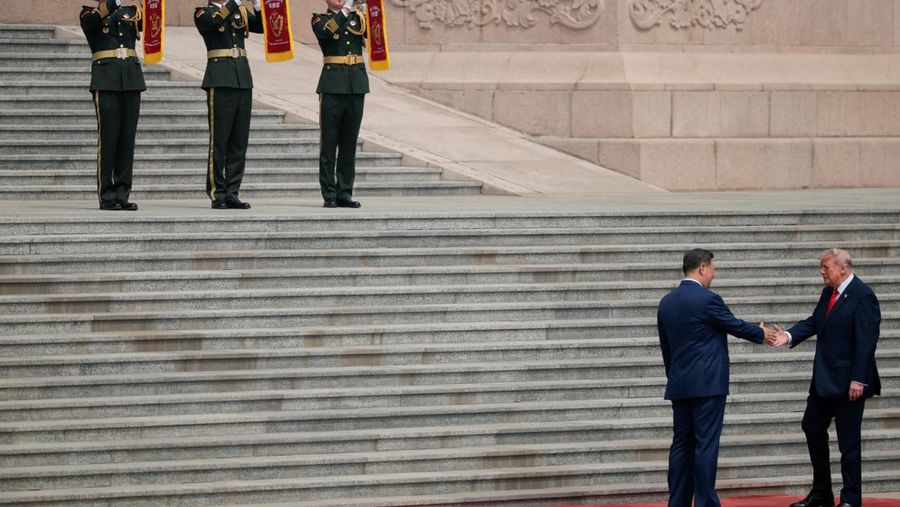
The core of the summit commenced on Thursday, May 14, with formal meetings and a grand reception. Photographs captured the two leaders, Trump and Xi, shaking hands with a blend of formality and the weight of their respective nations’ global standing. The visual symbolism of their handshake, particularly given the historical ebb and flow of Washington-Beijing relations, became an immediate focal point for international observers grappling with the delicate balance of power and interdependence.
Xi’s Call for Cooperation and the Thucydides Trap
During his opening remarks, President Xi Jinping delivered a pointed message, acknowledging the turbulent global landscape. He characterized the current international situation as being "full of turmoil and transformation," placing the world at a "new crossroads." Central to his address was a philosophical query: could China and the United States set aside their differences to serve common interests and ensure global stability?
Xi unequivocally asserted that the relationship between the United States and China "should be built through cooperation, not competition." He articulated a core tenet of China’s foreign policy, stating, "When both sides cooperate, both will gain. When both sides fight, both will suffer." This statement directly challenged the prevailing narrative of great power rivalry that has often defined the relationship in recent years.
Significantly, President Xi also invoked the concept of the "Thucydides Trap," a historical theory suggesting an inevitable conflict when a rising power threatens to displace an established one. By referencing this ancient Greek historical paradigm, Xi subtly underscored the inherent risks of unchecked competition while simultaneously advocating for a path of collaborative engagement. His remarks were widely interpreted as an overt invitation for the U.S. to re-evaluate its strategic approach to China, moving beyond zero-sum calculations towards a more symbiotic future. The implicit question he posed was whether the two superpowers could defy historical precedents and forge a new model for coexistence.
The Enduring Shadow of Trade Wars
Beyond the grand geopolitical pronouncements, the summit’s agenda was heavily influenced by persistent economic tensions, particularly the legacy of the trade war initiated during President Trump’s previous administration. President Xi explicitly addressed the bilateral trade relationship, including the tariffs imposed by the U.S. on Chinese goods. He expressed hope that "further discussions on trade can yield more stable solutions for both countries."
The trade relationship between the U.S. and China is colossal, with two-way goods trade alone reaching hundreds of billions of dollars annually. For instance, in 2022, despite tariff barriers, U.S. goods imports from China totaled approximately $536 billion, while U.S. goods exports to China were around $154 billion. The imposition of tariffs on over $300 billion worth of Chinese goods by the Trump administration in 2018-2019, followed by retaliatory tariffs from Beijing, significantly disrupted global supply chains and impacted various industries from agriculture to technology. While some tariffs were later removed or reduced, a substantial portion remained in place, continuing to affect businesses and consumers in both nations.
The presence of tech titans like Jensen Huang of NVIDIA and Elon Musk of Tesla in Trump’s delegation was highly symbolic. NVIDIA, a leader in AI chips, and Tesla, a pioneer in electric vehicles, represent critical sectors at the heart of the U.S.-China technology competition and supply chain dependencies. Their inclusion suggested that discussions likely delved into sensitive areas such as semiconductor access, intellectual property protection, data security, and the future of technological collaboration and competition. For example, U.S. restrictions on advanced chip exports to China have significantly impacted Chinese tech companies, while China’s robust EV market remains a crucial battleground for global manufacturers. These economic discussions were not merely about tariff rates but about the fundamental architecture of future global commerce and technological leadership.
Chronology of a High-Stakes Visit
- Wednesday, May 13, 2026 (Evening): President Donald Trump arrives in Beijing aboard Air Force One. He is met by Chinese dignitaries and receives a formal welcome, setting the stage for the bilateral meetings. The presence of key U.S. business leaders, including NVIDIA CEO Jensen Huang and Tesla CEO Elon Musk, is noted, highlighting the economic and technological focus of the visit.
- Thursday, May 14, 2026 (Morning): A grand welcoming ceremony is held at the Great Hall of the People. President Trump inspects a guard of honor. Children waving U.S. and Chinese flags line the route.
- Thursday, May 14, 2026 (Late Morning/Early Afternoon): Bilateral meetings commence between President Trump and President Xi Jinping, joined by their respective delegations. Official opening remarks are made, during which President Xi delivers his statements on cooperation, the "Thucydides Trap," and global volatility.
- Thursday, May 14, 2026 (Afternoon): Further discussions are held, reportedly covering trade imbalances, technology policies, regional security concerns (including the Indo-Pacific and Taiwan), and global challenges such as climate change and public health. The presence of tech CEOs likely facilitated specific dialogues on supply chain resilience and technological innovation.
- Thursday, May 14, 2026 (Evening): A state dinner is hosted in honor of President Trump, providing another opportunity for informal diplomatic exchanges.
- Friday, May 15, 2026 (Morning): Expected final rounds of discussions or departure statement. The article implies a two-day visit, so Trump’s departure would likely occur on this day.
Background Context: A History of Intertwined Rivalry
The relationship between the United States and China has been characterized by a complex interplay of cooperation and competition for decades. Following China’s economic reforms and its accession to the World Trade Organization (WTO) in 2001, economic interdependence deepened dramatically. The U.S. became a primary market for Chinese manufactured goods, while China emerged as a significant holder of U.S. debt and a crucial market for American products and services.
However, beneath this economic integration, ideological differences and strategic rivalries persisted. Concerns in the U.S. grew over China’s human rights record, its military expansion in the South China Sea, and its state-backed industrial policies perceived as unfair trade practices. The first Trump administration (2017-2021) dramatically escalated these tensions, initiating a full-blown trade war marked by tariffs, export controls, and sanctions on Chinese technology firms like Huawei. This period also saw increased U.S. engagement with Taiwan and stronger rhetoric regarding China’s actions in Hong Kong and Xinjiang.
President Xi Jinping, for his part, has consistently championed a vision of a "community of shared future for mankind," portraying China as a responsible global power offering an alternative model of governance and development. His "Belt and Road Initiative" (BRI) has expanded China’s economic and geopolitical influence across continents, often challenging traditional Western-led development frameworks. Domestically, Xi has consolidated power, overseeing significant military modernization and an assertive foreign policy aimed at reclaiming China’s historical position on the world stage.
By 2026, global geopolitical dynamics had only intensified. The ongoing conflict in Eastern Europe, persistent tensions in the Middle East, and growing concerns about climate change and future pandemics underscored the urgent need for global leadership and cooperation. The U.S. and China, collectively accounting for over 40% of global GDP and wielding immense military and technological power, hold unparalleled sway over the trajectory of these global challenges. This makes their bilateral relationship not just a matter of national interest but a critical determinant of international peace and prosperity.
Analysis of Implications and Global Reactions
The Trump-Xi summit in Beijing carries significant implications across multiple domains:
- Geopolitical Stability: Xi’s direct invocation of the "Thucydides Trap" and his call for cooperation signal a potential willingness from Beijing to de-escalate rhetorical hostilities, at least publicly. However, the U.S. approach under Trump has historically been transactional and focused on securing perceived American advantages. The challenge lies in translating these high-level calls for cooperation into tangible policy shifts that address deep-seated mistrust and conflicting strategic interests, particularly regarding Taiwan, the South China Sea, and influence in the Indo-Pacific. A more stable U.S.-China relationship could free up diplomatic bandwidth to address other pressing global issues.
- Economic Future and Trade: The presence of U.S. tech CEOs and Xi’s mention of trade solutions suggest a renewed push to find common ground on economic issues. While tariffs might be a primary point of negotiation, deeper issues such as intellectual property rights, forced technology transfers, industrial subsidies, and market access for American companies in China are likely to be central. A de-escalation of trade tensions could provide a much-needed boost to global economic growth, stabilize supply chains, and reduce inflationary pressures. Conversely, a failure to reach agreements could prolong uncertainty, forcing companies to further decouple their operations.
- Technological Competition: The tech industry representatives in Trump’s delegation highlight the summit’s focus on the critical technology rivalry. From AI and quantum computing to semiconductors and 5G, the competition for technological supremacy is intense. Discussions would likely involve export controls, investment restrictions, and the future of global tech standards. The outcome could dictate the pace of technological innovation and the fragmentation of the global digital economy.
- Climate Change and Global Public Health: While not explicitly detailed in the initial reports, these global challenges are areas where U.S.-China cooperation is indispensable. Both nations are the largest emitters of greenhouse gases, and their joint action (or inaction) will largely determine the success of global climate goals. Similarly, lessons from past pandemics underscore the need for coordinated international responses, which require the world’s two largest powers to work in tandem. Any movement towards a shared agenda on these fronts would be a significant diplomatic achievement.
Initial reactions from international allies and adversaries would be varied. European nations, many of whom have sought a middle ground in the U.S.-China rivalry, would likely welcome any signs of de-escalation that could stabilize global trade and reduce pressure to choose sides. Countries in the Indo-Pacific region, particularly those with direct security concerns regarding China, would watch closely for any shifts in the U.S. commitment to regional alliances or any compromises on sovereignty issues. Economists and market analysts would be keenly observing any signals regarding tariff reductions or new trade agreements, as these would have immediate impacts on global financial markets and commodity prices.
The Road Ahead: A Precarious Balance
The Trump-Xi summit, while a crucial diplomatic engagement, represents merely a single chapter in the long and complex narrative of U.S.-China relations. The leaders’ ability to convey a sense of renewed commitment to dialogue and cooperation is significant, but the real test will lie in the implementation of any agreed-upon frameworks and the sustained effort to manage fundamental disagreements.
The "changes unseen in a century" that President Xi referenced are not merely rhetorical; they reflect a deeply interconnected yet increasingly fragmented world. The global order is indeed at a "new crossroads," and the path chosen by Washington and Beijing in the coming months and years will profoundly shape international politics, economics, and security for generations to come. The handshake in Beijing, therefore, was not just a photo opportunity but a symbol of the precarious balance between two titans, whose decisions will reverberate across the globe.