Azin Asro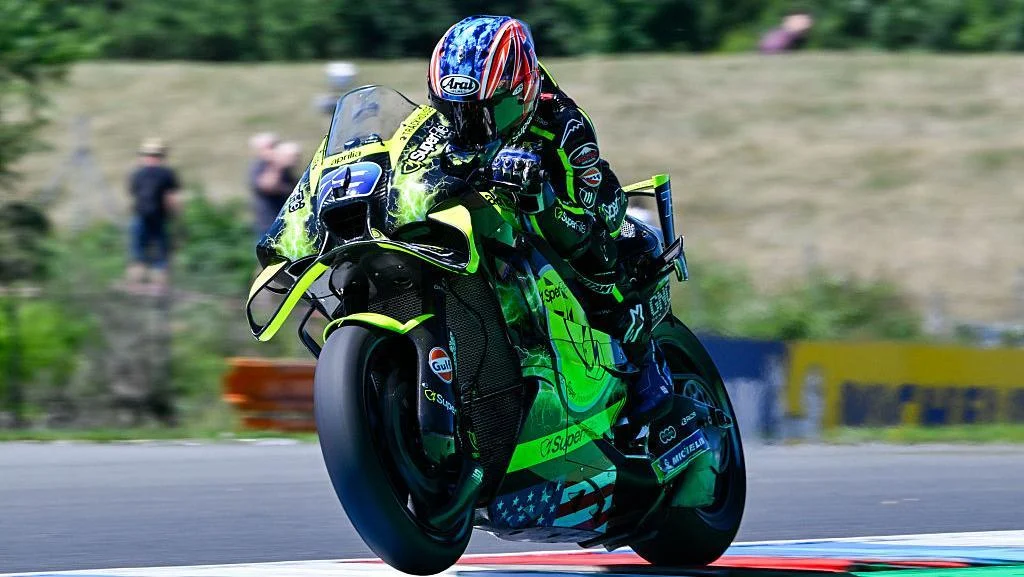
The landscape of the 2026 MotoGP World Championship underwent a significant shift at the TT Circuit Assen, as Trackhouse Aprilia’s Ai Ogura claimed his first-ever premier class victory. The Japanese rider’s triumph at the Dutch Grand Prix was not merely a milestone for his career but a tactical masterclass that has left his competitors and technical analysts scrutinizing a riding style described by peers as "strange" yet undeniably effective. After a challenging start to the season, Ogura’s breakthrough performance in the Netherlands has vaulted him into the heart of the title conversation, underscoring a rapid evolution in his adaptation to the Aprilia RS-GP.
A Definitive Breakthrough at the Cathedral of Speed
The 2026 Dutch Grand Prix, held on June 27, served as the stage for one of the most compelling narratives of the season. Ai Ogura, the 25-year-old talent who transitioned to the premier class with high expectations, had spent the first eight rounds of the championship searching for consistency. Prior to the Brno and Assen rounds, Ogura’s qualifying performances had been a point of weakness, with the rider often forced to start from as far back as 11th on the grid. This lack of track position frequently masked his late-race pace, a characteristic that has now become his competitive trademark.
The weekend at Assen signaled a change in momentum. Having secured a front-row start, Ogura demonstrated that he had finally unlocked the one-lap pace necessary to compete at the sharp end of the field. However, the race itself required more than just raw speed; it demanded a sophisticated approach to tire preservation on a circuit known for its high-speed changes of direction and abrasive surface.
Race Chronology: The Patient Ascent
The race began with Ogura facing immediate pressure. Despite his strong qualifying position, he did not enjoy a perfect launch, momentarily slipping to fourth place during the opening laps. While the lead group, spearheaded by championship leader Jorge Martin and Ogura’s teammate Raul Fernandez, attempted to break away, Ogura remained composed.
By the midpoint of the 26-lap contest, a clear hierarchy had formed. The front of the field was dominated by a "three-way Aprilia battle," featuring Martin (on the factory Aprilia Racing machine), Fernandez, and Ogura. As the race entered its final third, the physical toll on the tires began to dictate the pace. While his rivals started to struggle with rear-end stability, Ogura’s lap times remained remarkably consistent.
The pivotal moment occurred on Lap 18. Displaying superior late-braking capabilities, Ogura executed a double maneuver to pass both Martin and Fernandez in quick succession. Once in clean air, the Japanese rider began to gape the field. Even a late-race technical scare involving a malfunctioning ride-height device—a component critical for acceleration out of Assen’s slow corners—could not derail his charge. Ogura crossed the finish line with a comfortable two-second margin, etching his name into the history books as a MotoGP race winner.
The "Weird" Science of Ogura’s Riding Technique
In the aftermath of the race, the paddock conversation shifted from the result itself to the mechanics of how Ogura achieved it. Both Jorge Martin and Raul Fernandez were vocal about the unconventional nature of Ogura’s technique, which they had the opportunity to observe closely during the 18 laps they spent ahead of him.
Raul Fernandez noted that Ogura’s data shows a trend that contradicts the standard degradation curves seen in MotoGP. "Watching Ai ride is quite strange because the style he uses on the bike is different from all of us," Fernandez remarked. "In the data we see, his performance actually seems to improve relative to the field as the race progresses. He finds a rhythm that others cannot sustain."
Jorge Martin provided a more graphic description of Ogura’s ergonomics. The Spaniard noted that Ogura’s body positioning appears to defy traditional racing logic. "When you follow Ai, it’s strange because it looks like he is crashing in every single corner," Martin explained. "His upper body is completely off the bike, leaning extremely low toward the asphalt, but the bike itself remains relatively upright. It is a very unusual visual."
Martin further elaborated on the difficulty of trailing Ogura, stating that the Japanese rider’s lines and lean angles are so unorthodox that they create a psychological challenge for following riders. "I found it difficult to stay with him because I kept expecting him to lose the front end. But then, the bike just turns and he drives away. That is likely the secret to why he is so fast in the final five or six laps."
Analytical Insight: Tire Conservation and Physics
From a technical standpoint, the style described by Martin and Fernandez offers a significant advantage in modern MotoGP, where Michelin tire management is often the deciding factor in race outcomes. By "hanging off" the bike excessively while keeping the motorcycle more perpendicular to the ground, Ogura is effectively utilizing his body mass to generate cornering force.
This technique reduces the "lean angle" of the actual machine. When a bike is less leaned over, it utilizes a larger part of the tire’s contact patch rather than the fragile "edge" of the tire. The edge of the tire is where heat builds up most rapidly and where grip is most limited. By preserving the shoulder of the tire during the middle stages of the race, Ogura ensures he has significantly more rubber available for the final sprint. This explains his ability to maintain a high pace on Lap 25 that is nearly identical to his pace on Lap 5, a feat that few on the current grid can replicate.
Contextualizing the 2026 Season and Team Dynamics
Ogura’s victory is a landmark moment for Trackhouse Racing. As the American-owned satellite team for Aprilia, Trackhouse has invested heavily in providing Ogura and Fernandez with factory-spec equipment. Winning at a "temple" of motorcycling like Assen validates the team’s project and cements Aprilia’s status as a dominant force in the 2026 regulations.
The victory also marks a turning point for Japanese representation in the premier class. For years, Japanese fans have waited for a successor to the legends of the past, and Ogura’s rise suggests he is the most capable candidate to challenge for a world title in the modern era. His journey from the Asia Talent Cup through Moto3 and Moto2 has been characterized by this same methodical approach—initial struggles followed by a period of "unlocking" the bike’s potential.
Championship Implications and the Road Ahead
With the 25 points earned at Assen, Ai Ogura has solidified his fourth-place position in the riders’ standings. He now sits just 25 points behind Jorge Martin, effectively putting him within one race win of the championship lead.
The 2026 season has proven to be a volatile one, with the hierarchy shifting depending on circuit temperature and tire allocation. However, Ogura’s newfound ability to qualify on the front row, combined with his inherent late-race durability, makes him a formidable threat for the remaining rounds. If his "weird" riding style continues to provide a mathematical advantage in tire life, rivals like Martin and Francesco Bagnaia may be forced to adapt their own techniques to counter the Japanese rider’s efficiency.
As the paddock moves toward the next rounds, the focus will remain on whether Ogura can replicate this performance on stop-and-go tracks where the physical demands on the rider are different from the flowing nature of Assen. For now, however, Ai Ogura stands as the man of the hour, having proven that in the world of high-stakes motorcycle racing, being "strange" can sometimes be the fastest way to the top of the podium.
Final Summary of Standings and Stats
Following the Dutch GP, the top of the 2026 MotoGP Championship standings is as follows:
- Jorge Martin (Aprilia Racing): 185 Points
- Francesco Bagnaia (Ducati Lenovo): 172 Points
- Marc Marquez (Gresini Racing): 168 Points
- Ai Ogura (Trackhouse Aprilia): 160 Points
- Raul Fernandez (Trackhouse Aprilia): 142 Points
Ogura’s statistics for the 2026 season now include one victory and three second-place finishes. His average finishing position over the last four races is 1.75, the highest in the paddock during that period. As the series moves into the second half of the calendar, the "Ogura Method" of extreme body lean and tire preservation will undoubtedly be the subject of intense study by every factory engineering team on the grid.