 Tyo Susilo
Apple has officially announced a sweeping update for Apple Creator Studio, its comprehensive suite of creative and productivity software. Scheduled for release in November 2026, this major software refresh introduces sophisticated artificial intelligence capabilities across a wide array of applications, including Pixelmator Pro, Final Cut Pro, Logic Pro, Keynote, Pages, and Numbers. Designed to streamline workflows for professional creators, educators, students, and enterprise users alike, the update bridges the gap between manual execution and automated assistance, promising to make complex editing, music production, and document creation significantly more intuitive.
The announcement comes at a time when competition in the creative software sector is fiercer than ever, with tech giants and specialized developers racing to integrate generative AI into daily workflows. By embedding these capabilities directly into its native and acquired software suites, Apple aims to solidify its ecosystem as the premier choice for digital content creation. Existing subscribers will receive these advanced features at no additional cost, while new users can access the entire suite for USD 12.99 per month or an annual subscription of USD 129.
Revolutionizing Visual Media Editing Through Advanced Generative AI
At the forefront of the visual updates is Pixelmator Pro, which now incorporates a powerful feature known as Generate Fill. This tool allows users to alter, expand, or completely modify specific sections of an image simply by typing text instructions. Rather than relying on tedious manual masking and brushwork, users can prompt the AI to introduce new elements, remove unwanted objects, or extend backgrounds. The underlying algorithm automatically analyzes the surrounding pixels to match lighting, perspective, and surface textures, ensuring that the generated additions blend seamlessly with the original photograph.

Concurrently, Final Cut Pro has received a massive injection of creative assets and cross-application integration. Apple has partnered with MotionVFX to bring thousands of high-quality visual effects, transitions, and dynamic templates directly into the video editing suite. Furthermore, a newly established Content Hub provides editors with immediate access to a vast library of stock video footage and high-resolution photos without leaving the application environment.
Perhaps one of the most practical workflow improvements in Final Cut Pro is the direct integration with Pixelmator Pro. Video editors can now select any frame or image directly within the timeline and open it in Pixelmator Pro for immediate touch-ups. Once the edits are finalized, the changes are updated automatically in the video project, eliminating the traditional, time-consuming process of manual file exporting, re-importing, and relinking.
Streamlining Music Production and Office Productivity
In the realm of audio engineering, Logic Pro has been upgraded with a specialized AI assistant designed to help musicians overcome writer’s block and accelerate arrangement. Whether a user is trying to sketch out chord progressions, structure a new song, or clean up and mix vocal tracks, the AI acts as a collaborative partner in the studio. Additionally, the Stem Splitter feature has been significantly enhanced. Producers can now isolate, separate, and manipulate individual drum elements—such as kicks, snares, and hi-hats—from a mixed audio file with unprecedented clarity, opening up new avenues for remixing and sampling.
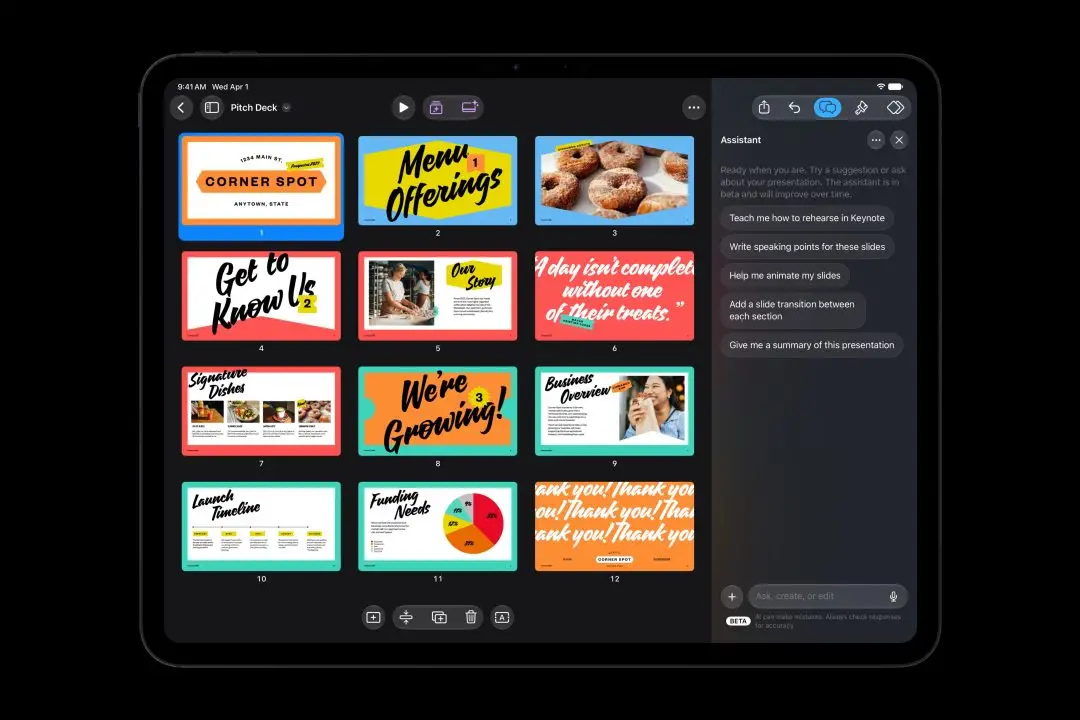
Beyond multimedia production, Apple’s core productivity trio—Keynote, Pages, and Numbers—has received substantial intelligence upgrades. The updated Keynote can now assist users in building visually compelling presentations from scratch, suggesting layouts, color palettes, and graphical elements based on textual outlines. Pages utilizes advanced natural language processing to help writers draft, summarize, and refine text documents, while Numbers provides smarter data analysis, automating the creation of charts and predictive financial models.

A notable addition to the productivity ecosystem is the integration of Model Context Protocol (MCP) support. This framework allows external AI agents to interact directly with Keynote, Pages, and Numbers documents. Authorized agents can read, analyze, and edit content across these files, as well as execute automated multi-step tasks. This capability is expected to appeal heavily to corporate environments and data-heavy workflows where repetitive administrative tasks consume valuable human hours.
Rollout Timeline, Pricing, and System Requirements
The rollout of these features is slated for November 2026, positioning Apple Creator Studio as a major focal point for the company’s fourth-quarter software strategy. Apple has maintained its established pricing model for the suite, ensuring that current subscribers are shielded from price hikes while maintaining an accessible entry point for newcomers at USD 12.99 monthly or USD 129 annually.
However, industry analysts note that certain limitations will apply upon launch. Many of the advanced generative AI features will initially operate under a beta status, reflecting Apple’s cautious approach to iterative software deployment. Furthermore, because these algorithms rely heavily on advanced on-device processing capabilities alongside cloud infrastructure, users will need compatible hardware—such as recent Mac models featuring Apple Silicon—to run the heaviest tasks smoothly. Additionally, initial language support for the conversational AI assistants will be restricted primarily to U.S. English, with localized rollouts for other languages expected in subsequent updates throughout 2027.
Broader Industry Implications and Market Analysis

The integration of deep AI tools across such a diverse collection of applications underscores a broader industry shift toward ambient computing and intelligent software assistance. By offering a unified suite that covers everything from pixel-level photo manipulation and cinematic video editing to professional audio engineering and corporate document management, Apple is presenting a compelling value proposition.
For independent creators and small production houses, the ability to accomplish complex visual and auditory tasks without needing separate third-party plugins could drastically lower the barrier to entry. Meanwhile, the inclusion of automation tools like MCP support signals Apple’s ambition to capture a larger share of the enterprise productivity market, where efficiency and automated data handling are paramount.
As the November 2026 release date approaches, tech observers will be watching closely to see how these beta features perform in real-world environments and whether the performance of Apple Silicon devices can adequately handle the heavy computational demands of real-time generative editing. If successful, this update could redefine user expectations for what an all-in-one creative and productivity ecosystem should deliver.