Azin Asro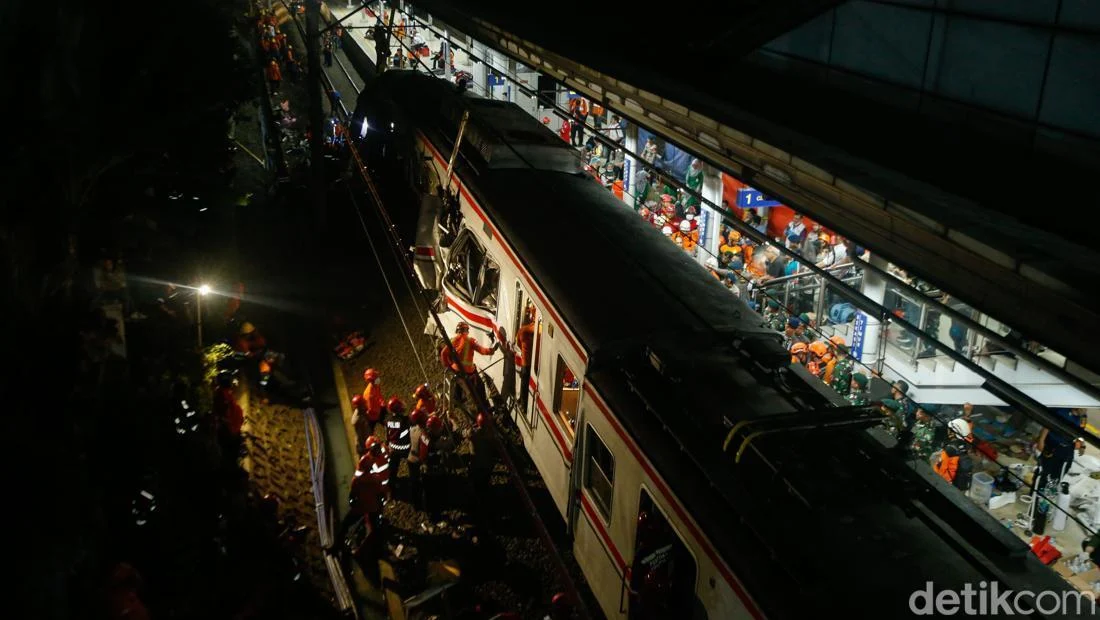
The city of Bekasi was plunged into mourning on the night of Monday, April 27, 2026, following a catastrophic multi-train collision that resulted in at least 15 fatalities and dozens of critical injuries. The incident, which unfolded near the JPL 85 Ampera level crossing and escalated into a secondary collision at Bekasi Timur Station, has sparked a national conversation regarding the persistent disregard for railway safety regulations and the technical vulnerabilities of the metropolitan transit network. Preliminary reports suggest that a single traffic violation by a motor vehicle set off a chain reaction that ultimately led to one of the deadliest maritime-railway corridor accidents in recent years.
The tragedy began shortly before 9:00 PM WIB when a Green SM taxi reportedly attempted to bypass a level crossing at JPL 85 Ampera despite active warnings. A Commuter Line train, traveling on the busy Jakarta-Cikarang corridor, struck the vehicle, causing an immediate halt to operations in the area. While the initial "temperan" (railway-to-vehicle impact) was severe, the situation turned catastrophic when a secondary collision occurred. A subsequent Commuter Line train, which had been held stationary at Bekasi Timur Station due to the disruption ahead, was struck from behind by the high-speed KA Argo Bromo Anggrek, an executive-class express train traveling from Surabaya to Jakarta.
Detailed Chronology of the Disaster
The timeline of the accident highlights a rapid transition from a localized traffic incident to a systemic failure. At approximately 8:45 PM, the Green SM taxi entered the tracks at the Ampera level crossing. Eyewitnesses reported that the crossing gates were in the process of closing, and the alarm signals were fully operational. The taxi driver, however, allegedly ignored these warnings in an attempt to clear the tracks before the arrival of the approaching Commuter Line. The train was unable to stop in time, dragging the vehicle several meters and causing significant damage to the train’s leading carriage and the local signaling infrastructure.
Following this initial impact, PT Kereta Api Indonesia (KAI) protocols required the immediate halting of all traffic on the affected segment to allow for emergency assessment and the clearance of the wreckage. Consequently, a Commuter Line train following behind was instructed to wait at the platform of Bekasi Timur Station.
However, the signaling system in the Bekasi Timur "emplasemen" (station yard) area reportedly suffered a malfunction or a delayed update following the first collision. The KA Argo Bromo Anggrek, which was operating on the same track, did not receive the necessary signal to decelerate or stop before entering the station block. At approximately 9:10 PM, the express train collided with the rear of the stationary Commuter Line at significant speed. The force of the impact caused the rear carriages of the Commuter Line to crumple and derail, while the locomotive of the Argo Bromo Anggrek sustained heavy frontal damage.
Casualties and Emergency Response Efforts
The scale of the carnage necessitated a massive mobilization of emergency services. According to the latest data from the Bekasi City Health Office and local police, 15 individuals have been confirmed dead. The majority of the deceased were passengers in the rear carriages of the stationary Commuter Line, which bore the brunt of the impact from the Argo Bromo Anggrek. Among the victims were daily commuters returning from Jakarta and the driver of the taxi involved in the initial collision.
In addition to the fatalities, more than 40 people were rushed to nearby hospitals, including RSUD Bekasi and several private medical centers. Doctors report that many of the survivors are suffering from blunt force trauma, broken limbs, and internal injuries. Emergency responders, including personnel from the National Search and Rescue Agency (Basarnas) and PT KAI’s internal security teams, worked through the night using hydraulic cutting tools to extract passengers trapped within the twisted metal of the train cars.
"The scene was chaotic. We had to prioritize those with signs of life while the wreckage was still being stabilized," said one first responder at the site. The evacuation process was further complicated by the proximity of the station to residential areas, which drew large crowds of onlookers, hindering the movement of ambulances.
Official Investigations and Systemic Concerns
Bobby Rasyidin, the President Director of PT Kereta Api Indonesia (KAI), addressed the media on Tuesday morning following a briefing with the Ministry of Transportation. He confirmed that the initial investigation points to the level crossing violation as the primary catalyst.
"This incident began just before 9:00 PM with the taxi collision at JPL 85. We strongly suspect that this initial impact disrupted the railway signaling and interlocking system in the Bekasi Timur Station area," Rasyidin stated. "This technical disruption is what we believe led to the subsequent rear-end collision involving the Argo Bromo Anggrek. However, we are handing the matter over entirely to the National Transportation Safety Committee (KNKT) to conduct a forensic analysis of the black boxes and signaling logs."
The KNKT has deployed a specialized team to examine whether the automated braking systems (if equipped) on the Argo Bromo Anggrek failed or if the signaling logic allowed two trains into the same block due to the damage caused by the first accident. The investigation will also look into the communication protocols between the train dispatchers (PPKA) and the drivers during the 25-minute window between the two collisions.
The Legal Framework and Road User Obligations
The tragedy has reignited a fierce debate over the enforcement of traffic laws in Indonesia, particularly regarding level crossings. Current legislation is clear on the hierarchy of right-of-way. Law Number 22 of 2009 concerning Traffic and Road Transport mandates that road users must yield to trains.
Specifically, Article 114 of the law dictates that at a level crossing, every driver must stop when the signal sounds or the gate begins to close. They are required to "look and listen" and may only proceed when it is certain that no train is approaching. Furthermore, Article 296 stipulates criminal penalties for violators, including a maximum of three months’ imprisonment or a fine of up to Rp 750,000.
Complementing this, Law Number 23 of 2007 concerning Railways, Article 124, reiterates that road users are legally obligated to prioritize the passage of trains at all intersections between rail lines and roads. Despite these stringent regulations, the frequency of "level crossing menerobos" (gate-crashing) remains alarmingly high in urban centers like Bekasi.
Expert Analysis: The Psychology of Safety Negligence
Jusri Pulubuhu, a prominent safety expert and founder of the Jakarta Defensive Driving Consulting (JDDC), argues that the root of the problem lies in a systemic lack of safety culture. In an interview following the accident, Pulubuhu emphasized that the act of bypassing railway gates is an indicator of a much larger behavioral issue.
"Menerobos (breaking through) when a train is about to pass should never happen. It is fundamentally the same as running a red light, driving in a busway lane, or using a mobile phone while driving," Pulubuhu explained. "These behaviors are clear indicators of extremely weak safety awareness. For these individuals, the trigger is often a lack of education and a poor reference from their environment."
Pulubuhu noted that "Normalcy Bias" plays a significant role in these tragedies. Many drivers observe others successfully bypassing gates without consequence and conclude that the risk is manageable. Over time, this leads to a dangerous overconfidence where even experienced drivers begin to underestimate the physics of a moving train. "They think, ‘I’ve done this before, I have time.’ They do not consider the safety of themselves, let alone the hundreds of passengers on the train," he added.
Statistical Context and Broader Implications
The Bekasi collision is not an isolated event but rather a high-profile example of a persistent national issue. Data from PT KAI indicates that hundreds of accidents occur at level crossings annually across Indonesia, many of them at "unauthorized" or "illegal" crossings that lack proper gate infrastructure.
The "Bekasi Corridor" is particularly vulnerable due to its high density of both rail and road traffic. As one of the primary arteries for the Greater Jakarta area (Jabodetabek), the line carries both the high-frequency KRL Commuter Line and long-distance intercity trains like the Argo Bromo Anggrek. The mix of high-speed transit and local road congestion creates a high-risk environment.
In the wake of this accident, there are growing calls for the government to accelerate the elimination of level crossings in favor of underpasses or flyovers. While the Ministry of Transportation has a long-term plan to remove level crossings on major corridors, budget constraints and land acquisition issues have slowed progress.
Impact on the National Transport Network
The accident has caused significant disruption to the national rail schedule. The Bekasi-Cikarang line remained partially closed on Tuesday as heavy equipment moved in to clear the derailed carriages. Thousands of commuters were forced to seek alternative transportation, putting immense pressure on the regional bus and ride-sharing networks.
Beyond the logistical hurdles, the psychological impact on commuters is profound. The safety of the rail network, often touted as a reliable alternative to the city’s congested roads, has been called into question. If a single taxi can cause a system-wide failure that allows an express train to rear-end a stationary one, the public’s trust in the "failsafe" nature of railway technology may be shaken.
As the KNKT continues its investigation, the focus remains on two fronts: the technical resilience of the signaling system and the urgent need for a shift in public behavior. While technology can provide layers of protection, the human element—whether it is a driver’s decision to bypass a gate or a dispatcher’s response to an emergency—remains the most critical link in the chain of safety. The lives lost in Bekasi serve as a grim reminder that in the intersection of road and rail, there is no room for error.