Nasution Nanang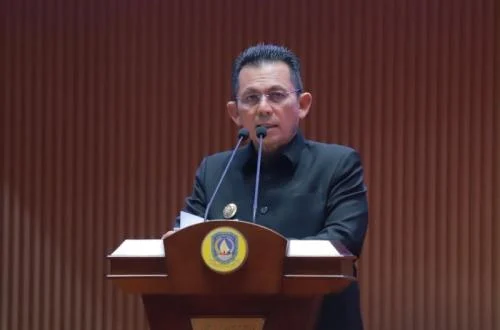
Tanjungpinang, Kepulauan Riau – Governor Ansar Ahmad of Kepulauan Riau (Kepri) has officially announced the provincial government’s projected Regional Budget (APBD) for the 2027 fiscal year, reaching an impressive IDR 3.510 trillion. This significant projection was unveiled during a plenary meeting for the submission of the Draft General Budget Policy (KUA) and Provisional Budget Ceiling and Priorities (PPAS) for the 2027 Kepri APBD, held at the local Regional People’s Representative Council (DPRD) office on Tuesday. The announcement marks a crucial step in the province’s long-term financial planning, laying the groundwork for future development initiatives designed to enhance economic growth, improve public services, and bolster regional competitiveness.
The financial blueprint for 2027 anticipates regional revenue to stand at IDR 3.480 trillion, forming the backbone of the province’s operational and developmental expenditures. Complementing this revenue, regional financing, on a net basis, is projected to reach IDR 18.27 billion. This net figure is derived from financing receipts totaling IDR 149 billion, offset by financing expenditures amounting to IDR 131 billion. Governor Ansar Ahmad elaborated on the sources of these financing receipts, specifically highlighting that a substantial portion, IDR 149 billion, is earmarked to come from the second phase disbursement of a regional loan secured from Bank Jabar Banten (BJB). This strategic borrowing underscores the province’s proactive approach to funding key infrastructure and social development projects that require significant capital outlay beyond immediate revenue streams.
Understanding the KUA-PPAS Framework: A Foundation for Fiscal Prudence
The submission of the Draft KUA-PPAS is a fundamental and mandatory stage in Indonesia’s regional budget formulation process. It serves as a critical preliminary document that outlines the general policies and priorities for the upcoming fiscal year’s budget. The KUA details the overall financial framework, including revenue and expenditure targets, while the PPAS specifies the ceiling for each regional government agency’s budget, along with the priorities for resource allocation. This meticulous process ensures that the subsequent detailed budget (RAPBD) aligns with the province’s long-term development plans and strategic objectives.
Governor Ansar emphasized that the compilation of the KUA-PPAS for the 2027 Kepri APBD is strategically anchored in the 2027 Regional Government Work Plan (RKPD). The RKPD itself is a comprehensive document that translates the province’s vision and mission into concrete programs and activities. Furthermore, the budget framework is meticulously synchronized with national development policy directions and the specific development priorities identified for the Kepri region. This integrated approach ensures that local initiatives contribute effectively to broader national goals, particularly in areas like maritime economy, infrastructure development, and human capital enhancement, which are critical for an archipelago province like Kepri.
Detailed Financial Breakdown: Revenue, Borrowing, and Strategic Investments
The projected regional revenue of IDR 3.480 trillion for 2027 is expected to be sourced from various streams, including Regional Original Income (Pendapatan Asli Daerah – PAD), transfer funds from the central government, and other legitimate regional income. PAD typically comprises taxes, levies, profits from regionally-owned enterprises, and other legitimate revenues. A robust PAD indicates the province’s economic vitality and its capacity to generate self-sustaining income. Transfer funds, on the other hand, are crucial for balancing regional development, especially in provinces with varying economic capacities. The careful estimation of these revenue sources is vital for creating a realistic and achievable budget.
The financing component, particularly the IDR 149 billion from Bank Jabar Banten (BJB), highlights the province’s strategy to leverage external funding for accelerated development. BJB, as a regional development bank, often plays a role in supporting the financial needs of local governments across Indonesia. Securing a loan, especially for multi-year projects, allows the provincial government to undertake large-scale initiatives that might otherwise be constrained by annual budget cycles. The "second phase" of this loan suggests a pre-existing financial arrangement, indicating a planned, multi-stage funding approach for ongoing or new capital-intensive projects. Such loans, while providing immediate capital, necessitate careful debt management to ensure long-term fiscal sustainability.
On the expenditure side of financing, the IDR 131 billion has two primary allocations. A significant portion, IDR 20 billion, is allocated for capital participation in Bank Riau Kepri Syariah (BRKS). This investment in a regionally-owned sharia bank aims to strengthen the financial institution, enabling it to better serve the local economy, particularly in providing financing for Micro, Small, and Medium Enterprises (MSMEs) and supporting sharia-compliant economic activities within the province. Regional governments often inject capital into their BUMD (Badan Usaha Milik Daerah) to enhance their capacity, stimulate local economic growth, and ensure the availability of financial services tailored to regional needs. The remaining IDR 111.12 billion is critically allocated for the repayment of principal debt that will mature in 2027. This provision underscores the province’s commitment to responsible financial management and honoring its financial obligations, which is crucial for maintaining fiscal credibility and future borrowing capacity.
Strategic Allocation for Key Development Projects: Building Kepri’s Future
The IDR 149 billion in financing receipts is earmarked for several crucial multi-year projects that are central to Kepri’s development agenda. These projects represent significant investments in critical sectors, demonstrating the province’s commitment to improving public welfare and enhancing its cultural and healthcare infrastructure.
One of the flagship projects is the construction of an Outpatient Polyclinic at RSUD Raja Ahmad Tabib. RSUD Raja Ahmad Tabib is the provincial general hospital, serving as a primary healthcare referral center for the entire Kepri province. The expansion of its polyclinic facilities is a direct response to the growing demand for specialized outpatient services, aiming to reduce patient waiting times, improve diagnostic capabilities, and provide more comprehensive healthcare to the population. This investment is vital for strengthening the provincial healthcare system, ensuring better access to quality medical care, and ultimately improving public health outcomes across the scattered islands of Kepri.
Another significant initiative is the development of the National Language Museum and Monument on Penyengat Island. Penyengat Island holds immense historical and cultural significance, having served as the seat of the Johor-Riau Sultanate and a vibrant center of Malay culture and Islamic scholarship. It is recognized as a potential UNESCO World Heritage site, making it a crucial heritage location. The establishment of a National Language Museum and Monument on this island is a powerful statement about the preservation and promotion of the Indonesian language, particularly its Malay roots. This project is expected to boost cultural tourism, educate visitors about the rich linguistic and historical heritage of the archipelago, and serve as a national landmark celebrating the country’s linguistic identity. It aligns with Kepri’s broader strategy to leverage its unique cultural assets for sustainable tourism development.
Guiding Principles: RKPD 2027 and National Synergy
Governor Ansar emphasized that the 2027 APBD formulation is meticulously guided by the RKPD 2027. This document typically sets the strategic direction for regional development, identifying key targets and performance indicators. The overarching goals for the 2027 budget are clearly defined: sustaining regional development through strengthened economic growth, enhanced quality of human resources, equitable regional development, fortified infrastructure, and improved community welfare. These pillars collectively aim to create a more prosperous and competitive Kepri.
The alignment with national development policies is also a critical aspect. As an archipelago province, Kepri plays a strategic role in Indonesia’s maritime agenda, border security, and connectivity initiatives. Therefore, the provincial budget must complement national programs, such as those related to maritime infrastructure, logistics hubs, and economic corridors. This synergy ensures that regional efforts contribute to the broader national vision, maximizing the impact of both central and regional government investments.
Broader Development Agenda: Pillars of Progress for a Prosperous Kepri
The 2027 budget policy is specifically designed to support an array of priority sectors, reflecting a holistic approach to regional development. These include:
- Enhanced Basic Services: A primary focus remains on strengthening the education and health sectors. This means investing in school infrastructure, teacher training, public health facilities, disease prevention programs, and access to affordable healthcare, which are foundational for human capital development.
- Maritime Economy Development: Given Kepri’s strategic geographical position at the crossroads of international shipping lanes and its vast marine resources, the development of the maritime economy is paramount. This includes supporting fisheries, aquaculture, port development, shipbuilding, and marine tourism, unlocking the full potential of the blue economy.
- Increased Investment Competitiveness: Attracting domestic and foreign investment is crucial for job creation and economic diversification. The budget will support initiatives to improve the ease of doing business, develop industrial zones (e.g., Batam, Bintan, Karimun special economic zones), and promote the province as an attractive investment destination.
- MSME Development: Micro, Small, and Medium Enterprises are the backbone of the local economy. The budget will fund programs for MSME training, access to capital (partly through BRKS), market access, and technological adoption to empower local entrepreneurs and foster inclusive economic growth.
- Food Security: Ensuring food self-sufficiency and stability is a critical goal, especially for an island province. Investments in agriculture, fisheries, and food supply chain management are essential to safeguard the population against price fluctuations and shortages.
- Poverty Alleviation: Targeted programs aimed at reducing poverty through social assistance, job creation initiatives, and skill development are central to the welfare agenda, striving for a more equitable society.
- Accelerated and Equitable Infrastructure Development: Bridging the development gap between various islands and regions within Kepri requires continuous investment in roads, bridges, ports, airports, and utilities. This ensures better connectivity, facilitates trade, and improves access to services for all communities.
Governor Ansar firmly stated that "Every rupiah allocated in the APBD must be able to provide a real impact on improving community welfare and regional progress." This declaration underscores the government’s commitment to ensuring that public funds are utilized effectively and yield tangible benefits for the citizens of Kepri.
Commitment to Fiscal Prudence and Transparency
The Provincial Government of Kepri is unwavering in its commitment to managing regional finances effectively, efficiently, transparently, and accountably. This commitment is not merely a procedural formality but a cornerstone of good governance, aiming to build public trust and ensure optimal utilization of resources. Through meticulous and targeted budget planning, the government expresses optimism that its various priority programs can be executed optimally, thereby fostering inclusive economic growth that benefits all segments of society. The emphasis on transparency is particularly important in a democratic system, allowing public scrutiny and fostering confidence in government operations. Accountability mechanisms will be crucial in tracking the progress of projects and ensuring that funds are disbursed and utilized as intended.
Stakeholder Perspectives and Expected Outcomes
The announcement of the 2027 APBD projection sets the stage for intensive discussions and deliberations between the provincial government and the DPRD. Governor Ansar expressed his hope for a constructive dialogue during the review of the KUA-PPAS APBD 2027. The DPRD, as the representative body of the people, plays a vital oversight role, scrutinizing the proposed budget to ensure it aligns with the aspirations and needs of the constituents, prioritizes essential services, and is fiscally responsible. Their input and approval are essential for the budget to be enacted into law.
From the perspective of the business community, a well-structured and transparent budget signals stability and clear development directions, which can encourage investment. Investments in infrastructure, human capital, and a supportive business environment are key factors that attract enterprises and foster job creation. Citizens, on the other hand, will be looking for tangible improvements in their daily lives – better schools, accessible healthcare, reliable infrastructure, and economic opportunities. The success of the 2027 APBD will ultimately be measured by its ability to deliver on these expectations.
The governor concluded with an optimistic outlook, expressing confidence that the 2027 APBD will serve as an effective instrument of development, driving Kepulauan Riau towards a future that is more advanced, prosperous, and competitive on both national and regional stages. The blend of strategic investments, prudent financial management, and a clear vision for sustainable growth positions Kepri to continue its trajectory of progress.
This content was processed with the assistance of AI.
Source: Antara