Nila Kartika Wati
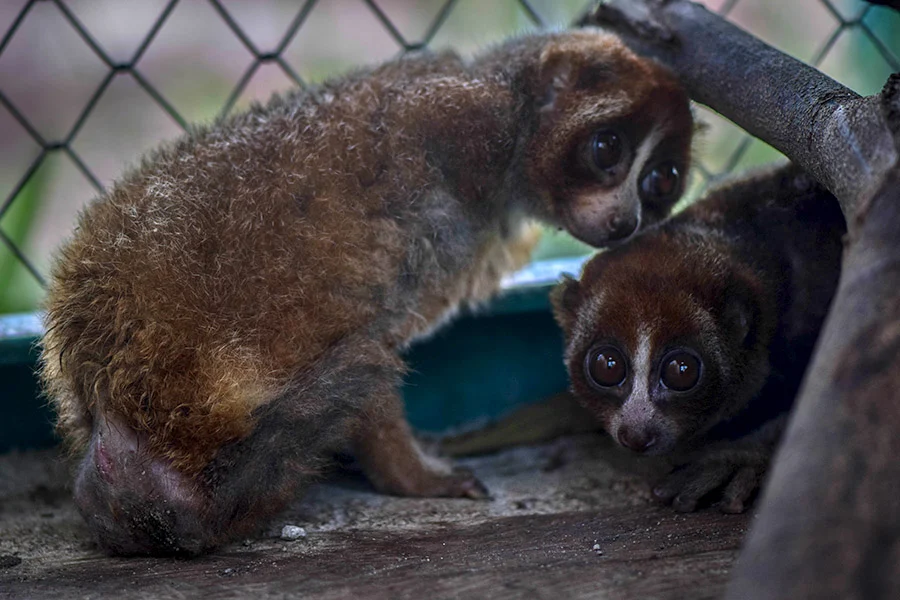
The Bangka slow loris (Nycticebus bancanus), a cryptic primate with large, forward-facing eyes adapted for low-light survival, has emerged from a century-long silence in the annals of formal science. While local residents in the Bangka Archipelago of Indonesia have long been familiar with this nocturnal inhabitant, the species had been absent from global scientific literature since 1937. A landmark study published in the 2026 journal Spixiana, titled "Neglected but still alive: Further evidence for the continued existence of the Bangka Slow Loris (Nycticebus bancanus) on Bangka Island, Indonesia," has officially bridged the gap between local knowledge and international conservation taxonomy. This rediscovery confirms that while the species has survived in the shadows of human expansion, it remains on the precipice of extinction, categorized as Critically Endangered on the IUCN Red List.
A Century of Scientific Absence
The documentation of Nycticebus bancanus dates back to the seminal work of H.J.V. Sody in 1937, whose publication "On The Mammals of Bangka" served as the last formal academic record for nearly nine decades. For years, the scientific community operated in a vacuum regarding the status of this primate. However, the absence of records was never a reflection of the animal’s actual disappearance. Instead, it represented a disconnect between field conservation efforts led by local organizations and the global academic tracking systems.
Over the past decade, the Alobi Foundation, a dedicated conservation group based in the Kepulauan Bangka Belitung, has been documenting the frequent, often tragic, encounters between the local human population and these slow-moving primates. Their data provides a sobering chronology of a species forced into the periphery of human civilization. Between 2015 and 2025, the organization successfully rescued over 90 individuals, revealing that the "lost" species was, in reality, struggling to survive in a rapidly fracturing landscape.

The Anatomy of a Vulnerable Predator
The Bangka slow loris possesses physical characteristics that are evolutionarily optimized for a life in the canopy. Its eyes, disproportionately large relative to its face, allow for acute night vision, while its specialized digits enable a powerful, slow-motion grip on branches. Despite its small size—often no larger than a common domestic kitten—the loris is a formidable biological anomaly.
It is one of the few known venomous primates in the world. Its toxicity is not delivered through a simple bite but through a complex two-stage mechanism. The loris possesses a brachial gland on its upper arm that produces a specialized exudate. When the animal is threatened, it licks this gland, mixing the secretion with its saliva to create a toxic compound. A bite from a stressed loris can cause significant swelling, necrosis, and, in some cases, severe allergic reactions in humans. This biological defense mechanism is often misunderstood, frequently leading to fear-based persecution rather than respect for the animal’s role in the ecosystem.
Habitat Fragmentation and Human Conflict
The primary driver of the Bangka slow loris’s decline is the profound transformation of its habitat. The island of Bangka, located southeast of Sumatra, has been a global hub for tin mining for more than 300 years. This legacy of intensive extraction, coupled with the more recent, rapid conversion of land for industrial oil palm plantations, has left the island’s landscape heavily fragmented.
According to the report published in Spixiana, the forest habitat essential for the survival of the Bangka slow loris plummeted by approximately 62 percent between 2000 and 2012. This loss of primary forest has forced the nocturnal primates into closer contact with human settlements. The data from the Alobi Foundation is telling: the majority of the 90-plus rescued individuals were found entering residential homes, trapped in gardens, or wandering near high-voltage electrical lines.

The infrastructure of modern development serves as a death trap for the species. Seven of the rescued individuals suffered severe electrical burns from power lines, while others were recovered from roadsides or seized from illegal wildlife trade networks. The proximity of these animals to human infrastructure is not an indication of thriving, but rather a symptom of a shrinking habitat where the line between protected forest and human enterprise has been erased.
Socio-Cultural Pressures
Beyond the physical destruction of their environment, the Bangka slow loris faces threats rooted in cultural practices. Researcher Randi Syafutra of the Universitas Muhammadiyah Bangka Belitung has noted that in some rural pockets of the island, the loris is still sought after for its perceived mystical properties. Specifically, there is a persistent demand for the oil derived from the animal, which is erroneously believed to possess supernatural efficacy in certain traditional rituals.
This demand creates an auxiliary pressure on the population, as hunting for the wildlife trade intersects with habitat loss to create a "double threat." Conservationists argue that protecting the species requires a dual approach: rigorous habitat preservation and community-based education to dismantle the myths that drive the illegal hunting of these animals.
Official Responses and Future Conservation
The collaborative effort behind the recent study—involving the Alobi Wildlife Rescue Center, the Haus des Meeres Aqua Terra Zoo in Vienna, and the Taman Safari Prigen Conservation Breeding Ark—underscores the international urgency of this situation. Langka Sani, Director of the Alobi Foundation, has been vocal about the implications of the findings.

"We are pleased to contribute to the scientific record to show that the Bangka slow loris has not disappeared, but the species remains extremely close to extinction," Sani stated. "Its natural habitat on Bangka Island has shrunk significantly due to illegal tin mining and large-scale land clearing for palm oil plantations. We call on the global community to support our efforts to save the Bangka loris while we still have the chance."
The implications of this rediscovery are profound. The scientific validation of the species’ existence provides the necessary leverage to lobby for stronger legal protections and more rigorous enforcement of land-use regulations. However, the path forward is complex. The conservation strategy must now pivot from mere documentation to active management, which includes:
- Genetic Research: Determining the viability of the current population to prevent inbreeding and ensure long-term genetic health.
- Population Monitoring: Implementing systematic surveys to identify remaining "islands" of high-quality habitat that can serve as sanctuaries.
- Infrastructure Mitigation: Working with local utility companies to insulate electrical infrastructure in areas identified as wildlife corridors to prevent electrocution.
- Community Engagement: Bridging the gap between traditional belief systems and contemporary conservation values to discourage the demand for loris-based products.
The Path Forward
The story of the Bangka slow loris is a poignant reminder that extinction often occurs in silence, well before a species is officially declared lost by the scientific community. For decades, the local residents of Bangka were the only ones aware of the loris’s persistent presence, observing it in their kelekak (traditional orchards) and forest fragments.
The recent publication in Spixiana is not merely an academic footnote; it is a call to action. It serves as a bridge between the local reality and the global conservation framework. The survival of the Bangka slow loris now depends on whether the international community and local authorities can translate this scientific recognition into tangible policy changes. As the island continues to face the pressures of industrial expansion, the loris stands as a bellwether for the remaining biodiversity of the Bangka region. The scientific record has been updated, but the real work—the restoration of the forest and the protection of its inhabitants—is only just beginning. The loris, once "lost," is now found; the task at hand is ensuring it does not become a ghost in the landscape once more.