
 Lina Irawan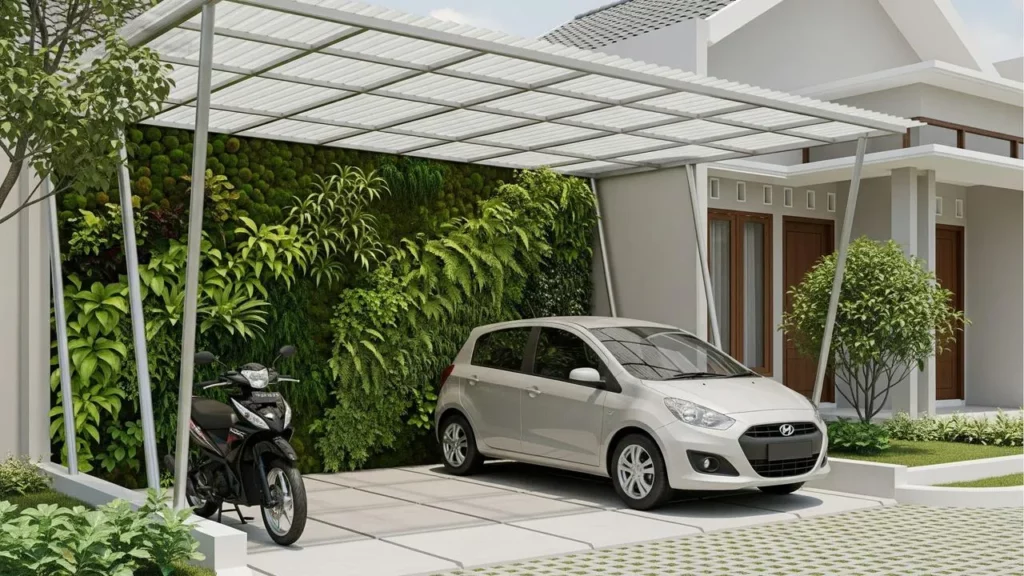
The ideal minimal dimensions for a single-car and motorcycle carport are 3.5 meters by 5.5 meters. This specific dimension, championed by leading architectural and interior design firms like InteriorDesign.ID, is crucial for ensuring full vehicle door clearance, adequate motorcycle parking that doesn’t obstruct movement, and a safe 90 cm pedestrian pathway. Such a pathway is vital for easy maneuvering of baby strollers or folded bicycles towards the main entrance, mitigating the risk of accidental collisions with parked vehicles. This recommended standard moves beyond the often-misleading compact dimensions found in many residential development brochures, which frequently lead to significant functional limitations in everyday use.
Many homeowners, often swayed by brochure layouts, settle for carports measuring a mere 3 x 5 meters. While vehicles like an MPV (e.g., Toyota Kijang Innova) or an SUV (e.g., Mitsubishi Pajero Sport) might theoretically fit within these parameters, the practical reality is starkly different. In real-world scenarios, once a vehicle is parked, occupants struggle to open doors fully. They often resort to squeezing out of the car, contorting their bodies, and holding doors ajar to prevent them from scraping against walls or other obstacles. This constrained environment inevitably forces motorcycles to be parked outside the property gates, compromising security and convenience. As practitioners in the field consistently highlight, the critical factor is not merely the static dimensions of a vehicle, but the "real movement space" required around it for comfortable and safe human activity.
A functional carport design must meticulously account for human movement. This includes routine activities such as unloading groceries from the trunk, children darting towards the main door, or guests arriving with multiple bags. Overlooking these dynamic elements in the planning phase can transform a seemingly adequate space into a daily source of frustration and potential hazard.
Understanding Vehicle Dimensions and Future-Proofing
Before laying out any design, a thorough understanding of vehicle sizes is paramount. A common oversight is designing a carport based on current vehicle ownership without anticipating future changes. For instance, a city car like a Honda Brio or Toyota Agya, averaging around 3.8 meters in length and 1.6 meters in width, might fit comfortably in a 3 x 4 meter carport today. This initial spaciousness, however, is often temporary.
As families grow and evolve, so do their transportation needs. A shift to a larger MPV or SUV is common. For example, the Toyota Innova Zenix measures approximately 4.75 meters in length and 1.85 meters in width. If the carport dimensions remain at 3 x 4 meters, the front of such a vehicle would undoubtedly protrude beyond the property’s boundary or gate, creating an obstruction and potential security risk.
Therefore, experts strongly advise clients to design carports based on the dimensions of the largest vehicle they might foreseeably own in the future. A practical benchmark for a single-car carport would be an SUV with a length of 5 meters and a width of 1.9 meters. This proactive approach ensures long-term functionality and avoids costly modifications down the line.

The presence of motorcycles, particularly larger automatic scooters like the Yamaha NMAX or Honda PCX, also requires dedicated planning. These scooters typically have a body length of about 1.9 meters and handlebar widths of around 75 cm. Merely "squeezing" them into an available gap beside a car is insufficient and risky. Without a properly planned space, the handlebars of a motorcycle can easily scrape against the car’s body when hastily moved, especially during busy mornings. A designated, well-thought-out area for motorcycles prevents damage to both vehicles and streamlines daily routines.
Deconstructing the "Real Movement Space" Concept
Functional architecture prioritizes human scale and reach during activities. For parking areas, this "real movement space" is broadly divided into three critical zones:
1. Door Opening Tolerance
Car doors typically have two to three stages of opening. The first stage, around 30-40 cm, is usually sufficient for quickly grabbing an item from the seat. However, for an adult to comfortably exit or enter the vehicle, a second-stage opening of approximately 60-80 cm from the car body is necessary. For individuals with special needs, such as the elderly, pregnant women, or parents with small children, an even wider clearance of 90 cm to 1 meter might be required for maximum ease and safety.
To illustrate, consider an SUV with a width of 1.9 meters. Adding an 80 cm clearance for the driver’s door and another 80 cm for the passenger door means the pure functional width required for the vehicle alone, accounting for door access, already totals approximately 3.5 meters. This calculation underscores why a 3-meter wide carport is fundamentally inadequate.
2. Pedestrian Pathways & Main Access
Upon exiting a vehicle, occupants immediately transition to walking towards the house entrance. Without a well-defined and unobstructed circulation path, individuals are forced to navigate awkwardly, often sideways, through narrow gaps in front of the car’s hood to reach the terrace.
A single adult requires a minimum width of 60 cm for comfortable walking. However, the front area of a home often sees heavier traffic, with people carrying various bulky items, groceries, or even furniture. More importantly, scenarios like pushing a baby stroller from outside the gate to the main entrance demand ample space. Standard strollers have a wheel width of approximately 60-65 cm. A pathway measuring 90 cm to 1 meter ensures smooth movement for the stroller, free from the risk of scraping against pillars or parked vehicles.
This pedestrian path must remain clear of obstructions. High shoe racks, bulky plant pots, or other decorative elements placed along this route can impede movement and create tripping hazards. Ideally, the pedestrian path should run directly alongside and connect smoothly with the steps leading up to the main terrace.

3. Motorcycle Maneuvering Space
Parking a motorcycle involves more than just static placement; it requires a specific turning radius for maneuvering. This process typically involves moving the motorcycle forward, turning the handlebars, and then backing it into its final stationary position.
If the motorcycle parking area is situated behind the car, close to the terrace, a minimum clearance of 1.5 meters should be maintained between the car’s rear bumper and the building wall. This generous space acts as a critical maneuvering zone for turning the motorcycle’s wheels without striking the car or wall.
For motorcycles parked parallel to the car, alongside it, an additional width of approximately 1.2 meters is needed. This allowance prevents clothes from brushing against the dusty car body while guiding the two-wheeled vehicle into position and provides adequate space to dismount and walk around the motorcycle comfortably.
Ideal Carport Zoning for Optimal Flow
These real movement space requirements can be translated into a fundamental layout for construction drawings. For a land area of, for example, 4 x 6 meters, a strategic zoning approach would be:
- Vehicle Placement: Position the four-wheeled vehicle closer to the boundary wall furthest from the main house access. Maintain a minimum gap of 40 cm between the wall and the car body. This gap prevents side mirrors from hitting the wall and allows for adequate heat dissipation from the engine compartment, which is crucial in tropical climates.
- Wider Access Zone: The side of the car facing the house entrance should have a wider clearance, ideally 1.2 meters. This dual-purpose zone serves as both the primary access area for opening car doors and a comfortable corridor for pedestrians walking to the terrace.
- Dedicated Motorcycle Parking: The motorcycle parking area should be aligned with the pedestrian pathway. It can be positioned closer to the property fence or adjacent to the edge of the terrace floor. Separating the motorcycle route from the car’s parking space significantly improves morning mobility, as it eliminates the need to move the car just to free up the motorcycle’s exit path. This thoughtful separation minimizes daily friction and maximizes efficiency.
Technical Considerations: Floor Elevation and Ramp Management
The management of floor elevation and ramp gradients is frequently overlooked during construction, yet it profoundly impacts the functionality and longevity of a carport. A perfectly flat (waterpas) carport floor, while seemingly straightforward, creates several problems.
Carports are exposed to the elements, including rain and car washing activities. A flat surface will inevitably retain stagnant water, dirt, and soap residue. This not only creates an unsightly and unhygienic environment but also accelerates the deterioration of flooring materials. To counteract this, a subtle slope of 1% to 2% is essential. Technically, this means for every 1 meter of length, there should be a 1-2 centimeter drop in elevation. For a 5-meter long carport, the end nearest the house terrace should be 5 to 10 cm higher than the outermost edge near the street boundary, ensuring efficient water runoff towards street drains.

The transition from the street asphalt to the carport, typically a ramp, also demands careful design. An overly steep or abruptly angled ramp can easily cause the front bumper of sedans or lower-clearance vehicles to scrape against the surface. The maximum safe angle for a ramp’s curved transition should be no more than 15 percent. The connection between the street asphalt and the concrete ramp must be designed with a gradual, smooth curve. If the building plot is significantly higher than the street, a longer ramp dimension is necessary to achieve this gentle slope, preserving vehicle undercarriages.
The surface of the carport floor endures heavy daily traffic and exposure. Therefore, material selection is critical. Durable, non-slip options such as natural stone pavers, heavy-duty ceramic tiles (with high PEI ratings), or exposed aggregate concrete are highly recommended. These materials possess textured or porous surfaces that provide better grip, preventing slips and falls, especially when the surface is wet from rain or vehicle washing. Consulting specific guides for minimalist home carport flooring can provide further material insights.
Strategic Gate Selection
The design of the protective gate can significantly impede or facilitate vehicle maneuverability from the street. An improperly chosen or installed gate can negate all other thoughtful design elements.
For carport openings measuring 3.5 to 4 meters wide, folding gates or sliding gates (without central concrete pillars) are highly suitable. Central pillars drastically reduce the effective entry width, making it difficult for vehicles to pass through without careful, time-consuming maneuvers. Sliding gates require an adjacent wall section to serve as a rail. If space is constrained by a neighboring property’s wall, a stacking gate (multiple panels that fold and slide compactly) offers an excellent alternative.
Crucially, the small pedestrian gate, specifically for those entering or exiting on foot, must be designed to open outward towards the street. Gates that open inward towards the garden or carport often collide with the front of a parked car, particularly if the engine is running or if there’s insufficient clearance, creating an unnecessary obstruction and potential damage.
Vehicle Area Lighting Specifications
Effective lighting is an essential yet often underestimated component of a functional and safe carport and front building area. Insufficient illumination hampers activities like unloading groceries, compromises nighttime security, and diminishes the overall aesthetic appeal of the home’s facade.

Modern lighting systems advocate for a layered approach rather than relying on a single overhead light. This tiered distribution of light better caters to the diverse needs of residents and visitors. Exterior-grade LED downlights (with an IP65 rating for dust and water resistance) should be strategically installed as general ambient lighting on the canopy ceiling. An intensity of 150-200 Lux provides clear visibility without causing glare that might disturb neighbors.
Task lighting should be focused where it’s most needed. Wall-mounted lights can direct a focused beam towards key areas like the house door handle or a pillar designated for helmet storage. This direct illumination eliminates the frustration of fumbling with keys in the dark.
For aesthetic enhancement, small, recessed spot lights embedded at the base of facade walls can highlight architectural features, such as natural stone textures, adding depth and visual interest to the home’s exterior at night. Further details on wattage calculations, motion sensor integration, and specific lighting types can be found in specialized articles on safe terrace and carport lighting.
Integrating the Carport with the Main Terrace
Contemporary architectural trends increasingly favor seamless integration between the family terrace and the vehicle shelter, moving away from distinct, separated spaces. The design of a single-car carport now often harmonizes with the overall theme and functionality of adjacent living areas.
A subtle elevation difference of 10-15 cm between the carport floor (often asphalt or rougher tiles) and the main terrace (ceramic tiles) serves a practical purpose: it acts as a low barrier to prevent water runoff, soap residue from car washing, or dirt from splashing onto the cleaner, more relaxed terrace area.
Optical boundaries can further enhance this integration without physical dividers. This is achieved by strategically employing different ceramic tile patterns or textures. For instance, a coarse, durable, elongated tile pattern can mark the tire tracks and heavy-traffic areas of the carport. As the space transitions to the pedestrian path and the more leisurely terrace seating area, smoother, finer-textured tiles from a similar color palette can be installed. This visual distinction defines zones while maintaining a cohesive aesthetic. Detailed guides on expanding these optical boundary patterns are often available in articles on minimalist small-scale terrace and garage designs.
Safe Ceiling and Gutter Specifications

Overlooking the vertical clearance of the carport roof structure can lead to significant issues. A canopy steel frame installed too low can damage the upper bodywork of larger family vehicles, especially those with roof racks or taller profiles.
A safe vertical clearance between the carport floor and the lowest point of the roof structure (e.g., steel beams or ceiling panels) is typically between 2.8 and 3 meters. This generous clearance ensures that vehicles, even those equipped with roof racks carrying luggage or bicycles, can enter and exit without the risk of snagging or collision.
Furthermore, a well-designed roof structure should not be completely enclosed. An open or semi-open roof design facilitates air circulation. This is crucial for dissipating the hot air and exhaust fumes from a recently driven engine, preventing them from accumulating and creating an uncomfortable, stagnant atmosphere near the outdoor terrace.
For roofing materials, options like uPVC hollow core panels (e.g., Alderon), tough transparent polycarbonate sheets, or frosted glass offer excellent solutions. These materials provide effective shade, block harmful UV rays, and significantly reduce heat transfer, all while allowing ample natural light to filter through, ensuring the carport and adjacent areas remain bright during the day without excessive reliance on artificial lighting.
Finally, a properly installed gutter system is indispensable. Gutters should be strategically placed to collect and direct rainwater from the edges of the canopy into a closed downspout, leading it efficiently to the property’s drainage system. Uncontrolled runoff from the roof edges can cause dirty water to splash and drip onto vehicles, leaving stubborn stains and potentially damaging the paintwork over time.
Construction Oversight and Avoiding Fatal Flaws
Even the most meticulously designed plans on paper can be poorly executed in the field, leading to functional failures and costly rectifications. Homeowners must actively oversee construction and be aware of common pitfalls.
- Utility Placement: Items like hose bibs or outdoor electrical outlets, if installed directly in the path of tire tracks, are highly susceptible to being run over and damaged, leading to leaks or electrical hazards. These utilities should be mounted flush against a building pillar or wall, out of the direct path of vehicles. Similarly, protruding electricity meter boxes or distribution panels on walls can cause shoulder bumps or snagging for residents carrying bags or children while navigating narrow access ways.
- Vehicle Proximity to Walls: Parking a car with its rear bumper pressed tightly against a terrace pillar or wall can direct hot exhaust fumes directly into adjacent living spaces. A buffer of approximately 80 cm behind the rear tires is recommended. This clearance not only allows for proper exhaust ventilation but also provides essential space for accessing the trunk, especially for hatchback vehicles with upward-opening rear doors, simplifying loading and unloading.
- Inappropriate Flooring Materials: Areas directly under tire contact must never be paved with glossy, smooth interior tiles. Such surfaces offer poor traction, especially when wet, and cannot absorb oil or fluid leaks. This creates a dangerously slippery surface, increasing the risk of slips, falls, and injuries. Durable, textured, and slip-resistant materials are paramount.
- Sacrificing Walkways for Aesthetics: While aesthetically pleasing, overly wide garden pots (e.g., 50 cm thick) can significantly reduce the effective width of pedestrian paths. Prioritizing a clear, ample walkway over minor decorative elements is crucial for daily convenience and safety.
The precision of these spatial calculations directly impacts the fluidity and safety of daily transportation activities. Regularly review the design diagrams, and ensure that specific notes regarding elevation, clearances, and material choices are clearly communicated to your construction team. A well-designed and meticulously executed carport enhances safety, convenience, property value, and overall living quality, ensuring a smooth and stress-free experience for years to come.








