Azin Asro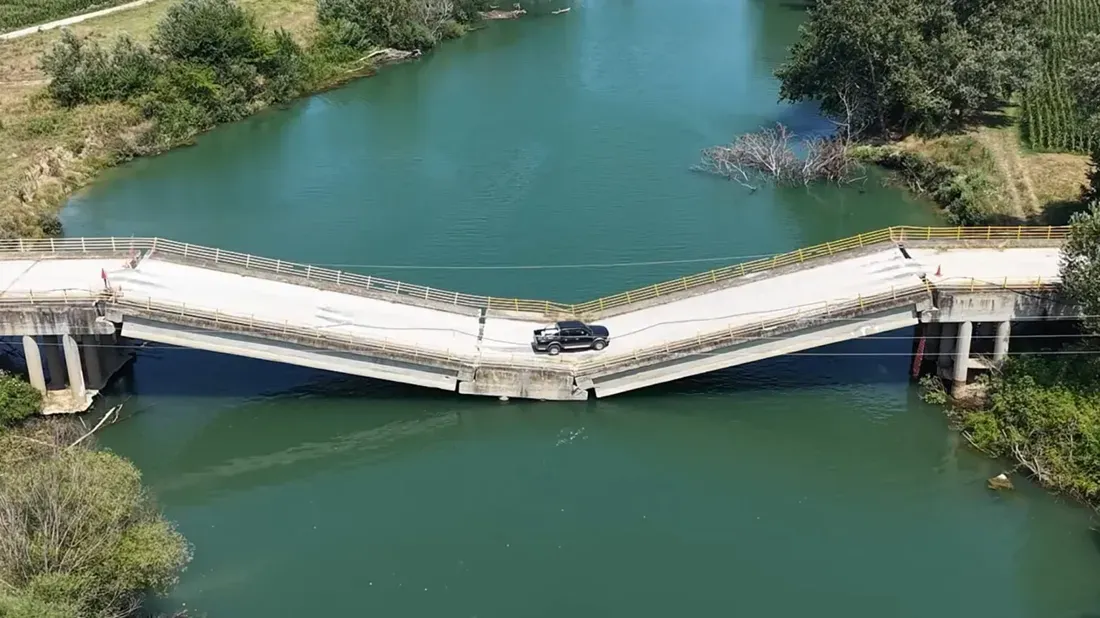
The Palaiopygros bridge, a vital link spanning the Pineios River near the city of Larissa in central Greece, remains a haunting symbol of the catastrophic weather events that ravaged the Mediterranean in late 2023. Despite a significant structural failure that has left the center of the concrete span sagging just inches above the water line, local residents and agricultural workers continue to utilize the crossing. This precarious behavior, captured in recent footage showing heavy vehicles navigating the buckled ruins, underscores a deepening frustration with the pace of reconstruction and the economic desperation facing the Thessaly region’s farming community.
The bridge’s current state is the result of the extreme hydraulic pressure and flooding caused by Storm Daniel, a "medicane" (Mediterranean hurricane) that struck the region in September 2023. While traffic signs have been erected to prohibit passage, the lack of physical barriers has allowed motorists to treat the collapsed structure as a makeshift off-road course. For many in the rural outskirts of Larissa, the risk of a total structural failure is weighed against the immediate costs of long detours and rising fuel prices, highlighting a critical gap between public safety protocols and the logistical realities of Greek agricultural life.
The Chronology of a Catastrophe: Storm Daniel and Its Aftermath
The destruction of the Palaiopygros bridge was not an isolated incident but part of a broader environmental disaster that redefined the limits of Greek infrastructure. In early September 2023, Storm Daniel unleashed what meteorologists described as a "one-in-a-thousand-year" rainfall event. Over the course of several days, parts of central Greece received more rain than they typically see in a year and a half. In the village of Zagora, located in the neighboring Pelion region, 754 millimeters of rain fell in just 24 hours—a record for the country.
The resulting floods transformed the Thessaly plain, Greece’s primary agricultural hub, into a vast inland sea. As the Pineios River burst its banks, the sheer volume of water and debris exerted immense pressure on bridge piers and foundations. In total, the Greek Ministry of Infrastructure and Transport reported that 79 bridges across the region were either completely destroyed or rendered structurally unsound. The Palaiopygros bridge suffered a partial collapse of its central support, causing the concrete deck to "V" downward, nearly touching the rushing water below.
The timeline of recovery has been hampered by subsequent weather events. Just weeks after Storm Daniel, Storm Elias struck the same region, bringing further flooding and complicating initial damage assessments. While the Greek government quickly pledged billions of euros for reconstruction, the sheer scale of the damage across thousands of square kilometers has led to a prioritized list of repairs that has left smaller, secondary crossings like the Palaiopygros bridge in a state of limbo for over a year.
Socio-Economic Pressures and the Risk of Negligence
The continued use of the collapsed bridge is driven by the economic geography of the Larissa region. As the capital of Thessaly, Larissa is surrounded by intensive agriculture, including cotton, corn, and grain production. For farmers operating on both sides of the Pineios River, the Palaiopygros bridge serves as a shortcut between fields and processing facilities.
According to local reports, bypassing the damaged bridge requires a detour of several kilometers through congested secondary roads or larger highway interchanges. For heavy agricultural machinery and transport vehicles, such as the Ford Ranger SUVs and tractors frequently seen on the bridge, these detours represent a significant increase in fuel consumption and labor time. In an economy still recovering from inflationary pressures and the loss of crops during the 2023 floods, many locals view the risk of crossing the bridge as a necessary gamble.
However, engineering experts warn that this "gamble" is increasingly dangerous. The structural integrity of a reinforced concrete bridge relies on the continuity of its tension and compression zones. Once a span has buckled to the degree seen at Palaiopygros, the internal rebar is likely stretched beyond its elastic limit, and the remaining supports are under stresses they were never designed to withstand. Each crossing by a heavy vehicle creates vibrations and dynamic loads that further fatigue the compromised materials. There is a high probability that the bridge could suffer a "sudden-onset" total collapse, particularly if further erosion occurs at the riverbed level during the winter rainy season.
Supporting Data: The Scale of the Thessaly Infrastructure Crisis
The crisis in Thessaly is reflected in staggering statistics that illustrate the challenge facing the Hellenic Republic. The following data points provide context for the regional struggle:
- Agricultural Impact: Thessaly accounts for approximately 15% of Greece’s total agricultural output. The 2023 floods submerged over 150,000 hectares of land, leading to the loss of thousands of livestock and the destruction of high-tech irrigation systems.
- Infrastructure Damage: Beyond the 79 bridges, the floods damaged over 1,000 kilometers of the regional road network and significant portions of the national railway line connecting Athens and Thessaloniki.
- Financial Burden: The total cost of the damage in Greece was estimated by the European Commission to be roughly €2.5 billion. The Greek government has accessed the European Union’s Solidarity Fund, but the disbursement of these funds involves rigorous bureaucratic hurdles and environmental impact assessments.
- Historical Context: While some reports suggest the bridge has been damaged for "three years," this likely refers to a cumulative degradation beginning with Storm Ianos in 2020, which also caused significant flooding in Thessaly. The 2023 events were the final blow that rendered the structure unusable by modern safety standards.
Official Responses and the Challenge of Enforcement
The Greek Ministry of Infrastructure and Transport has emphasized that the safety of citizens is a primary concern, yet the enforcement of road closures in rural areas remains difficult. While local police and municipal authorities in Larissa have placed warning signs and "no entry" markers, they lack the resources to station guards at every damaged crossing in the province.
Government officials have recently announced the "Thessaly Recovery Plan," which includes the creation of a specialized agency to oversee the reconstruction of the region. Prime Minister Kyriakos Mitsotakis has stated that the goal is not just to rebuild, but to "build back better" with climate-resilient designs that can withstand the increasingly frequent extreme weather events. However, for the residents of Palaiopygros, these long-term promises offer little relief for their daily logistical hurdles.
Legal experts have also raised concerns regarding liability. Should a vehicle fall into the Pineios River while crossing the bridge, the driver would likely be held liable for ignoring government signage. Yet, there is also a growing movement among local community leaders to hold the state accountable for the delay in providing temporary bridging solutions, such as Bailey bridges (portable, pre-fabricated truss bridges) that are often used by the military in emergency situations.
Broader Implications for Climate Resilience and Policy
The situation at the Palaiopygros bridge serves as a microcosm of the broader challenges facing Mediterranean nations in the era of climate change. As the sea temperatures of the Mediterranean rise, the region is becoming a breeding ground for more intense and unpredictable storms. Traditional infrastructure, designed for the weather patterns of the 20th century, is proving inadequate for the 21st.
The persistent use of the bridge also highlights a "normalization of risk" that occurs when infrastructure remains broken for extended periods. When a bridge is not repaired for months or years, the initial fear of the damage is replaced by a routine of bypass, eventually leading to the dangerous behavior witnessed in Larissa. This creates a secondary crisis: a breakdown in the trust between the rural population and the central government’s ability to provide essential services.
To address this, analysts suggest that the Greek government must prioritize "quick-win" infrastructure projects—smaller interventions that restore connectivity even if a permanent, high-cost bridge is years away. Furthermore, there is a need for better communication regarding the specific risks of structural fatigue to discourage the public from taking life-threatening shortcuts.
Conclusion
The sight of an SUV traversing the mangled remains of the Palaiopygros bridge is a stark reminder of the resilience—and the desperation—of the people of Thessaly. While the bridge remains a monument to the destructive power of Storm Daniel, it also serves as a warning of the consequences of delayed reconstruction. As Greece continues to navigate the complex financial and logistical path toward recovery, the safety of its citizens depends not only on the arrival of new concrete and steel but on the immediate enforcement of safety standards and the provision of viable, safe alternatives for the agricultural heartbeat of the nation. Until then, the Pineios River remains a dangerous crossing for those who feel they have no other choice but to drive over the edge of a disaster.