Nila Kartika Wati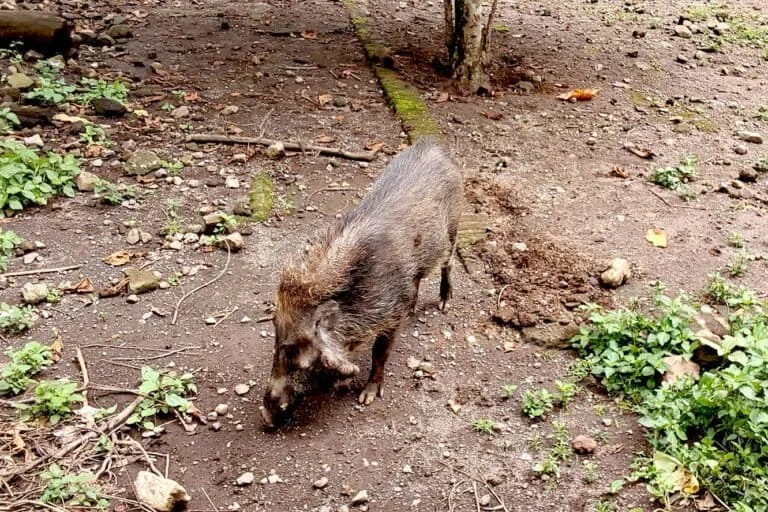
For the farmers of Pundakit Timur Village on Bawean Island, the arrival of dusk does not signal a time for rest but rather the beginning of a high-stakes vigil. As the sun sets over the Java Sea, men like Arkham prepare to defend their livelihoods against a persistent and elusive intruder. For months, these farmers have meticulously tended to their crops of rice, corn, cassava, and bananas, only to see their hard work threatened in a single night by the Bawean warty pig. To the local community, these animals are a destructive agricultural pest, a nuisance that raids fields and depletes the meager profits of small-scale farming. However, to the global scientific community, these same animals represent one of the most critically endangered mammals on Earth, a unique evolutionary lineage teetering on the precipice of total extinction.
The Bawean warty pig (Sus verrucosus blouchi) is a subspecies endemic exclusively to Bawean Island, a small volcanic outcrop covering just 196.3 square kilometers in the Gresik Regency of East Java. This isolation has created a biological treasure, but it has also created a geographical trap. With a population estimated to be between 172 and 467 individuals, the species is confined to a fragmented habitat of protected forests spanning a mere 46.6 square kilometers. The International Union for Conservation of Nature (IUCN) has classified the species as Endangered, though many experts argue its precarious numbers and limited range make it one of the most vulnerable suids in the world.
The Biological Identity of a Rare Endemic
Physically, the Bawean warty pig is a striking creature, distinct from the more common wild boars found across the Indonesian archipelago. Its most defining characteristic is the presence of three pairs of large, hardened flesh protuberances—or "warts"—located around the snout. These grape-sized growths are found only on males and are believed to serve as protective padding during ritualized combat with rivals. Additionally, the species sports a distinctive mane of long hair that runs from the crown of the head along the spine to the tail.
The rarity of the species was highlighted in a comprehensive 2016 survey led by Mark Rademaker of VHL University of Applied Sciences in the Netherlands. Utilizing an array of 100 camera traps, Rademaker’s team provided the first robust data on the pig’s distribution and behavior. The study confirmed that the Bawean warty pig is not only one of the rarest pigs in the world but also an essential component of the island’s ecosystem. As a "forest engineer," the pig plays a vital role in seed dispersal and the aeration of forest soil through its foraging habits, facilitating the natural regeneration of the island’s unique vegetation.
The Triple Threat: Poaching, Logging, and Pathogens
Despite its ecological importance, the Bawean warty pig faces a trifecta of threats that jeopardize its continued existence. The most immediate threat is human-wildlife conflict, which often escalates into illegal hunting. Faldy Devalen Fehabtoro, Chairman of the Binaya Foundation, conducted an intensive ecological study of the species from January to March 2025. His findings revealed a sobering reality: even within the boundaries of nature reserves and wildlife sanctuaries, the pigs are not safe.
Fehabtoro’s team discovered numerous signs of poaching, including the tracks of hunting dogs, steel wire snares, nylon traps, and discarded spears. Many residents of the buffer zone villages justify this hunting as a form of pest control. When the pigs descend from the hills to forage in agricultural lands, farmers feel they have no choice but to take lethal action to protect their food security. This conflict is exacerbated by the fact that the pigs are most active at night, making them difficult to deter without constant surveillance or physical barriers.
Adding to the pressure is the ongoing issue of illegal logging. The "buluh" tree (Irvingia malayana) is a primary target for illegal loggers due to its high economic value. The removal of these trees does more than just deplete timber; it destroys the canopy and the undergrowth that the warty pigs rely on for cover and food. As the highland and mixed forests of Bawean are thinned out, the pigs are forced closer to human settlements in search of sustenance, further fueling the cycle of conflict.
Perhaps the most terrifying threat, however, is one that cannot be stopped by a snare or a spear: the African Swine Fever (ASF) virus. Jochen Klaus Menner, a curator at the Prigen Conservation Breeding Ark (PCBA), has identified ASF as the single most significant existential threat to the species today. ASF is a highly contagious and lethal viral disease that affects both domestic and wild pigs. Because the Bawean warty pig population is small and geographically isolated, they lack the genetic diversity or the migratory options to survive an outbreak.
"Humans can transmit the virus to pigs through contaminated clothing, food, or equipment," Menner explained. "Because they are isolated on a small island with no possibility of migration, a single outbreak of ASF could trigger a mass mortality event and lead to extinction in a very short time. The Bawean warty pig is currently the most threatened pig species in the world."
Conservation Strategies and Ex-Situ Safeguards
In response to the looming threat of ASF and the continued decline of the wild population, conservationists have turned to ex-situ measures. The Prigen Conservation Breeding Ark (PCBA) currently manages a small safety-net population consisting of three individuals—two males and one female. These animals are kept in a highly controlled environment outside of their natural habitat to ensure that if a catastrophic event occurs on Bawean Island, the genetic lineage of the subspecies will not be lost forever.
While there are currently no plans for immediate reintroduction into the wild, the breeding program serves as a biological insurance policy. The goal is to stabilize the captive population and gain a deeper understanding of the species’ reproductive biology, which remains largely under-researched.
On the island itself, experts are advocating for a more integrated approach to conservation that addresses the needs of the local farmers. Faldy Devalen Fehabtoro has recommended several mitigation strategies designed to reduce crop raiding without harming the animals. These include the establishment of "buffer forests" between the wildlife sanctuary and agricultural land, as well as the implementation of agroforestry systems.
One promising solution involves the use of "living fences" made from thorny or pungent plants. Species such as thorny bamboo and Lantana camara—a flowering shrub with a scent that pigs find repulsive—could be planted around fields to create a natural deterrent. These biological barriers are more sustainable and humane than steel snares or spears and could provide farmers with a way to protect their crops while allowing the pigs to remain in their natural forest habitat.
The Socio-Ecological Irony of Bawean
The situation on Bawean Island presents a profound socio-ecological irony. Research conducted by the Binaya Foundation suggests that the majority of residents in the four main buffer villages are actually well-aware of the pig’s ecological importance. Survey respondents acknowledged that the pigs help the forest grow by spreading seeds and that their presence is a sign of a healthy ecosystem.
However, this intellectual understanding often collapses when faced with economic reality. For a subsistence farmer, the theoretical value of a rare pig does not outweigh the immediate loss of a season’s harvest. "They know the pig is important," Fehabtoro noted. "But when the fields are destroyed every night before the harvest, that knowledge is often secondary to the more urgent need for survival."
This disconnect suggests that conservation efforts must go beyond biology and enter the realm of social engineering and economic support. To save the Bawean warty pig, conservationists must work with village governments, religious leaders, and academic institutions to create a community-based conservation model. This could include compensation schemes for crop loss, the development of eco-tourism initiatives that provide alternative income, or the provision of modern agricultural tools that are more resilient to wildlife interference.
Analysis of Implications and Future Outlook
The fate of the Bawean warty pig is a litmus test for Indonesia’s ability to protect its endemic biodiversity in the face of human expansion and globalized threats like ASF. If the species were to go extinct, it would not only be a loss for global biodiversity but also a failure of the ecological systems that sustain Bawean Island itself. Without the warty pig to facilitate forest regeneration, the island’s water catchment areas and soil stability could eventually be compromised, leading to long-term agricultural challenges far worse than a raided cornfield.
The chronology of the pig’s decline—from its recognition as a distinct subspecies to its current status as a critically endangered relic—highlights the speed at which isolation can turn from an evolutionary advantage into a conservation nightmare. The next five years will be critical. The success of the PCBA breeding program, combined with the implementation of effective buffer zones on the island, will determine whether the Bawean warty pig remains a living part of Indonesia’s heritage or becomes another entry in the growing list of extinct species.
Ultimately, the survival of Sus verrucosus blouchi depends on a fragile truce between the people of Bawean and the animals that share their home. As Arkham and his fellow farmers continue their nightly patrols, the hope is that new strategies will soon allow them to lay down their spears, ensuring that both the farmers’ harvests and the world’s rarest pigs can thrive in the unique landscape of Bawean.