Nila Kartika Wati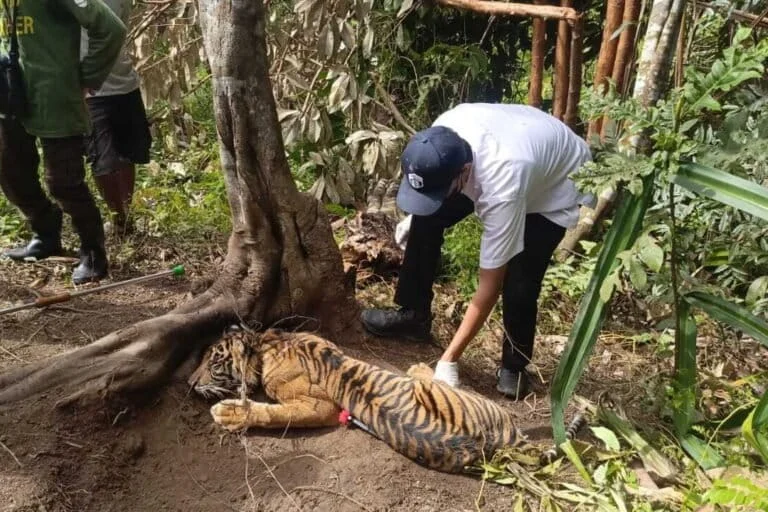
The critical endangerment of the Sumatran tiger (Panthera tigris sumatrae) has been brought into sharp focus once again following the rescue of an 11-month-old female tiger in Pasaman Regency, West Sumatra. On Thursday, May 21, 2026, the young predator was found severely entangled in a wire snare intended for wild boars in Jorong Lima Sempadang, Nagari Padang Mantigi Utara. This incident serves as a grim reminder of the persistent threat posed by unregulated trapping devices in the region’s forests and agricultural fringes. The tiger is currently receiving intensive medical treatment at the Animal Transit Center (TTS) managed by the West Sumatra Natural Resources Conservation Agency (BKSDA), as experts warn that without immediate regulatory intervention, the "silent killer" of snares will continue to decimate Indonesia’s remaining apex predators.
Chronology of the Rescue Operation
The incident began on the morning of May 21, when a local farmer arrived at his rubber plantation to find a large, striped animal struggling violently. The farmer immediately reported the discovery to local authorities, who then alerted the BKSDA Pasaman Resort. Edi Susilo, the Head of the BKSDA Pasaman Resort, confirmed that the team received the report in the early morning hours and mobilized a specialized rescue unit.
The rescue team reached the remote plantation site at approximately 1:30 PM WIB. Upon arrival, they discovered a juvenile female tiger, estimated to be less than a year old, trapped in a "jerat ratus"—a heavy-duty wire snare commonly used by locals to catch wild pigs. The animal was in a state of high distress, alternating between aggressive lunges and exhausted moans as it tried to free itself.
According to Edi Susilo, the snare was particularly damaging because it had coiled around the animal multiple times. "The tiger was entangled in five different loops of wire. The snares were constricted around her neck, her front torso, and her right front leg, specifically under the armpit area," Susilo stated. The complexity of the entanglement necessitated a delicate approach to prevent further injury or a lethal flight response.
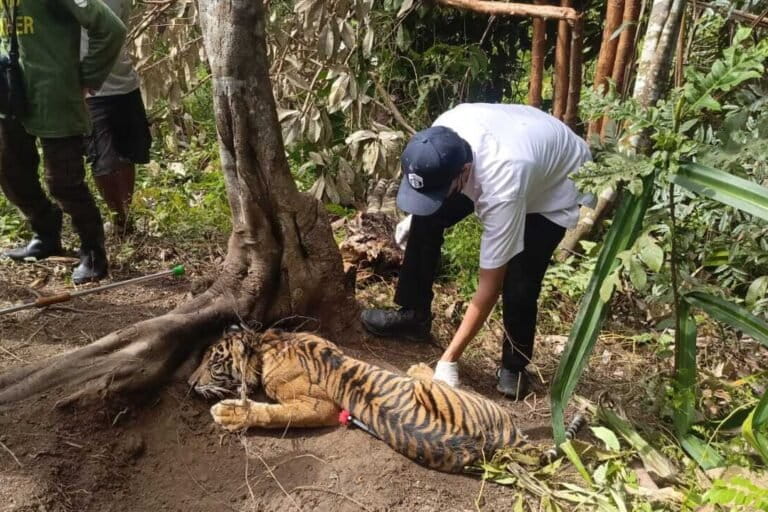
To ensure the safety of both the animal and the rescue team, the BKSDA veterinarians performed a remote sedation via a tranquilizer dart. Once the tiger was unconscious, the team moved in to carefully cut away the high-tension wires that had bitten into her flesh. Following the successful removal of the snares, the tiger was stabilized and transported to the BKSDA West Sumatra transit facility for further observation and wound care.
The Ecological Trap: Why Young Tigers are Vulnerable
The presence of the 11-month-old cub in a rubber plantation highlights a dangerous phase in the life cycle of Sumatran tigers. At this age, cubs are in a critical learning period, following their mothers and practicing their hunting skills. Edi Susilo noted that while adult tigers are often experienced enough to detect or avoid human-made disturbances, curious and inexperienced juveniles are much more likely to stumble into traps.
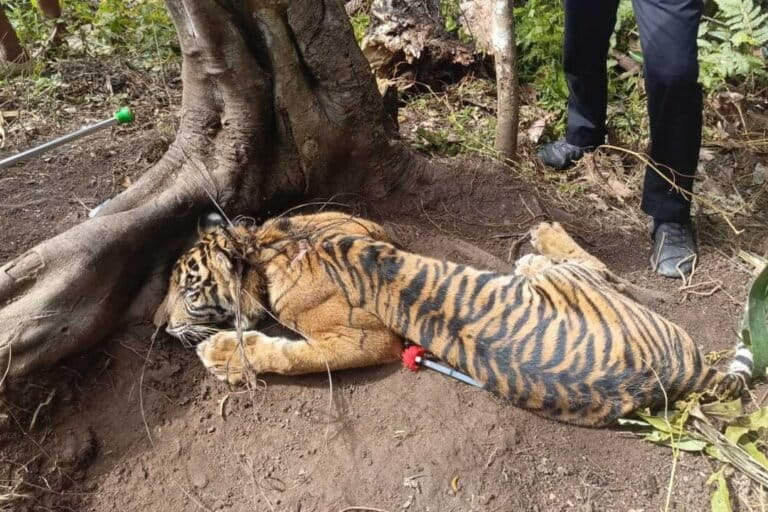
"The snare was set for wild boars, which are the primary prey for tigers in this region," Susilo explained. "While a small pig might be able to slip through or trigger the trap without being caught, the larger, more muscular frame of a tiger—even a juvenile—ensures that once they step into the loop, the wire tightens and holds them fast."
Evidence suggests that this cub was not alone. BKSDA officials believe there are at least three tigers currently roaming the vicinity of Nagari Padang Mantigi Utara: one adult mother and two cubs, including the one that was rescued. This proximity to human activity creates a high-risk environment for "Human-Wildlife Conflict" (HWC). In response, the BKSDA has issued an advisory to the local community, urging farmers to vacate their plantations by 4:00 PM or 5:00 PM, as tigers are nocturnal hunters and become most active during the twilight hours. Furthermore, residents have been advised not to enter forested areas alone.
A Pattern of Mortality: West Sumatra’s Snare Epidemic
The May 2026 incident is far from an isolated event. West Sumatra has become a hotspot for snare-related tiger injuries and deaths over the past two years. A review of recent records indicates a disturbing trend:
- November 2025: A tiger was found trapped in a community plantation in the Bukit Koto Tabang area, Agam Regency.
- March 2025: A tiger was successfully captured in a box trap in Matur, Agam, after it was spotted wandering near human settlements due to habitat fragmentation and prey scarcity.
- July 2024: A tragic incident resulted in the death of a Sumatran tiger that succumbed to its injuries after being caught in a wire snare for several days before discovery.
These recurring incidents suggest that despite the Sumatran tiger’s status as a protected species under Law No. 5 of 1990, the practical application of conservation laws on the ground is struggling to keep pace with the proliferation of illegal and semi-legal trapping.
The Case for National Snare Regulation
Wildlife experts are now calling for a fundamental shift in how Indonesia manages the use of snares. Dwi Nugroho Adhiasto, a prominent wildlife trade and conservation expert, argues that the current approach—relying on occasional "snare sweeps" by rangers—is insufficient.
"Snares are the most dangerous threat to wildlife today because they are easy to make, cheap to acquire, and almost impossible to regulate under current laws," Adhiasto said. He pointed out that unlike firearms, which require permits and leave a ballistic trail, snares can be fashioned from simple industrial cables, nylon ropes, or even bicycle brake wires. They are often produced by home industries or assembled on-site by hunters.
Adhiasto emphasized that the ratio of hunters placing snares to the number of rangers removing them is heavily skewed. "A single hunter can set dozens of snares in a single afternoon, whereas a patrol team might spend a week searching the thick undergrowth just to find five or ten," he added.
The expert consensus is that Indonesia needs a specific legal framework to regulate the distribution and possession of materials used for large-scale snaring. This could include:
- Restricting Sales: Monitoring the sale of high-tension steel cables in regions adjacent to protected forests.
- Liability Laws: Holding landowners accountable if snares are found on their property, incentivizing them to clear traps.
- Banning Non-Discriminatory Traps: Legally distinguishing between small-scale traditional traps and the lethal wire snares that pose a risk to megafauna.
The "Silent Forest" Phenomenon
Sunarto, a leading Wildlife Ecologist, warned that the snare crisis is not unique to Sumatra but is a systemic issue across Southeast Asia, particularly in the Indochina region. He referred to the "Empty Forest" or "Silent Forest" syndrome, where forests remain physically intact, but the wildlife has been completely stripped away by indiscriminate trapping.
"Snares are non-discriminatory. They don’t care if they catch a pig, a tiger, a sun bear, or even a human," Sunarto remarked. He noted that many snares are "set and forgotten," meaning that if an animal is caught and the hunter does not return, the animal dies a slow, agonizing death from dehydration, infection, or predation while immobilized.
The ecological impact of losing a single tiger is profound. As apex predators, Sumatran tigers regulate the populations of herbivores like wild boars and deer. When tiger populations decline, boar populations can explode, ironically leading to more crop damage for the very farmers who set the snares in the first place. This creates a vicious cycle of ecological imbalance and increased human-wildlife conflict.
Implications for Conservation Policy
The rescue in Pasaman serves as a critical data point for the Ministry of Environment and Forestry (KLHK). While the tiger’s survival is a victory for the BKSDA team, the long-term survival of the species remains in jeopardy. Current estimates suggest that fewer than 600 Sumatran tigers remain in the wild, fragmented across several landscapes including Gunung Leuser, Kerinci Seblat, and Bukit Barisan Selatan.
The socio-economic aspect of the problem cannot be ignored. Farmers in Pasaman and Agam often use snares as a desperate measure to protect their livelihoods from wild boar raids. Therefore, any move toward regulation must be accompanied by alternative conflict-mitigation strategies. These could include:
- Government-subsidized fencing: Providing physical barriers that do not harm wildlife.
- Compensation schemes: Streamlining the process for farmers to receive financial aid when crops are destroyed by wildlife.
- Community-based patrols: Training locals to become "forest guardians" who are paid to remove snares rather than set them.
As the 11-month-old tiger recovers in the BKSDA facility, the focus shifts to her eventual release. For a tiger to be successfully reintroduced to the wild, she must not only be physically healed but must also retain her fear of humans—a challenge in a rehabilitation setting. Her story remains a symbol of the fragile boundary between Indonesia’s burgeoning agricultural needs and the survival of its most iconic natural heritage. The message from experts is clear: without a robust regulatory framework for snares, the Sumatran tiger is walking into a future where the odds are increasingly stacked against its survival.