Nasution Nanang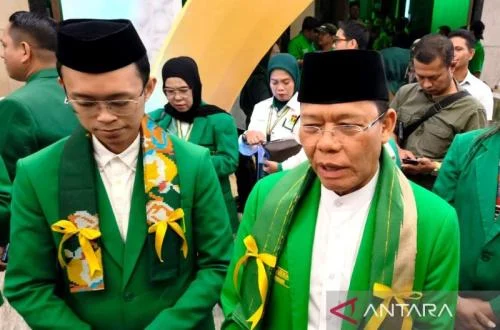
MAKASSAR, South Sulawesi – Muhamad Mardiono, the Chairman of the United Development Party (PPP), has laid down a formidable challenge for the newly inaugurated provincial board of PPP South Sulawesi, demanding that the party secures the highest vote count in the upcoming legislative elections. This ambitious directive was delivered following the official inauguration of the PPP South Sulawesi Regional Executive Board (DPW) for the 2026-2031 period, held at Hotel Claro Makassar on Saturday. Mardiono expressed unwavering optimism that the fresh composition of the leadership would invigorate the party’s electoral performance, propelling it back to its former glory, a status it has enjoyed since its inception in 1973.
"We are targeting to achieve the highest vote acquisition in South Sulawesi. While there was a commendable increase in 2024, our ambition remains set on an even greater target," Mardiono stated to reporters, underscoring the party’s resolve to not only build upon past successes but to surpass them significantly. The mandate reflects a strategic pivot towards strengthening regional strongholds as a foundation for national resurgence, particularly in the wake of the party’s recent electoral setbacks at the national level.
Aspirations for South Sulawesi DPRD Leadership
Mardiono’s vision extends beyond merely increasing vote share; he explicitly articulated the party’s aspiration to secure the chairmanship of the South Sulawesi Regional House of Representatives (DPRD). This objective signifies a deep commitment to exerting substantial influence within the provincial legislative body, asserting that legislative and executive struggles must progress in tandem to achieve comprehensive political impact. The PPP chairman emphasized the symbiotic relationship between these two spheres, asserting that success in one domain naturally complements and strengthens efforts in the other.
"Perhaps it is now PPP’s turn to lead the South Sulawesi DPRD. This is a goal we are actively fighting for, just as we are striving in the executive arena. Both must align, running in parallel; that is our ultimate objective," he reiterated with emphasis, signaling a comprehensive strategy that targets both governance and policymaking at the provincial level. This goal is particularly potent given South Sulawesi’s considerable political weight and the competitive nature of its electoral landscape, where the DPRD chairmanship often serves as a significant indicator of a party’s regional dominance and influence.
Historical Context and the Significance of South Sulawesi
The United Development Party, or PPP, boasts a rich and complex history in Indonesian politics. Established on January 5, 1973, through the forced merger of four Islamic parties—Nahdlatul Ulama, Parmusi, PSII, and Perti—under the New Order regime, PPP was intended to be the sole Islamic political vehicle. Throughout the New Order era, it served as one of only two government-sanctioned opposition parties, alongside the Indonesian Democratic Party (PDI). Its unique position allowed it to maintain a consistent presence in the political arena, often drawing significant support from religious communities across the archipelago.
Post-Reformasi, with the liberalization of the political system, PPP faced increased competition from a multitude of new parties, including other Islamic-based parties. Despite these challenges, it has consistently managed to secure seats in the national parliament (DPR RI) in every election since 1999, often playing a crucial role in coalition governments. Its electoral performance, however, has seen fluctuations, peaking at certain junctures and experiencing declines in others.
South Sulawesi, where the current targets are set, represents a critical battleground in Indonesian politics. As one of the most populous provinces in Eastern Indonesia, with a vibrant economy and a strong traditional and religious base, it holds significant electoral sway. The province’s political landscape is characterized by robust competition among various national and local parties, making any claim to legislative leadership a testament to substantial grassroots mobilization and strategic campaigning. For PPP, a party with historical ties to Islamic communities, South Sulawesi, with its predominantly Muslim population, has traditionally been a region of considerable importance and potential support. Securing the highest vote share and the DPRD chairmanship here would not only be a symbolic victory but also a practical one, providing a powerful platform for the party’s broader agenda.
Optimism Amidst National Setbacks: The Parliamentary Threshold Challenge
Mardiono’s forward-looking statements come against the backdrop of a significant national setback for PPP in the 2024 General Election. The party regrettably failed to surpass the 4 percent parliamentary threshold (PT), consequently losing its representation in the DPR RI. The parliamentary threshold, a mechanism introduced in Indonesia to streamline the party system and prevent excessive fragmentation in the national legislature, mandates that political parties must secure a minimum percentage of the national popular vote to qualify for seats in the DPR RI. For the 2024 election, this threshold was set at 4 percent. Failure to meet this benchmark, as PPP experienced, means that even if a party wins votes in individual constituencies, it cannot convert those votes into national parliamentary seats, regardless of its regional strength.
Despite this substantial blow, Mardiono maintains a remarkably optimistic outlook. He articulated a clear ambition to restore the party’s national prominence, asserting that PPP’s support base at the grassroots level remains robust and stable. "Our aspirations are indeed high. The United Development Party’s foundation at the grassroots remains intact; our vote share is still significant at the regional level. There was indeed a shortfall at the national level, but provincially, we are still very much whole," he explained, differentiating between localized strength and national electoral conversion.
Mardiono expressed hope that the strong regional support could be effectively synchronized and aggregated to reclaim the party’s previous national standing, particularly referencing its performance in the 2014 election, where PPP successfully secured 39 seats in Senayan (the popular term for the DPR RI building). This goal underscores the challenge of translating diffused regional popularity into concentrated national electoral success, a common hurdle for many parties in a multi-party democratic system with a parliamentary threshold.
PPP’s 2024 Election Performance and the Road Ahead
In the 2024 legislative election, official results from the General Election Commission (KPU) showed that PPP garnered approximately 5,878,777 votes nationally, which translated to about 3.87 percent of the total valid votes. This figure, though substantial, fell just short of the 4 percent parliamentary threshold, leading to the party’s unprecedented absence from the DPR RI since the Reformasi era. This outcome represented a significant decline from its 2019 performance, where it secured 6,323,147 votes (4.52 percent), and even further from its 2014 result of 8,157,488 votes (6.53 percent), which had indeed yielded 39 seats.
The immediate implication of failing the parliamentary threshold is the loss of a national platform, reduced visibility, and a diminished capacity to influence national policy-making. However, the party’s continued presence and success at the provincial and regency/city levels (DPRD I and DPRD II) remain critical. The strategy now appears to be to leverage this enduring regional strength, consolidate it, and build a stronger foundation for the next national election cycle in 2029. The focus on South Sulawesi, a province where PPP has historically had a notable presence, is therefore a vital component of this recovery strategy. If the party can demonstrate overwhelming success in key provinces, it can create momentum and a compelling narrative for its national comeback.
Addressing Internal Party Disputes
Mardiono also addressed the ongoing internal party dispute, specifically a lawsuit challenging the results of the party’s muktamar (national congress) filed at the Jakarta District Court. He dismissed the contention with a casual demeanor, likening the internal strife to routine disagreements within a large family. This analogy sought to normalize the situation and downplay its potential impact on the party’s operational readiness and future electoral preparations.
"Those who are suing are not outsiders. This is simply an internal dispute, much like within our own families; if a couple has five children, disputes every week are commonplace. We are moving forward; all national consolidation efforts are progressing as planned," he responded, projecting an image of calm and control. His remarks suggest a strategic attempt to reassure party members and the public that these internal challenges, while present, are not existential threats and will not derail the party’s overarching objectives for the upcoming elections. The ability to manage and resolve such internal conflicts effectively will be crucial for presenting a united front and mobilizing resources efficiently for the ambitious targets set.
Local Leadership’s Resolve and Faith in Resurgence
Ilham Ari Fauzi, the newly appointed Chairman of PPP South Sulawesi DPW, echoed Mardiono’s sentiments, expressing his commitment to the ambitious targets while acknowledging the inherent challenges. He called for the unified support of all party elements to realize the goals set by the national leadership. Fauzi conceded that the burden was significant but maintained an optimistic outlook, drawing strength from the party’s enduring presence at the grassroots.
"Indeed, the weight on our shoulders is both heavy and, in some aspects, not. But PPP remains highly relevant at the grassroots; the community knows this party intimately. Although we did not secure seats in the DPR RI, we believe there is wisdom behind every outcome," Fauzi articulated, emphasizing resilience and faith.
He went further, drawing a powerful analogy to the biblical story of Prophet Ayyub (Job), who endured immense loss but ultimately had his blessings multiplied. Fauzi expressed a profound conviction that the loss of potential 12 seats in the DPR RI during the 2024 election—a common estimate of what PPP might have secured had it passed the threshold—would ultimately lead to a manifold increase in PPP’s seat acquisition in future legislative elections. This analogy serves to rally party members, imbuing them with a sense of divine purpose and unwavering hope for a triumphant return.
Implications and Future Outlook
The ambitious targets set for South Sulawesi and the broader narrative of national resurgence signal a critical juncture for PPP. The party is in a phase of introspection and strategic recalibration, seeking to transform its regional strengths into national political capital. The emphasis on winning the highest vote share and securing the DPRD chairmanship in South Sulawesi is not merely a localized objective; it is a test case and a blueprint for revitalizing the party across Indonesia.
The challenge lies in overcoming the psychological impact of the 2024 national election setback and ensuring internal cohesion amidst ongoing disputes. Effective leadership, robust grassroots mobilization, and a compelling political platform will be paramount. PPP must articulate clear policy positions that resonate with the electorate, especially its traditional base, while also appealing to broader demographics. The journey towards reclaiming national parliamentary representation and achieving provincial dominance will be arduous, but Mardiono and Fauzi’s defiant optimism suggests a party determined to write a new chapter in its long and storied history. The coming years will reveal whether this blend of ambition, resilience, and faith can indeed translate into the tangible political power that PPP so earnestly seeks.