Nila Kartika Wati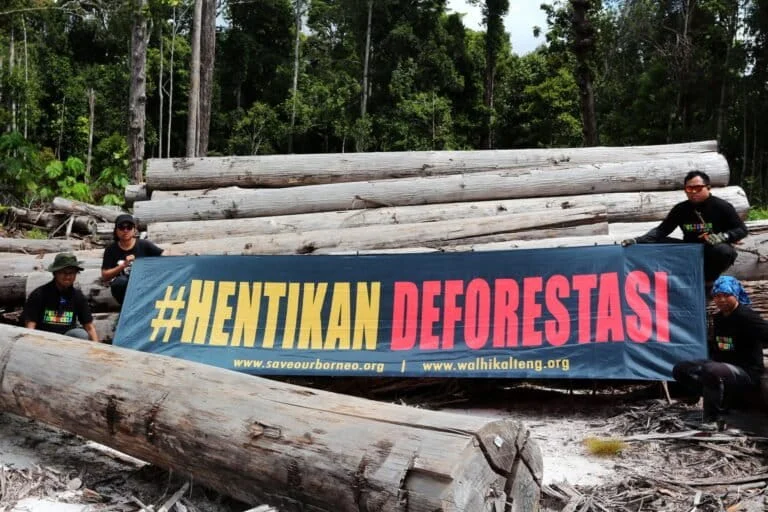
The Indonesian archipelago’s largest island, Kalimantan, is currently facing an unprecedented environmental and social emergency as a decade of intensive industrial exploitation continues to hollow out its tropical rainforests. According to the latest comprehensive report from the Indonesian Forum for the Environment (Walhi) Regional Kalimantan, the island has witnessed the destruction of approximately 33.59% of its ecological landscape over the last ten years. This degradation represents an average loss of 412,790 hectares of tropical forest every year, driven primarily by a surge in palm oil plantations, industrial timber estates, mining operations, and large-scale infrastructure development.
The environmental watchdog emphasizes that this massive transformation of the landscape is not an accidental byproduct of development but a direct result of investment policies that grant expansive access to corporate entities at the expense of ecological stability and local communities. The data reveals a staggering scale of land allocation: 4,110 Right to Cultivate (HGU) permits for plantations—mostly palm oil—1,717 mining licenses, and 330 Forest Utilization Business Licenses (PBPH) for timber and other extractive activities. This systematic partitioning of the island has triggered a rise in both natural disasters and agrarian conflicts, with the frequency and intensity of these incidents escalating annually.
Regional Analysis: East Kalimantan’s Industrial Burden
East Kalimantan (Kaltim) stands out as the province suffering the most significant forest loss due to industrial pressure. Out of its total land area of 12.7 million hectares, an alarming 10.74 million hectares—or 84.36% of the province—is currently burdened by various corporate concessions. Yudi Saputra, the Executive Deputy of Walhi East Kalimantan, notes that this area is divided into 5.571 million hectares for timber estates (PBPH), 4.131 million hectares for mining (IUP), and 1.037 million hectares for palm oil plantations.
The historical data from 2001 to 2025 illustrates a grim trajectory. Total deforestation in the province during this period reached approximately 5.2 million hectares. The most massive losses were concentrated in specific regencies: East Kutai lost an estimated 1.4 million hectares, followed by Kutai Kartanegara (920,000 hectares), Berau (760,000 hectares), Paser (620,000 hectares), and West Kutai (580,000 hectares). Recent data suggests the rate of destruction is accelerating. Between 2023 and 2024, forest loss jumped from 28,633 hectares to 44,483 hectares—a 55% increase in just one year.
Central and South Kalimantan: Emissions and Corporate Control
The situation in Central Kalimantan (Kalteng) is equally dire. Janang Firman, Executive Director of Walhi Central Kalimantan, reports that in 2025 alone, deforestation reached 56,900 hectares. As of 2023, approximately 60% of the province’s 15.4 million hectares—roughly 9.1 million hectares—is controlled by large-scale corporations. The forestry sector remains the most dominant, occupying 5.1 million hectares, while plantations and mining cover 2.9 million and 1 million hectares, respectively.
This concentration of land ownership leaves very little room for local communities. Furthermore, these figures do not yet account for additional land allocated for National Strategic Projects (PSN), which further tighten the corporate grip on the province’s landscape. The encroachment into community-managed spaces has left villagers with dwindling resources and increased vulnerability to environmental shifts.
In South Kalimantan (Kalsel), the landscape is similarly besieged. Roughly 51.57% of the province’s territory is currently under permit licenses, an area equivalent to 29 times the size of Jakarta. This includes 645,611 hectares for HGU, 722,895 hectares for timber estates, and 559,080 hectares for mining. Raden Rafiq, Executive Director of Walhi South Kalimantan, points out that this expansion contributed to the loss of 2,200 hectares of forest cover in 2025 and the release of 1.7 million tons of carbon emissions into the atmosphere. This massive carbon pulse underscores the role of local deforestation in exacerbating the global climate crisis.
West Kalimantan and the Destruction of Peatlands
West Kalimantan (Kalbar) presents a chilling example of how industrial permits can surround and suffocate an entire region. The province is currently home to 368 palm oil companies controlling 3.9 million hectares, 737 mining permits covering 4.4 million hectares, and 65 industrial forest permits (HTI) spanning 2.75 million hectares. Sri Hartini, Executive Director of Walhi West Kalimantan, warns that more than half of the province is effectively "under siege" by environmentally destructive licenses.
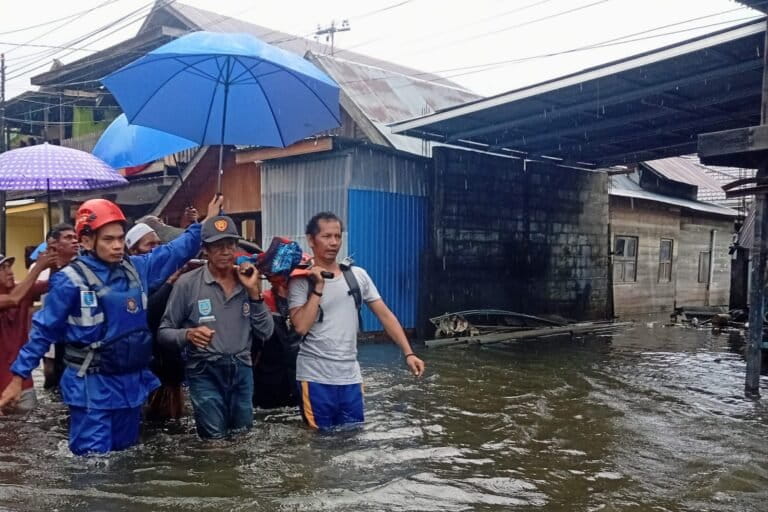
Of particular concern is the encroachment into Peatland Hydrological Areas (KHG), which serve as vital carbon sinks and water regulators. Walhi Kalbar identified 135 palm oil companies, 25 HTI permits, and 123 mining operations functioning within these sensitive zones. By draining and excavating peatlands, these industries destroy the headwaters of major rivers, triggering downstream flooding and increasing the risk of uncontrollable peat fires during the dry season.
The Human Toll: Agrarian Conflict and Criminalization
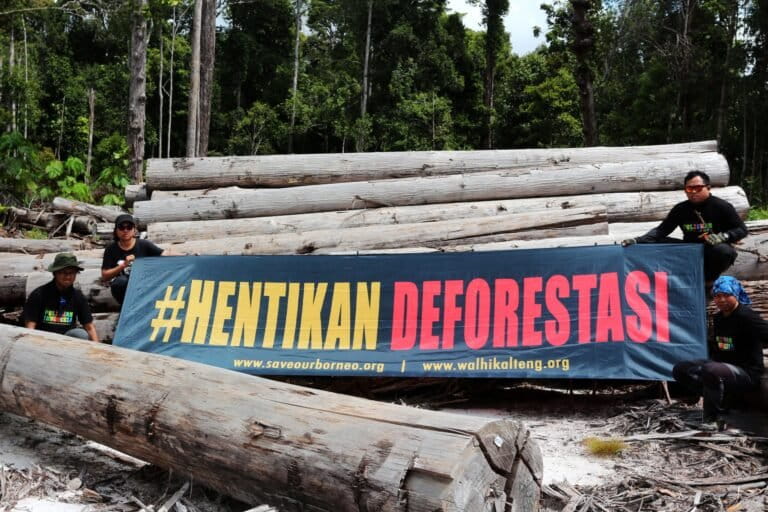
The environmental crisis in Kalimantan is inseparable from a growing social crisis. As forests disappear, the conflicts between corporations and local communities over land rights have intensified. Walhi is currently assisting in 35 active tenurial conflicts across four provinces: eight in East Kalimantan and nine each in West, Central, and South Kalimantan.
These disputes typically arise from overlapping claims where the state has granted corporate permits on land traditionally managed by local or Indigenous communities. In Central Kalimantan, the scale of the issue is particularly staggering, with 401 social conflicts recorded between 2004 and 2025 that remain unresolved. This "hanging" status of conflicts leaves communities in a state of permanent legal and economic uncertainty.
The lack of state protection often leads to the criminalization of Indigenous peoples and small-scale farmers. When communities attempt to defend their ancestral lands or traditional livelihoods, they frequently face legal repercussions or physical displacement. This model of development treats land and natural resources as mere commodities for exploitation, effectively pushing the rights of the people and the health of the environment to the periphery.
Impact on Vulnerable Groups and Food Security
The expansion of extractive industries is systematically eroding the foundations of local livelihoods. In East Kalimantan, 65% of the 1,038 villages and sub-districts are now burdened by large-scale industrial permits. This prevents residents from practicing traditional agriculture, sustainable forest management, and fishing, thereby threatening regional food security and creating a cycle of structural poverty.
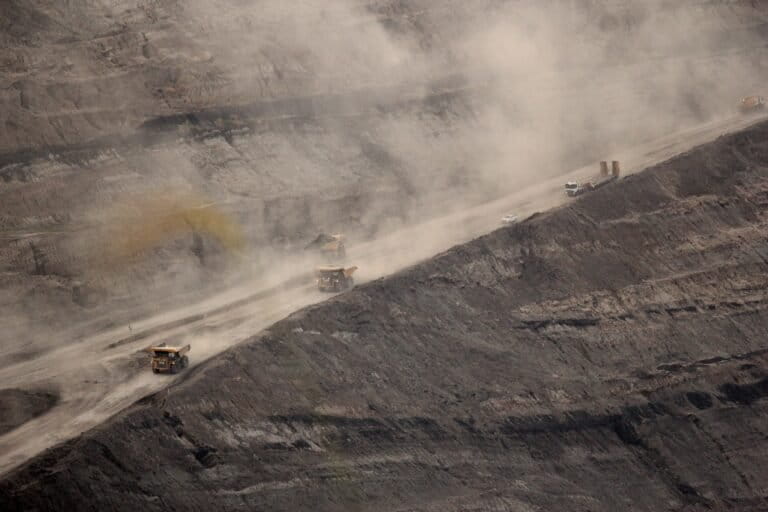
The impact is felt most acutely by women in these communities. Sri Hartini explains that Indigenous women, farmers, and traditional fishers lose access to essential resources such as food, traditional medicines, and raw materials for crafts when forests are converted. Furthermore, the domestic burden on women increases as environmental degradation compromises water quality. Many are forced to travel long distances to find clean water for cooking, cleaning, and reproductive health, as local water sources become contaminated by mining runoff or plantation chemicals.
Policy Analysis and the Push for Reform
Walhi’s findings suggest that the current regulatory environment in Indonesia prioritizes short-term economic growth and investment over long-term ecological sustainability. The introduction of various National Strategic Projects (PSN) has only accelerated this trend, often bypassing standard environmental safeguards.
The organization argues that the state must stop sacrificing the safety of its citizens for the sake of GDP growth. There is an urgent need for a comprehensive evaluation of all existing business permits. This includes auditing companies for environmental compliance and revoking licenses for those found responsible for illegal deforestation or peatland destruction.
A critical component of the proposed solution is the legal recognition of Indigenous rights. For years, activists have pushed for the passage of the Indigenous Peoples Bill (RUU Masyarakat Adat). This legislation would provide a clear legal framework for communities to claim and manage their ancestral territories, offering a "counter-weight" to the dominance of corporate concessions. Walhi also calls for the progressive implementation of Home Affairs Ministry Regulation (Permendagri) 52/2014, which provides guidelines for the recognition and protection of Indigenous communities.
Recommendations for Future Governance
To address the multifaceted crisis in Kalimantan, Walhi has issued a series of urgent demands to the Indonesian government:
- Immediate Moratorium on Deforestation: The government must halt the issuance of new permits in primary forests and peatlands, shifting the focus from investment attraction to environmental restoration.
- End to Criminalization: The state must provide legal protection for environmental defenders and community members who are protecting their living spaces from industrial encroachment.
- Transparency and Accountability: Results of environmental audits on corporations should be made public. Companies that have caused significant ecological damage should not only lose their licenses but also be held financially responsible for restoration efforts.
- Spatial Planning Revision: A thorough review of the Regional Spatial Plan (RTRW) is necessary to ensure that ecological corridors and community-managed areas are protected from future industrial expansion.
- Just Energy Transition: As Indonesia moves toward a greener economy, the government must ensure that "green" projects do not repeat the mistakes of the past by displacing vulnerable groups or ignoring the rights of women and future generations.
The data presented by Walhi paints a picture of an island at a breaking point. Without a radical shift in how land and resources are governed, the "lungs of Southeast Asia" may soon be unable to support the diverse ecosystems and vibrant communities that have called Kalimantan home for millennia. The ecological and social cost of another decade of business-as-usual is a price the region—and the planet—cannot afford to pay.