Nasution Nanang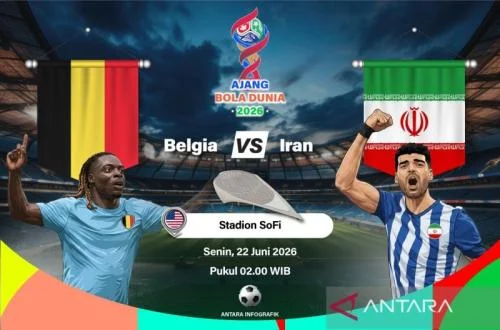
Los Angeles, United States — Belgium’s formidable striker, Romelu Lukaku, has been confirmed as a starter and will spearhead the Red Devils’ attack in their crucial second Group G match of the FIFA World Cup 2026 against Iran. The high-stakes encounter is scheduled to take place at the iconic Stadion Los Angeles on Monday, local time, with both teams vying for a strong position in their qualification campaign for the knockout stages. This fixture is anticipated to be a tactical battle, pitting Belgium’s star-studded offensive talent against Iran’s renowned defensive solidity and counter-attacking prowess.
Belgium’s head coach, Rudi Garcia, has placed his trust in the powerful forward, Romelu Lukaku, to lead the line in a flexible 4-2-3-1 formation. Lukaku, known for his physical presence, clinical finishing, and ability to hold up play, will be pivotal in breaking down what is expected to be a resolute Iranian defense. Supporting him from a dynamic attacking midfield trio will be the creative maestro Kevin De Bruyne, the versatile Leandro Trossard, and the industrious Alexis Saelemaekers. This combination is designed to provide both intricate passing and direct attacking threats, aiming to unlock spaces and create goal-scoring opportunities against a deep-lying opponent.
The selection of this attacking quartet highlights Garcia’s intent to maximize offensive output while maintaining a degree of tactical balance. Kevin De Bruyne, often considered one of the world’s premier playmakers, will be the orchestrator, dictating the tempo and threading passes through the Iranian defensive lines. His vision, range of passing, and ability to strike from distance will be crucial in dismantling Iran’s compact structure. Leandro Trossard, stepping in due to Jeremy Doku’s absence, brings a different dimension with his intelligent movement, dribbling skills, and eye for goal, capable of operating effectively on either flank or through the middle. Alexis Saelemaekers, meanwhile, offers pace, width, and a strong work rate, adding another layer of dynamism to Belgium’s forward press and transition play.
Belgium’s Strategic Adjustments and Midfield Balance
Belgium has implemented several changes to their starting XI following their opening group stage fixture, reflecting both tactical adjustments and necessary responses to player availability. The most notable change sees Leandro Trossard stepping into the starting lineup to replace the absent Jeremy Doku, who is sidelined due to illness. Doku’s electrifying pace and directness will be missed, but Trossard’s composed finishing and intelligent link-up play offer a different, equally potent threat. Saelemaekers’ inclusion from the start further underscores Garcia’s desire to inject additional attacking impetus and energy into the team, aiming to keep Iran’s defenders constantly under pressure.
In the heart of the midfield, Garcia has opted for the pairing of Nicolas Raskin and Youri Tielemans. This duo is tasked with maintaining control of the central park, shielding the defense, and facilitating the transition from defense to attack. Raskin, known for his tenacity, ball-winning ability, and progressive passing, will act as a deep-lying anchor, breaking up opposition play and initiating Belgian offensives. Tielemans, a more complete midfielder, will complement Raskin with his excellent range of passing, tactical awareness, and ability to drive forward and contribute to attacks. Their partnership will be vital in controlling the midfield battle, preventing Iran from launching quick counter-attacks, and ensuring a steady supply of possession to Belgium’s creative attackers.
The defensive line for Belgium will be marshaled by the central defensive pairing of Nathan Ngoy and Brandon Mechele. Both defenders will need to be alert and disciplined to neutralize Iran’s primary attacking threat, Mehdi Taremi, and prevent any penetrative runs. Flanking them will be the experienced Thomas Meunier at right-back and Maxim De Cuyper at left-back, both expected to contribute to both defense and attack, providing width and delivering crosses into the box. Protecting the goal will be the towering presence of Thibaut Courtois, widely regarded as one of the world’s best goalkeepers, whose commanding presence, shot-stopping prowess, and distribution will be crucial for Belgium’s stability.
Iran’s Defensive Strategy and Counter-Attacking Threat
In contrast to Belgium’s offensive focus, Iran, under the guidance of head coach Amir Ghalenoei, has adopted a more conservative yet tactically astute 4-3-3 formation, which often morphs into a 5-4-1 defensive block when out of possession. This strategic setup is clearly designed to absorb Belgium’s expected onslaught and stifle their attacking movements, with a strong emphasis on defensive compactness and resilience. Ghalenoei’s pragmatic approach aims to frustrate the Belgian attackers and capitalize on any opportunities for rapid transitions.
Iran’s defensive unit is formidable, featuring Saleh Hardani, Hossein Kanani, Ali Nemati, Shoja Khalilzadeh, and the experienced captain Ehsan Hajsafi. This backline, often augmented by deeper-lying midfielders, will prioritize denying space to De Bruyne and Lukaku, aiming to force Belgium wide and limit their penetration through the central channels. Hossein Kanani and Shoja Khalilzadeh, as the central defensive pairing, will be responsible for neutralizing Lukaku’s aerial threat and physical presence, while the full-backs, Hardani and Hajsafi, will need to balance their defensive duties with providing occasional width in attack.
The midfield unit for Iran comprises Ramin Rezaeian, Saman Ghoddos, Saeid Ezatolahi, and Mohammad Mohebi. Their primary task will be to provide a robust shield in front of the defense, disrupting Belgian passing lanes and winning possession in crucial areas. Ezatolahi, often acting as the deepest midfielder, will be key in breaking up play and initiating counter-attacks with his distribution. Ghoddos and Mohebi will offer energy and pressing, while Rezaeian provides an additional creative outlet and support on the flanks. This midfield quintet is expected to work tirelessly, covering vast amounts of ground to contain Belgium’s creative forces and then swiftly transitioning the ball forward.
Leading the line as the sole striker for Team Melli will be the prolific Mehdi Taremi. Taremi is Iran’s primary offensive weapon, known for his intelligent movement, clinical finishing, and ability to create chances even from limited opportunities. He will be tasked with holding up the ball, bringing midfielders into play, and exploiting any defensive lapses from Belgium on the counter-attack. His pace and predatory instincts will be critical if Iran is to convert their few anticipated chances into goals, making him a constant threat despite often being isolated upfront.
Background and Context: Group G Dynamics
This match holds immense significance for both nations within the context of Group G, which is widely considered one of the more competitive groups in the FIFA World Cup 2026. While the results of the first group stage matches are not explicitly detailed, the fact that this is the "second match" implies that both teams will be looking to either consolidate an initial victory or bounce back from an opening setback. A win for Belgium would significantly boost their chances of advancing to the knockout stages, potentially placing them at the top of the group. For Iran, a victory against a higher-ranked opponent like Belgium would be a monumental achievement, dramatically improving their qualification prospects and sending a strong message to the footballing world. Even a draw would be a valuable point for Iran, especially against a team of Belgium’s caliber, keeping their hopes alive for the final group fixture. Conversely, a loss for either side would heap immense pressure on their last group stage game, making progression much more challenging.
Team Rankings and Historical Performance
Belgium consistently ranks among the top teams in FIFA’s global rankings, often hovering within the top five. This reflects their sustained period of success and the presence of a ‘Golden Generation’ of players who have consistently performed at the highest level of European club football. While the 2022 World Cup saw them exit disappointingly in the group stage, the 2018 tournament saw them reach the semi-finals, demonstrating their capability to compete with the world’s elite. For 2026, the aspirations remain high, with many viewing this as a potential last chance for some of their veteran stars to secure a major international trophy. The blend of experienced players like De Bruyne, Lukaku, and Courtois with emerging talents is seen as crucial for their long-term success.
Iran, on the other hand, is consistently ranked as one of Asia’s strongest footballing nations, typically within the top 20-30 globally. They have been regular participants in recent World Cups, earning a reputation for their tactical discipline, defensive resilience, and passionate support. While they have historically struggled to advance beyond the group stage, they have often proven to be a tough opponent, capable of holding their own against more fancied teams. Their qualification for the 2026 tournament underscores their continued strength in the AFC region, and they will be looking to defy expectations and make history by progressing to the knockout rounds.
Statements and Reactions: Coaches’ Perspectives
Ahead of the highly anticipated clash, both coaches have likely conveyed a mix of confidence in their respective strategies and respect for their opponents. Rudi Garcia, known for his methodical approach, would undoubtedly have emphasized the importance of focus and execution for his Belgian squad. "We understand the challenge Iran poses with their defensive organization and quick transitions," Garcia might have stated in a pre-match press conference. "However, our focus remains on playing our game, utilizing the quality we have in attack, and securing the three points that are vital for our campaign. Romelu (Lukaku) is a key part of our strategy, and we have full confidence in the players selected to support him in breaking down their defense." Regarding the changes, he might have added, "While Jeremy Doku’s absence is unfortunate, Leandro Trossard brings different, valuable qualities that fit our tactical plan for this particular match. We are prepared for any scenario."
From the Iranian camp, Amir Ghalenoei would likely have stressed the importance of unity, tactical discipline, and seizing opportunities. "We are facing one of the best teams in the world, a side full of individual brilliance," Ghalenoei might have commented. "But our strength lies in our collective spirit, our organization, and our ability to fight for every ball. We have prepared meticulously to counter their threats, and we believe we can exploit spaces on the counter-attack, especially with a player of Mehdi Taremi’s caliber leading the line. Every player understands their role, and we are determined to make our nation proud and secure a positive result." His words would aim to instill belief and resilience in his squad, knowing they are considered the underdogs.
Broader Impact and Implications
The outcome of this match will have significant implications not only for Group G but also for the broader narrative of the FIFA World Cup 2026. For Belgium, a convincing victory would not only solidify their position in the group but also serve as a strong statement of intent, reaffirming their status as genuine contenders for the title. It would build momentum and confidence heading into their final group stage fixture, potentially allowing Garcia to rotate players if qualification is secured early. A draw, while not ideal, would keep them in a strong position, but a loss would raise serious questions about their ability to perform under pressure and potentially derail their tournament ambitions early on.
For Iran, a positive result—especially a win—would be monumental. It would be a significant upset against a European powerhouse and would dramatically increase their chances of reaching the knockout stages for the first time in their history. Such an achievement would be celebrated across Asia and would undoubtedly inspire future generations of Iranian footballers. A draw would also be a respectable and valuable point, maintaining their hopes. However, a defeat would make their path to qualification considerably more difficult, likely requiring a victory in their final group match against another strong opponent. The psychological impact of the result on both teams, and indeed on their respective fan bases, cannot be underestimated as the tournament progresses. The match in Los Angeles is set to be a captivating encounter, demonstrating the tactical depth and competitive spirit that define the FIFA World Cup.