Nasution Nanang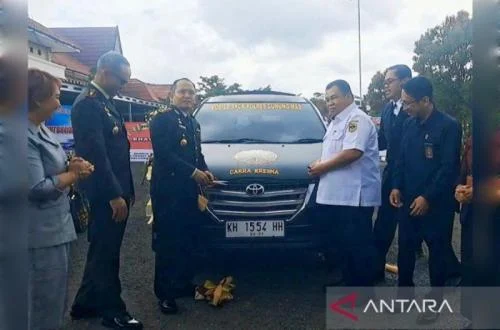
The Government of Gunung Mas Regency, Central Kalimantan, has demonstrated unwavering support for an innovative mobile Police Clearance Certificate (SKCK) service initiated by the Gunung Mas Resort Police (Polres Gunung Mas). This crucial backing manifests as the provision of operational vehicles, strategically designed to empower law enforcement officers to extend their reach to communities residing far beyond the regency’s capital, Kuala Kurun. This collaborative effort underscores a concerted drive towards equitable access to essential public services, particularly in geographically challenging regions.
Edison, Assistant III of the Gunung Mas Regency Secretariat, articulated the scope of this commitment from Kuala Kurun on Thursday. The support package includes one four-wheeled vehicle and one two-wheeled vehicle. These assets are earmarked for enhancing the mobility of officers tasked with facilitating SKCK issuance in remote villages and sub-districts, many of which are situated at significant distances from the urban core. The initiative represents a tangible response to the logistical hurdles faced by residents in a regency characterized by vast landscapes and dispersed populations.
This pioneering service has been aptly named "SKCK Gula Madu," an acronym derived from "Gunung Mas Layani Masyarakat Daerah Hulu," which translates to "Gunung Mas Serves Upstream Communities." The program emerged as a vital solution following a significant policy shift wherein the authority to issue SKCKs was centralized at the Polres level, effectively discontinuing their issuance by Polsek (Sector Police) offices. This centralization, while aimed at standardizing procedures and enhancing security, inadvertently created a bottleneck for many citizens. The geographical reality of Gunung Mas, where the Polres headquarters is situated in Kuala Kurun, Kurun District, while other districts are scattered with varying and often arduous travel times, posed a substantial challenge for residents requiring an SKCK. Prior to this innovation, obtaining such a document often entailed significant financial burdens, loss of productive time due to travel, and considerable physical effort for those in distant locales.
Understanding the Importance of SKCK and the Geographical Context
The Police Clearance Certificate, or SKCK, is a fundamental document in Indonesia, serving as proof that an individual has no criminal record. It is indispensable for a wide array of official purposes, including job applications across various sectors, university admissions, scholarship applications, visa processing for international travel, applications for public office, and even certain business permits. For many Indonesians, especially those seeking employment or higher education, an SKCK is a non-negotiable requirement. Any impediment to its acquisition can severely impact an individual’s socio-economic advancement and access to opportunities.
Gunung Mas Regency, located in the heart of Central Kalimantan, is a sprawling area characterized by dense forests, winding rivers, and often rudimentary infrastructure connecting its many communities. With a population of approximately 130,000 spread over nearly 10,800 square kilometers, the regency’s population density is relatively low, and communities are often isolated. Travel from some upstream areas to Kuala Kurun can take several hours, sometimes even a full day, involving a combination of land and river transport. The costs associated with such journeys – fuel, public transport fares, accommodation if an overnight stay is required, and lost wages – can be prohibitive for many, particularly those in lower-income brackets. The centralization of SKCK issuance, while perhaps efficient from an administrative perspective, inadvertently exacerbated these challenges for the rural populace, making the SKCK Gula Madu program not merely a convenience but a necessity for equitable service access.
Technological Advancement and Bridging the Digital Divide
In a significant stride towards modernizing public services, Kapolres Gunung Mas, AKBP Heru Eko Wibowo, had previously elaborated on the advanced capabilities of the SKCK Gula Madu service. Each mobile unit is equipped with independent devices and a specialized internet connection. This cutting-edge setup ensures that SKCKs can be issued even in areas with minimal cellular signal or so-called "blank spots," which are prevalent in many remote parts of Indonesia. This dedicated internet connectivity is a direct response to a directive from the Central Kalimantan Regional Police Chief (Kapolda Kalteng), mandating that SKCK applications be processed online via the national "Super App Presisi."
The Super App Presisi is an ambitious digital platform launched by the Indonesian National Police (Polri) to streamline various police services, including SKCK applications, reporting crimes, and accessing information. While promoting efficiency and transparency, the reliance on digital platforms can inadvertently exclude citizens in areas with poor internet infrastructure, thereby widening the digital divide. The SKCK Gula Madu’s integrated internet solution directly addresses this potential pitfall, ensuring that the benefits of digitalization are extended to all citizens, regardless of their geographical location or local connectivity challenges. This proactive approach by Polres Gunung Mas, supported by the local government, exemplifies a commitment to inclusive digital transformation in public service delivery.
AKBP Heru Eko Wibowo expressed profound appreciation for the comprehensive support extended by the Regional Government and the entire Forkopimda (Regional Leadership Coordination Forum). He emphasized the critical importance of such synergy in realizing public service innovations that genuinely benefit the community. This collaborative model, where different government agencies pool resources and expertise, is often cited as a best practice in public administration, particularly in diverse archipelagic nations like Indonesia.
Streamlined Procedures and Transparent Costs
Kasat Intelkam Polres Gunung Mas, AKP Raden Rachmad Abdul Rahim, provided further details regarding the user-friendly procedures for obtaining an SKCK through the mobile service. Residents wishing to utilize this service are only required to bring their Identity Card (KTP) and Family Card (KK). The processing time for an SKCK is remarkably efficient, typically taking around 15 minutes from the submission of the required documents. This swift turnaround significantly reduces the burden on applicants, allowing them to complete the process quickly and return to their daily activities with minimal disruption.
Regarding the associated costs, the SKCK Gula Madu service adheres strictly to the existing regulations for Non-Tax State Revenue (PNBP). The fee for an SKCK remains at IDR 30,000 (approximately USD 2.00), in line with official government stipulations. This transparency in pricing ensures that citizens are not subjected to arbitrary or inflated charges, fostering trust in the service. The PNBP system ensures that these fees contribute directly to state revenue, funding public services and development initiatives.
The Gunung Mas Regency Government harbors strong hopes that the SKCK Gula Madu program will serve as a leading example of effective synergy between local government bodies and law enforcement agencies. The ultimate goal is to inspire and facilitate the provision of prime and equitable public services that penetrate even the most remote corners of the region, ensuring that no citizen is left behind due to geographical or infrastructural limitations.
Broader Implications and Impact
The SKCK Gula Madu program, bolstered by the Gunung Mas Regency government’s vehicle provision, carries several significant broader implications for public service delivery and regional development:
-
Enhanced Accessibility and Social Equity: The most immediate and profound impact is the dramatic improvement in access to a vital public document for rural communities. By bringing the service directly to the people, the program effectively eliminates the barriers of distance, cost, and time, promoting social equity. Residents, particularly those in remote "hulu" (upstream) areas, no longer face the daunting prospect of long, expensive journeys to Kuala Kurun. This reduces financial strain on households and allows individuals to pursue opportunities (jobs, education) without an initial, burdensome hurdle.
-
Model of Inter-Agency Synergy: The collaboration between the local government (Pemkab) and the National Police (Polres) sets a precedent for effective inter-agency cooperation. This synergy is crucial for holistic regional development, where different governmental bodies work in concert to address complex challenges. The provision of vehicles by the Pemkab demonstrates a practical understanding of the Polres’s operational needs and a shared commitment to citizen welfare. This model could inspire similar collaborations in other regencies facing comparable logistical challenges in Indonesia.
-
Bridging the Digital Divide with Practical Solutions: While the national police push for digital services via the Super App Presisi is commendable, the reality of uneven internet penetration in Indonesia cannot be ignored. The SKCK Gula Madu’s provision of specialized internet connectivity for blank spots is a pragmatic solution to ensure that digital inclusion is not just an ideal but a lived reality. It shows an understanding that technology must be adapted to local conditions, not simply imposed. This approach ensures that the benefits of digitalization reach all segments of the population, preventing a widening gap between digitally connected and disconnected communities.
-
Economic Benefits and Productivity: By reducing the need for extensive travel, the program indirectly contributes to local economic well-being. Individuals save money on transport and accommodation, and they lose less time from work or other productive activities. This increased efficiency can have a ripple effect, allowing more people to apply for jobs or educational opportunities, thereby stimulating local human capital development and economic activity.
-
Strengthening Community-Police Relations: Proactive and citizen-centric services like SKCK Gula Madu can significantly enhance trust and positive relations between the community and the police force. When law enforcement agencies are seen as facilitators of essential services rather than just enforcers of law, it fosters a more cooperative and supportive environment. This community engagement is vital for maintaining peace, order, and effective policing in the long run.
-
Potential for Replication: The success of SKCK Gula Madu in Gunung Mas could serve as a blueprint for other regencies across Indonesia, particularly those in Kalimantan, Sumatra, Sulawesi, and Papua, which often grapple with similar geographical and infrastructural challenges. The adaptable nature of the mobile service, combined with technological solutions for connectivity, makes it a scalable model for improving public service delivery in vast and remote areas.
The Gunung Mas Regency’s support for the SKCK Gula Madu initiative is more than just a logistical arrangement; it is an embodiment of good governance principles – responsiveness, efficiency, and equity. It represents a forward-thinking approach to public service delivery, leveraging inter-agency cooperation and appropriate technology to ensure that the promise of accessible government services extends to every citizen, irrespective of their location. This program is a testament to the commitment to build a more inclusive and connected Gunung Mas, empowering its "upstream communities" with the documents they need to thrive.