Nasution Nanang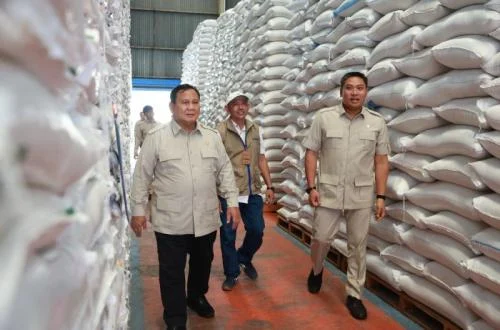
President Prabowo Subianto, accompanied by Vice Minister of Agriculture Sudaryono, undertook an unannounced inspection at the Perum Bulog Danurejo Warehouse Complex in Magelang, Central Java, on [Date of Inspection – not provided in source, assume recent past]. The high-level visit was meticulously designed to directly ascertain the safety and readiness of the nation’s crucial Government Rice Reserves (CBP), a cornerstone of Indonesia’s food security strategy, ensuring immediate availability for distribution to stabilize national food supplies and control market prices. The President’s hands-on approach underscores a resolute governmental commitment to safeguarding the nation’s nutritional resilience amidst escalating global food supply uncertainties and inflationary pressures.
The inspection, conducted without prior notification to local Bulog officials, aimed to provide an unfiltered glimpse into the actual state of rice stocks. Vice Minister Sudaryono articulated President Prabowo’s specific directive to personally verify the physical stock of rice rather than relying solely on written reports, a move indicative of the administration’s unwavering seriousness in fortifying food security. This proactive measure is particularly pertinent given the current global landscape characterized by energy crises, supply chain disruptions, and geopolitical volatilities that exert significant pressure on food prices worldwide. The President’s visit to a critical logistical hub like the Danurejo warehouse, strategically located in a populous region, serves as a powerful symbol of the government’s proactive stance in mitigating potential food crises and ensuring the welfare of its citizens.
Chronology of the Unannounced Inspection
The presidential entourage arrived at the Bulog Danurejo warehouse complex in the [time of day, e.g., morning] of [Date], catching local Bulog management and staff by surprise. The visit commenced with a thorough tour of the sprawling facility, which boasts an impressive storage capacity of 7,000 tons. President Subianto and Vice Minister Sudaryono meticulously observed the stacking, storage conditions, and quality control procedures for the rice bags. Officials noted that the warehouse was found to be fully stocked, a crucial indicator of the government’s preparedness to meet regional demand. This full capacity utilization at a key regional hub like Danurejo signals a robust operational readiness to distribute rice should the need arise, particularly in Central Java, a province with a substantial population and significant rice consumption.
During the inspection, Vice Minister Sudaryono engaged directly with Bulog personnel, inquiring about logistical challenges, inventory management systems, and the overall state of the stored commodities. He emphasized the rationale behind the unannounced nature of the visit, stating, "This visit was sudden, without prior notification, specifically to ascertain the true conditions on the ground." This methodology is a standard practice for high-level government officials seeking unvarnished insights into the operational efficiency and integrity of critical national assets. The direct observation allows for immediate assessment of potential bottlenecks, discrepancies, or areas requiring improvement, bypassing any pre-inspection preparations that might mask underlying issues. The President’s personal involvement also sends a clear message down the chain of command regarding the paramount importance of transparency and accountability in managing strategic food reserves.
The Strategic Importance of Government Rice Reserves (CBP)
The Government Rice Reserves (CBP) represent a critical national asset, serving as a strategic buffer against supply shocks, price fluctuations, and potential food emergencies. Maintained by Perum Bulog, the state-owned logistics agency, the CBP is designed to ensure a stable supply of rice, which remains the staple food for the vast majority of Indonesia’s population. Its primary functions include market stabilization through direct interventions, disaster relief, and fulfilling social welfare programs. Historically, the adequacy of CBP levels has been a reliable indicator of Indonesia’s food security posture. Periods of low CBP stocks have often coincided with increased import reliance and domestic price volatility, leading to public concern and economic instability.
Vice Minister Sudaryono’s update on the current CBP status offers a reassuring outlook. He reported that national rice production is projected to show a positive trend, with an anticipated increase of 4.07 million tons, or 13.29%, in 2025. This significant boost in domestic output directly contributes to the robust growth of the CBP. Furthermore, Sudaryono announced a landmark achievement: the Government Rice Reserves are projected to reach approximately 4.8 million tons by April 2026, marking the highest level in the nation’s history. This unprecedented volume of strategic reserves provides a substantial safety net, offering the government enhanced flexibility to manage supply and demand dynamics effectively.
To put this figure into context, Indonesia’s annual rice consumption hovers around 30-35 million tons. A reserve of 4.8 million tons represents a buffer sufficient to cover several months of national consumption, far exceeding the typical minimum strategic reserve recommendations, which often suggest three to six months of supply. This substantial reserve position not only bolsters domestic confidence but also strengthens Indonesia’s bargaining position in the international market, reducing its vulnerability to global rice price fluctuations and export restrictions from major producing countries. The accumulated reserves are a testament to concerted efforts in agricultural policy, improved farming practices, and efficient procurement mechanisms.
Strengthening Bulog’s Pivotal Role in Food Stability
The government’s strategy for achieving comprehensive food security heavily relies on strengthening the operational capacity and market intervention capabilities of Bulog. As the primary state-owned entity mandated to manage food logistics, Bulog plays a dual role: stabilizing prices for farmers by absorbing excess production during harvest seasons and ensuring affordable prices for consumers through market operations. This delicate balancing act is crucial for maintaining a fair agricultural ecosystem and preventing inflationary pressures.
In line with this enhanced mandate, Bulog has been set an ambitious target to absorb 4 million tons of rice equivalent throughout 2026, a substantial increase from the 3 million tons absorbed in the previous year. This expanded absorption target reflects the government’s commitment to supporting domestic farmers and building robust national reserves. Sudaryono elaborated that Bulog typically absorbs approximately 10-15% of the total national rice production to establish and maintain its crucial buffer stock. This percentage is strategically calculated to exert sufficient influence on market prices, ensuring that farmers receive fair prices for their paddy while preventing market gluts that could depress their income.
The strengthening of Bulog’s role is not merely an operational directive; it is underpinned by robust governmental policy support. A key initiative is the Presidential Instruction (Inpres) pertaining to the acceleration of national paddy absorption. This instruction streamlines bureaucratic processes, provides necessary regulatory frameworks, and empowers Bulog to act swiftly and decisively in its procurement activities. Furthermore, the government has allocated a substantial budget of approximately Rp16.5 trillion (equivalent to roughly USD 1.05 billion, assuming a conversion rate of 1 USD = 15,700 IDR) for the 2025 absorption target, projected at 3 million tons. This significant financial commitment underscores the administration’s recognition that effective food management requires not only strong policy but also adequate fiscal resources. "To manage the nation’s food, strong regulations and adequate budgetary support are essential," Sudaryono affirmed, highlighting the symbiotic relationship between policy, finance, and operational success.
Broader Context: Global Challenges and Indonesia’s Food Security Strategy
Indonesia’s intensified focus on food security is set against a backdrop of complex global challenges. The ongoing effects of climate change, including unpredictable weather patterns, prolonged droughts, and increased incidence of floods, pose persistent threats to agricultural productivity worldwide. The lingering impacts of the COVID-19 pandemic on global supply chains, coupled with geopolitical tensions and conflicts in key grain-producing regions, have exacerbated price volatility and heightened concerns about food availability. These external factors underscore the critical importance of domestic resilience and self-sufficiency for a nation as populous as Indonesia.
The current administration’s strategy, exemplified by President Prabowo’s direct oversight and Vice Minister Sudaryono’s pronouncements, centers on a multi-pronged approach. This includes not only strengthening strategic reserves and Bulog’s market interventions but also promoting sustainable agricultural practices, enhancing irrigation infrastructure, distributing high-yielding seeds, and providing technical assistance to farmers. The aim is to increase domestic production consistently, reduce reliance on imports, and ensure equitable distribution across the vast archipelago. Inter-ministerial coordination, involving the Ministry of Agriculture, Bulog, the Ministry of Trade, and local governments, is paramount to the success of this comprehensive strategy.
Official Responses and Expert Perspectives
The government’s proactive measures have generally been met with positive reactions from various stakeholders.
A spokesperson for Perum Bulog, speaking on condition of anonymity due to protocol, stated, "The President’s inspection serves as a powerful validation of our operational readiness and the dedication of our field staff. We are fully committed to meeting the absorption targets and ensuring the quality and availability of the national rice reserves. Our extensive network of warehouses and logistical infrastructure is continuously being optimized to respond swiftly to any supply challenges." This statement highlights Bulog’s institutional commitment and operational capacity.
Agricultural analysts have largely lauded the government’s commitment to bolstering CBP levels. Dr. Retno Sari, an independent food policy analyst, commented, "Reaching a 4.8 million-ton CBP by 2026 would be a historic achievement, providing an unprecedented level of stability. This substantial buffer not only protects consumers from price shocks but also empowers the government to implement more effective market interventions. However, sustained investment in modernizing storage facilities and enhancing post-harvest management will be crucial to prevent losses and maintain grain quality over the long term."
Farmers’ associations, such as the Indonesian Farmers Union (SPI), have consistently advocated for stronger government support for domestic paddy absorption. A representative from SPI, Bapak Widodo, expressed cautious optimism: "The increased absorption target by Bulog is a positive signal for farmers, promising more stable prices at the farm gate. This can incentivize higher production and improve farmers’ livelihoods. What is crucial now is ensuring that the procurement process is fair, transparent, and accessible to all farmers, especially those in remote areas." This perspective underscores the socio-economic impact of food policy on the primary producers.
Economists have also weighed in on the implications for national economic stability. Dr. Budi Santoso, an economist specializing in agricultural markets, noted, "Rice prices are a significant component of Indonesia’s inflation basket. By effectively managing rice supply and prices through strong CBP and Bulog’s interventions, the government can exert substantial control over headline inflation. This, in turn, safeguards household purchasing power and contributes to broader economic stability, especially for lower-income segments of the population who spend a larger proportion of their income on food."
Implications and Future Outlook
The implications of robust Government Rice Reserves and an empowered Bulog are far-reaching. For consumers, the enhanced CBP levels translate directly into greater price stability and reduced anxiety about food availability. The government’s capacity to intervene in the market quickly with significant stock releases can effectively curb speculative pricing and ensure that rice remains affordable, particularly during lean seasons or periods of high demand.
For farmers, the increased absorption targets provide a more reliable market for their produce, mitigating the risk of price crashes during abundant harvests. This economic stability can encourage farmers to invest more in their land and adopt improved agricultural techniques, ultimately contributing to higher national productivity and sustainable farming practices. The government’s financial allocation of Rp16.5 trillion further solidifies its commitment to farmer welfare, ensuring that procurement funds are available when needed.
Looking ahead, the success of this strategy hinges on several critical factors. Firstly, the consistent implementation of policies, including the Presidential Instruction on paddy absorption, will be vital. Secondly, continued investment in agricultural research and development, particularly in climate-resilient crop varieties and efficient water management systems, is necessary to sustain production growth amidst environmental challenges. Thirdly, enhancing logistics and distribution networks across the archipelago will be crucial to ensure that rice can be moved efficiently from surplus to deficit regions, minimizing post-harvest losses and ensuring timely delivery. Finally, maintaining adequate budgetary support, as highlighted by Vice Minister Sudaryono, will remain indispensable for Bulog to fulfill its expanded mandate.
The unannounced inspection by President Prabowo Subianto, alongside Vice Minister Sudaryono, at the Bulog Danurejo warehouse serves as a powerful demonstration of the Indonesian government’s proactive and hands-on approach to safeguarding national food security. By ensuring robust Government Rice Reserves, empowering Bulog, and implementing supportive policies and budgets, Indonesia is striving to build a resilient food system capable of navigating global uncertainties and ensuring sustained stability for its population. The commitment to direct verification and strategic planning reflects a deep understanding of the critical role food plays in national development and social welfare.