Nila Kartika Wati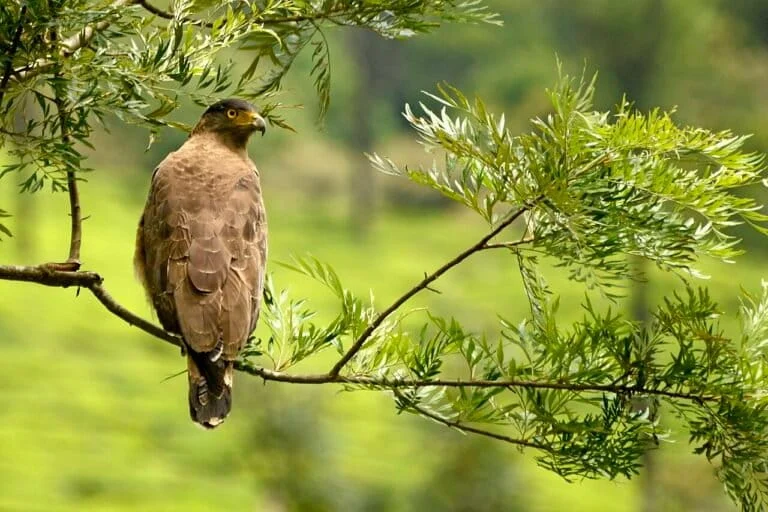
The cobra remains one of the most feared organisms on the planet, characterized by a lethal neurotoxic venom, lightning-fast reflexes, and a defensive posture that can intimidate almost any potential aggressor. In the dense jungles and forest edges of South and Southeast Asia, few creatures dare to challenge a cobra once it has raised its hood. Most predators, recognizing the risk of a fatal bite, maintain a respectful distance. However, within this complex ecosystem, there exists a specialized raptor that does not merely avoid the cobra but actively seeks it out as a primary food source. The Crested Serpent Eagle (Spilornis cheela) has evolved into a formidable specialist, possessing the anatomical tools and tactical patience required to hunt, disable, and consume some of the world’s most dangerous reptiles.
Widely distributed across the Indian subcontinent and Southeast Asia, the Crested Serpent Eagle is a common yet majestic sight. It is frequently observed perched along forest edges, near cultivated lands, and within riparian zones—areas where rivers and streams provide a constant source of moisture and high biodiversity. The bird’s common name is a direct reflection of its dietary specialization. While other raptors may be generalists, the Crested Serpent Eagle’s survival is intrinsically linked to its ability to predate upon snakes and other reptiles, a feat made possible by millions of years of evolutionary refinement.
Evolutionary Anatomy: Built for the Kill
The success of the Crested Serpent Eagle in hunting venomous prey is not a matter of luck but the result of specific physical adaptations. To engage a cobra is to enter a high-stakes duel where a single mistake can result in death. Consequently, the eagle’s body is a masterclass in anti-snake defense and offensive precision.
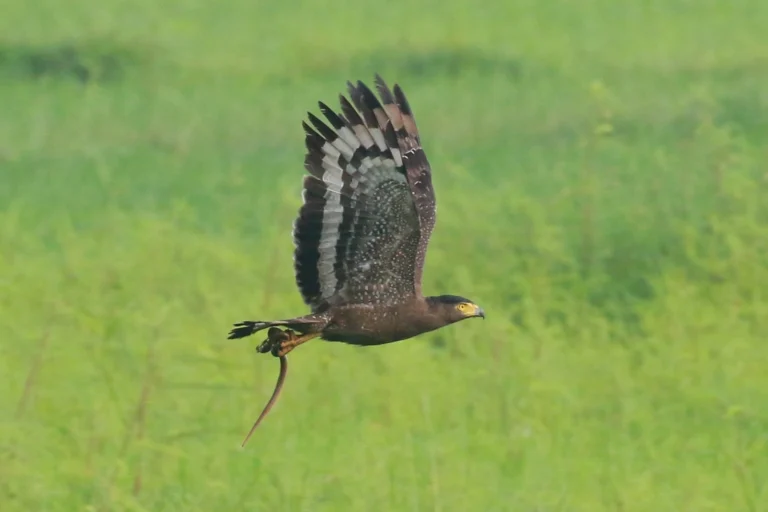
The most critical defensive feature lies in the eagle’s legs and feet. Unlike many birds of prey that have relatively thin skin on their lower extremities, the Crested Serpent Eagle possesses exceptionally thick, heavy scales covering its tarsi and toes. These scales act as a form of natural armor, significantly reducing the likelihood that a cobra’s fangs can penetrate the skin to deliver venom. When the eagle strikes, it uses its powerful talons to exert immense pressure. Once the eagle’s grip is locked onto the snake’s body, the reptile’s ability to coil or maneuver its head for a counterstrike is severely restricted.
Furthermore, the eagle’s hunting technique involves a specific focus on the head. Once the body is secured, the raptor uses its sharp, hooked beak to deliver a crushing blow to the snake’s skull. By neutralizing the head—the source of the venom and the primary weapon of the snake—the eagle ensures that the struggle is short-lived. This "head-first" philosophy is a hallmark of serpent-eating specialists, minimizing the window of vulnerability during which the eagle is at risk.
The eagle’s sensory kit is equally specialized. Its eyes, large and forward-facing, provide exceptional binocular vision and depth perception. From a high vantage point, the eagle can detect the slight shimmer of scales or the subtle rustle of dry leaves as a snake moves through the undergrowth. This visual acuity allows the bird to identify its target from a distance, giving it the advantage of surprise. By the time a cobra realizes it is being hunted, the eagle has often already committed to its terminal dive.
The Strategy of the Patient Hunter
The Crested Serpent Eagle is rarely seen engaging in the high-speed aerial pursuits characteristic of falcons. Instead, it is a "sit-and-wait" predator. This strategy requires immense patience and an intimate knowledge of the terrain. The eagle typically chooses a high perch, often a dead branch or a protruding limb at the edge of the forest canopy, which offers an unobstructed view of the ground.
From this position, the eagle monitors the "ecotones"—the transition zones between different types of habitats. Snakes, being ectothermic, often frequent these edges to bask in the sun to regulate their body temperature or to hunt for their own prey, such as rodents and amphibians. The eagle waits for the moment the snake enters an open patch where its movement is visible and its escape routes are limited.
When the strike occurs, it is a controlled descent rather than a frantic plunge. The eagle calculates its angle of approach to ensure it lands directly behind or on top of the snake’s vital regions. By utilizing its broad wings to stabilize its descent, the eagle can make micro-adjustments in mid-air, ensuring that its talons find their mark with surgical precision. This combination of observation, timing, and mechanical force makes the Crested Serpent Eagle one of the most efficient reptilian hunters in the avian world.
Scientific Insights: The Gokula Study
To understand the true extent of the Crested Serpent Eagle’s reliance on venomous prey, researchers have conducted long-term field observations. One of the most significant studies was led by Dr. Varadarajan Gokula in the Kolli Hills of Tamil Nadu, India. Spanning five years from May 2005 to May 2010, this research provided a comprehensive look into the breeding ecology and dietary habits of the species in a natural forest environment.
The Kolli Hills, part of the Eastern Ghats, serve as a vital corridor for biodiversity, and Gokula’s study utilized this landscape to gather a massive dataset. Over the five-year period, the research team monitored 32 active nests, conducted 173 feeding sessions, and mapped 1,237 specific perching points. The results were definitive: the Crested Serpent Eagle is a reptile specialist by choice, not just by opportunity.
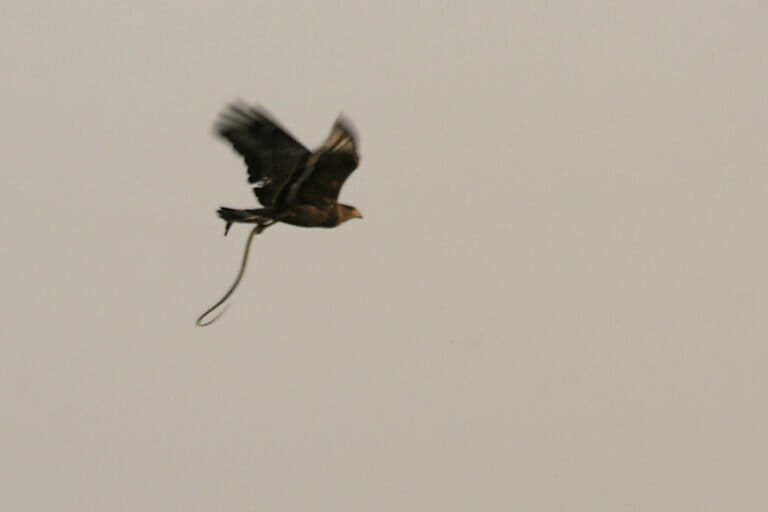
The data revealed that 74 percent of the eagle’s diet consisted of reptiles, including various species of snakes and lizards. Birds accounted for 18 percent of the diet, while the remaining 8 percent was comprised of small mammals and amphibians. This high percentage of reptilian prey underscores the bird’s ecological niche. It is not merely an opportunistic hunter that takes a snake when it finds one; it is a predator that actively filters the environment for reptiles.
The study also highlighted the bird’s preference for specific forest structures. The 1,237 recorded perching points were not randomly distributed. The eagles showed a consistent preference for the outer edges of the canopy, particularly trees that overlooked open areas or forest clearings. This behavior confirms the "edge effect" theory in raptor ecology, where predators utilize the high visibility of habitat borders to maximize hunting success.
Habitat Requirements and Conservation Implications
A crucial finding of the Gokula study was the importance of riparian forests—the lush vegetation corridors that line riverbanks. These areas are essential for the Crested Serpent Eagle for two primary reasons: prey density and nesting stability. Riparian zones are naturally high in reptile populations due to the abundance of water and prey for the snakes themselves. Furthermore, these areas often contain the large, mature trees necessary to support the eagle’s heavy nests.
The eagle’s nest is a substantial structure of sticks and leaves, usually placed in the fork of a tall tree. The study noted that the success of a breeding pair was closely tied to the presence of undisturbed, mature forest patches. In areas where the forest had been thinned or where riparian vegetation had been cleared for agriculture, the eagles struggled to find suitable nesting sites and their hunting efficiency plummeted.
This brings to light the broader ecological implications of habitat loss. As human encroachment, logging, and agricultural expansion continue to fragment the forests of South Asia, the Crested Serpent Eagle faces a double threat. First, the removal of large trees deprives them of nesting sites. Second, the degradation of the forest understory and riparian zones reduces the population of the reptiles they depend on.
The Trophic Role and Ecological Balance
The Crested Serpent Eagle serves as a vital regulator of the ecosystem. By preying on snakes, including highly venomous species like the cobra and the Russell’s viper, the eagle helps maintain a balance in the local food web. In the absence of such apex avian predators, snake populations could fluctuate unpredictably, potentially leading to an increase in human-snake conflicts in rural areas.
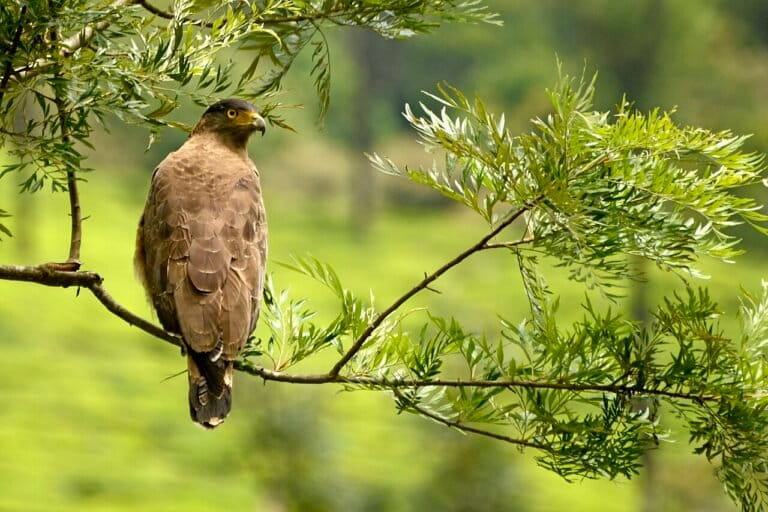
Furthermore, the presence of the Crested Serpent Eagle is often viewed by ecologists as an indicator of a healthy, functioning forest. Because these birds require large territories, specific nesting trees, and a robust population of lower-level predators (snakes) to survive, their presence suggests that the entire "trophic pyramid" below them is intact. Conversely, the disappearance of the eagle from a region is often a precursor to a wider collapse in local biodiversity.
The relationship between the eagle and the cobra is a testament to the complexity of natural selection. The cobra has evolved some of the most potent chemical weapons in the animal kingdom, yet the eagle has evolved the physical and behavioral "counter-measures" to bypass those defenses. It is a perpetual arms race that has resulted in a bird of prey that is as courageous as it is calculated.
Conclusion: A Guardian of the Forest Canopy
The Crested Serpent Eagle is more than just a bird of prey; it is a specialized guardian of the South Asian forests. Its ability to conquer the cobra—a feat that has inspired awe and fear in humans for millennia—demonstrates the incredible power of evolutionary adaptation. From its armored legs to its strategic patience, every aspect of the eagle’s life is fine-tuned for the pursuit of the most dangerous prey.
However, as the research from the Kolli Hills suggests, even this master hunter is vulnerable to the rapid changes brought about by human activity. The preservation of riparian forests and the protection of mature canopy trees are not just about saving a single species of bird; they are about maintaining the delicate balance of an ecosystem where the eagle and the cobra play their essential, albeit violent, roles. Ensuring the survival of the Crested Serpent Eagle means ensuring the survival of the wild, untamed spaces of Asia, where the shadows of the canopy still hold the secrets of the hunt.