Nila Kartika Wati
The Rawa Singkil Wildlife Sanctuary, a sprawling 81,765-hectare peat swamp forest spanning the districts of Aceh Singkil, South Aceh, and the city of Subulussalam, remains one of Indonesia’s most critical yet under-studied ecological bastions. Established under the Ministry of Environment and Forestry’s Decree No. 580 of 2018, this sanctuary represents the last remaining peat swamp forest in Aceh Province. While the region is globally recognized as a premier habitat for the Sumatran orangutan (Pongo abelii), a recent expedition has highlighted a glaring gap in scientific knowledge regarding its avian inhabitants. Environmental experts and conservationists are now sounding the alarm, warning that decades of data stagnation combined with accelerating habitat loss may be pushing rare bird species toward local extinction before they can even be properly documented.
For decades, the narrative surrounding Rawa Singkil has been dominated by its importance to megafauna. However, the sanctuary’s intricate network of waterways, marshes, and dense canopies serves as a vital corridor for a diverse range of bird species. Along the riverbanks and deeper into the swamp, egrets are frequently seen foraging, while the rhythmic calls of hornbills echo across the canopy. The area is also a known haunt for various species of eagles, kingfishers, storks, and a variety of migratory birds that utilize the peatlands as a seasonal refuge. Despite this visible abundance, the scientific community is operating on data that is over three decades old, a situation that conservationists describe as a major hurdle to effective management.
A Legacy of Data Stagnation and the 2026 Expedition
Between April 29 and June 1, 2026, a collaborative team comprising Mongabay Indonesia, Tedi Wahyudi from LetsBirding Sumatera, and the Yayasan Orangutan Sumatera Lestari – Orangutan Information Center (YOSL-OIC) conducted a field survey to assess the current state of Rawa Singkil’s biodiversity. The expedition was prompted by the realization that the most comprehensive reference for the area’s bird life dates back to a study conducted by Giesen and Bas van Balen in 1992.
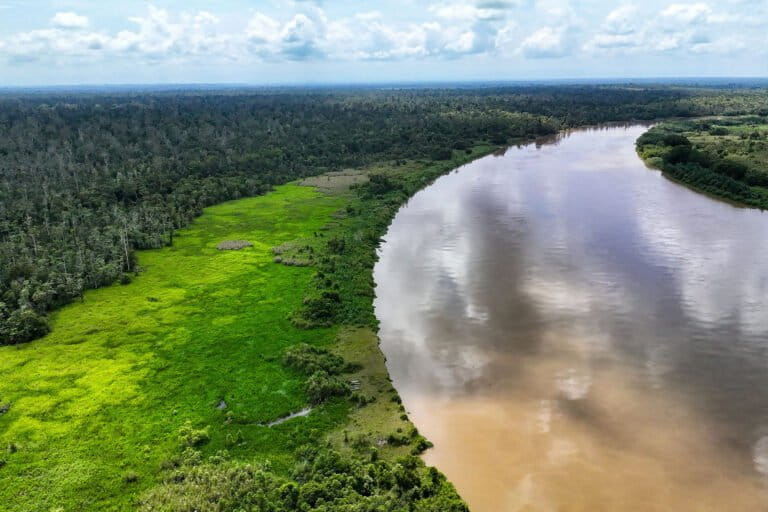
Syafrizaldi Jpang, the Director of YOSL-OIC, emphasized the necessity of a dedicated, large-scale research initiative focused on the sanctuary’s avian and mammalian populations. He noted that Rawa Singkil holds a wealth of undisclosed biodiversity that could redefine its status as a global conservation priority. The lack of updated records is particularly concerning given that the Trumon-Singkil region was designated as an Important Bird Area (IBA) by BirdLife International in 2001. This designation, covering approximately 157,000 hectares and including portions of the Leuser Ecosystem (KEL), was based on the presence of three key species: the White-winged Duck, the Storm’s Stork, and the Lesser Adjutant.
Tedi Wahyudi pointed out the gravity of the situation, noting that thirty-four years have passed without a systematic update to the 1992 baseline data. "We are essentially flying blind," Wahyudi remarked. "Without knowing what species currently remain and where they are concentrated, we cannot develop a targeted conservation strategy."
The Vanishing Icons of the Peat Swamp
The 2026 survey focused heavily on locating the species that originally justified the area’s IBA status. Chief among these is the White-winged Duck (Asarcornis scutulata), a forest-dwelling waterfowl classified as Critically Endangered by the IUCN. With a global population estimated at a mere 150 to 450 mature individuals, the species is on the brink of extinction. In Rawa Singkil, the last confirmed sighting was by Bas van Balen in 1992. During the recent three-day intensive observation period, the team failed to locate a single individual, raising fears that the species may have already vanished from the region.
Another species of high concern is the Storm’s Stork (Ciconia stormi), an Endangered tropical stork that relies heavily on primary peat swamp forests and undisturbed riparian zones with high canopy cover. Its global population is estimated between 300 and 1,750 individuals. Like the White-winged Duck, the Storm’s Stork was not detected during the recent survey. The team also sought the Masked Finfoot (Heliopais personatus), a Critically Endangered aquatic bird of tropical Asia. With a global population estimated at only 108 to 304 mature individuals, the Masked Finfoot is one of the rarest birds in the world, and its presence in Rawa Singkil remains unconfirmed in the modern era.
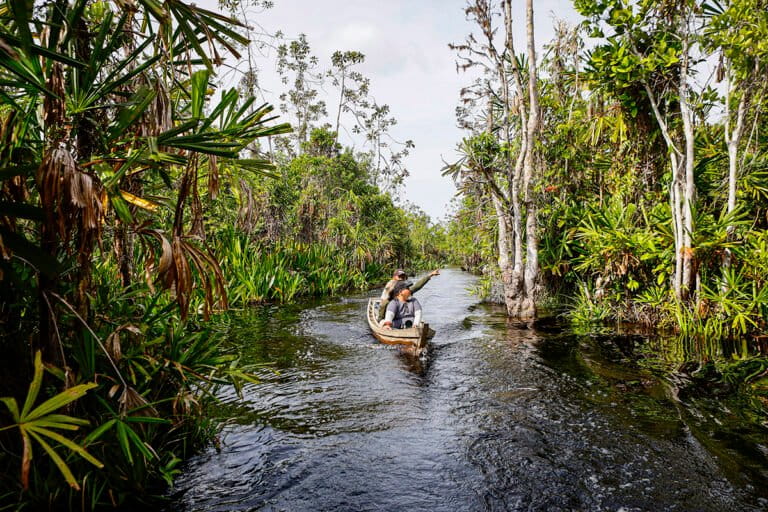
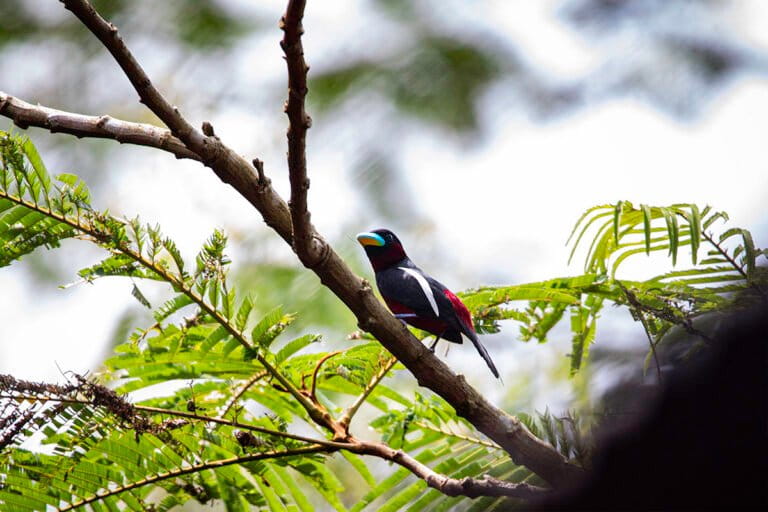
Despite the absence of these key targets, the three-day observation was not without success. The team recorded 40 bird species belonging to 24 different families. Among these were three protected species: the Pied Hornbill, the Changeable Hawk-eagle, and the Black-winged Kite. The presence of these predators and large canopy birds suggests that parts of the ecosystem still retain enough functional integrity to support diverse life, yet the absence of the more specialized wetland species points to a shifting ecological balance.
Methodological Challenges and the Path Forward
The difficulty of surveying Rawa Singkil cannot be overstated. The terrain is characterized by deep peat, dense vegetation, and a labyrinth of waterways that are often inaccessible by foot. To address these challenges, Tedi Wahyudi outlined three primary methodologies that should be employed in future, more comprehensive censuses.
- Point Count: This involves observers staying at a fixed location for 20 to 30 minutes to record every bird seen or heard before moving to a new station. This method is effective for assessing population density in specific habitat types.
- Visual Encounter Survey (VES): Researchers travel along established paths or waterways, documenting birds as they are encountered. This is particularly useful for spotting elusive species along the riverbanks.
- Bioacoustics: The use of automated recording units, such as Audiomoth devices, allows for 24-hour monitoring of bird calls. This technology can detect the presence of rare or nocturnal species that are easily missed by human observers during daylight hours.
Wahyudi stressed that the integration of bioacoustics is essential for a landscape as vast as Rawa Singkil. "Sound doesn’t lie," he said. "If the White-winged Duck is still there, an automated recorder will eventually catch its call, even if it avoids human presence."
Institutional Responses and Enforcement
The Balai Konservasi Sumber Daya Alam (BKSDA) Aceh, the government body responsible for the sanctuary, has acknowledged the lack of specialized bird data. Ujang Wisnu Barata, the Head of BKSDA Aceh, stated that while patrol teams have historically noted bird sightings, these records lack the scientific rigor of a dedicated census.
"We have focused heavily on the Sumatran orangutan, for which we have robust data," Barata explained. "However, since the beginning of 2026, we have initiated a broader biodiversity inventory to capture a more complete picture of the sanctuary’s health."
In addition to scientific surveys, the BKSDA is ramping up physical protection of the area. The agency is currently in the process of restoring degraded forest patches and has reinforced the sanctuary’s perimeter by establishing seven permanent security posts. These measures are intended to curb the illegal activities that have plagued the region for years.
Measuring the Crisis: Five Years of Rapid Deforestation
The most significant hurdle to conservation in Rawa Singkil is the relentless pressure of habitat destruction. Data provided by Lukmanul Hakim, the Geographic Information System (GIS) Manager at the Forest, Nature, and Environment of Aceh (HAkA) Foundation, paints a grim picture of the sanctuary’s recent history.
In 2020, the forest cover in Rawa Singkil was recorded at 76,488 hectares. By 2021, it had dropped to 76,323 hectares. The decline accelerated in the following years: 75,607 hectares in 2022; 74,775 hectares in 2023; and 74,350 hectares in 2024. As of May 2025, the forest cover stands at approximately 73,893 hectares.
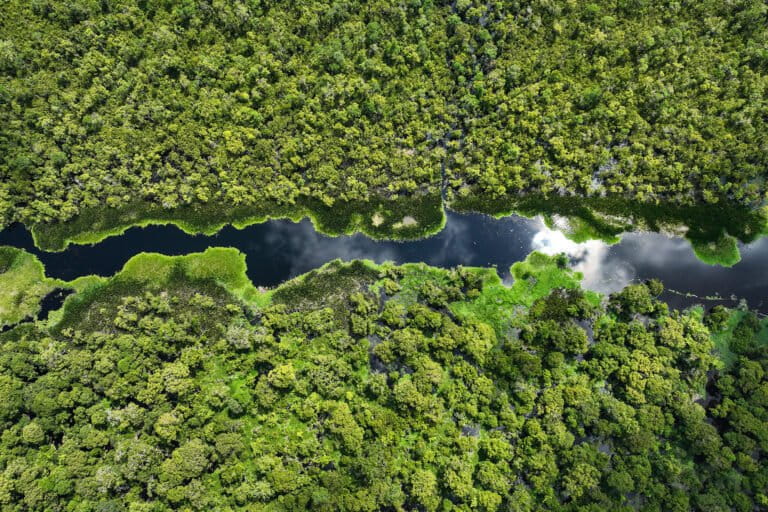
Over a five-year period, the Rawa Singkil Wildlife Sanctuary has lost more than 2,500 hectares of forest cover. This loss is primarily driven by land clearing for agriculture, illegal encroachment, and seasonal fires. Because Rawa Singkil is a peatland, these fires are particularly devastating; they burn deep into the organic soil, releasing massive amounts of carbon dioxide and making natural regeneration nearly impossible without active intervention.
Broader Implications and Conservation Analysis
The deforestation of Rawa Singkil is not merely a local issue; it is a significant blow to Indonesia’s climate goals and regional biodiversity. Peat swamp forests are among the most carbon-dense ecosystems on Earth. When they are drained or cleared, they transform from carbon sinks into massive carbon sources. Furthermore, the fragmentation of this habitat restricts the movement of wide-ranging species like the Sumatran orangutan and isolates bird populations, leading to reduced genetic diversity and increased vulnerability to environmental changes.
The loss of 2,500 hectares of forest in five years suggests a systemic failure in land management and enforcement. While the BKSDA’s new security posts are a positive step, the underlying economic drivers of encroachment—primarily the expansion of small-scale palm oil plantations and land speculation—must be addressed through policy and community engagement.
The call for a comprehensive bird census is more than a scientific endeavor; it is a plea for a change in conservation philosophy. By focusing only on "charismatic" megafauna, stakeholders risk overlooking the "canaries in the coal mine"—the specialized bird species whose disappearance signals a fundamental breakdown of the peatland ecosystem. As the 2026 expedition concluded, the window of opportunity to save the White-winged Duck and the Storm’s Stork in Aceh is closing. Without immediate, data-driven intervention, Rawa Singkil may soon become a "silent forest," a sanctuary in name only, stripped of the avian diversity that once made it a jewel of the Leuser Ecosystem.