Nila Kartika Wati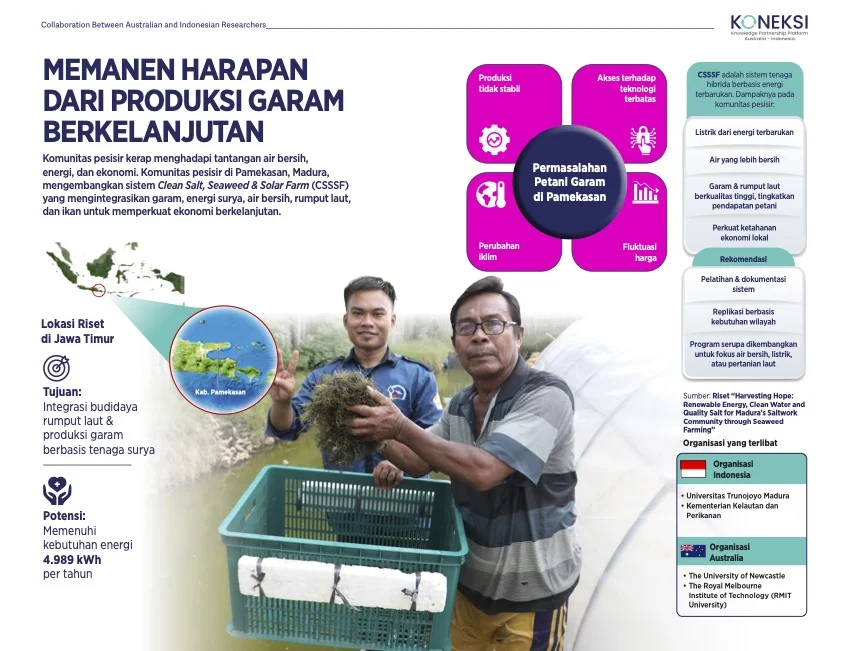
The Jakarta Summit 2026, held in late April, has emerged as a pivotal forum for addressing the intersection of climate resilience, technological innovation, and social equity. Under the banner of the Knowledge and Innovation Exchange (KIE), researchers, policymakers, and community leaders gathered to demonstrate that climate change adaptation is fundamentally dependent on the delivery of targeted, localized innovations. The summit underscored a critical reality: while global climate targets often focus on macro-level emission reductions, the immediate survival of vulnerable populations depends on the integration of research into practical, scalable technology. This movement is largely driven by collaborative efforts between Indonesian and Australian academic institutions, aiming to bridge the gap between high-level policy and grassroots implementation.
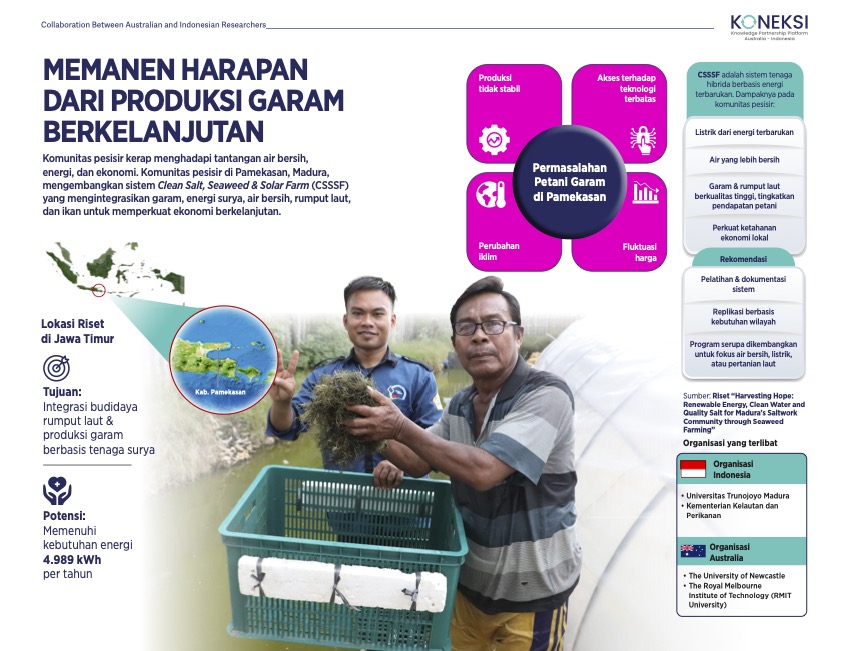
At the heart of the summit’s showcase was the Coupled Seaweed and Solar Salt Farming (CSSSF) initiative, a transformative project currently operating in Pamekasan, Madura, East Java. Traditional salt farming in Indonesia has long been a precarious livelihood, tethered to the whims of the weather and limited by antiquated production methods. The CSSSF model, developed by a consortium including the University of Trunojoyo, the University of Newcastle, the Royal Melbourne Institute of Technology (RMIT) University, and the Indonesian Ministry of Marine Affairs and Fisheries, reimagines traditional salt ponds as integrated production hubs. These hubs are designed to be self-sufficient, simultaneously producing clean water, green energy, and sustainable food sources.
The necessity of such innovation is underscored by the plight of traditional farmers like Fathur Rokhim. For generations, salt farmers in Madura have relied on a grueling seven-month dry season to harvest salt, using diesel-powered pumps that are both expensive and carbon-intensive. As the climate crisis shifts seasonal patterns, the reliability of this window has vanished. The CSSSF technology addresses this by utilizing an Organic Rankine Cycle (ORC) system, which captures thermal energy to drive processes that would otherwise require fossil fuels. This system facilitates faster crystallization, allowing for more frequent harvests and higher-quality salt.
The pilot project in Lembung Village covers six hectares and has yielded impressive empirical results. Data presented at the summit indicates that the system produces 100 tons of high-quality salt per hectare and two tons of seaweed per hectare. Beyond agriculture, the facility generates 1,000 liters of clean water every eight hours through desalination and provides between 1 and 6 kilowatts of solar power. On an annual basis, the CSSSF framework has the potential to meet energy demands of up to 4,989 kWh. For the local community, the implications are life-changing; the desalination process provides potable water for residents, while the surplus electricity powers local infrastructure, reducing the community’s reliance on the traditional power grid and volatile fuel prices.
A parallel breakthrough in water security was highlighted in Jepara, Central Java, where saltwater intrusion and pollution have historically forced residents—particularly women—to wait until the late hours of the night to access clean water. Researchers from Universitas Diponegoro (Undip) and the Australian National University (ANU) have pioneered a decentralized, village-scale desalination system. Unlike large-scale industrial desalination plants, which are often prohibitively expensive and difficult to maintain in rural settings, this modular approach focuses on the sub-district and village levels.
The Jepara facility is entirely solar-powered, capable of producing 200,000 liters of fresh water daily with a 40,000-watt peak capacity. To overcome initial public skepticism regarding the safety of desalinated water, the research team employed a strategy of "leadership by example," inviting local regents and university rectors to publicly consume the first batches of water. Today, the project serves approximately 1,000 families, with water distributed via university campus outlets and mobile units that can navigate the narrow alleyways of rural villages. Remarkably, the project also supplies 70 cubic meters of water daily to the Nusakambangan prison facility, demonstrating the scalability of decentralized infrastructure.
The Jakarta Summit also delved into the sociological and health-related dimensions of the climate crisis. Research presented by Universitas Udayana and ANU revealed a significant gap in Indonesia’s primary healthcare system (Puskesmas). While healthcare workers are increasingly aware of climate-related health risks—such as the spread of vector-borne diseases and heat-related illnesses—there is a lack of a comprehensive national framework to guide adaptive responses. Currently, efforts remain largely preventive and reactive rather than integrated into long-term health planning.
This vulnerability is gendered, as evidenced by a joint study from the University of Indonesia (UI), Monash University, and the University of Melbourne. The findings highlight that women in Indonesia are often the most severely impacted by climate-driven disasters like flooding and drought. Despite their central role in managing household health and resources, women are frequently the last to receive medical intervention or financial aid. Suryane Sulistiana Susanti, a lead researcher from UI, emphasized that climate challenges are not uniform; each region presents unique health hurdles that require gender-sensitive policy interventions.
In the realm of food security, the summit addressed the encroaching threat of urbanization on peri-urban agricultural lands. Research led by the University of Queensland focused on the "middle ground" between cities and rural villages, where agricultural land is rapidly being converted into residential and industrial zones. This shrinkage of productive land, combined with a widening gap in production yields, threatens the food supply of Indonesia’s growing urban centers. The proposed solution involves the development of eco-friendly certified food systems. By increasing the economic value of agricultural products through sustainability certifications, researchers believe they can incentivize the preservation of farmland and improve the livelihoods of smallholder farmers.
The situation is even more complex in Eastern Indonesia, specifically in Flores and Maluku. Here, the crisis is "multi-layered," involving a convergence of climate instability, market pressure, and high rates of stunting (tengkes) among children. The research approach in these regions has shifted away from simply increasing food production toward a more holistic "co-creation" model. This includes agroforestry, social forestry, and the strengthening of social protection systems. Ahmad Maryudi, a researcher involved in agroforestry projects in Sumbawa and Malacca, noted that the goal is not to impose new systems on local communities but to learn alongside them, enhancing socio-economic resilience through shared knowledge.
The final segments of the summit focused on the economic and policy frameworks necessary to sustain these innovations. Alin Halimatussadiah of the Institute for Economic and Social Research (LPEM UI) presented findings based on the Global Change Analysis Model (GCAM). The modeling suggests that while Indonesia’s pursuit of "Net Zero" targets is essential, the speed of the transition could place immense pressure on household welfare, particularly for those headed by women, the elderly, and persons with disabilities. The research advocates for a "Just Transition," where government intervention through fiscal stimuli is used to shield the most vulnerable from the economic shocks of energy transitions.

Government representatives at the summit acknowledged the necessity of this data-driven approach. Widya Adi Nugroho, a coordinator from the Ministry of Energy and Mineral Resources (ESDM), noted that climate policy can no longer be viewed through the narrow lens of emission targets alone. Instead, it must be integrated with social and economic impact assessments to ensure that the move toward green energy does not inadvertently deepen existing inequalities.
Yos Sunitiyoso, representing the Ministry of Higher Education, Science, and Technology, praised the researchers for moving beyond theoretical papers and into the realm of "downstreaming" or hilirisasi. He emphasized that the ultimate success of research lies in its ability to be utilized by local governments and communities to solve real-world problems.
As the Jakarta Summit 2026 concluded, the consensus was clear: the technology to adapt to a changing climate exists, but its success depends on political will and social protection. From the salt ponds of Madura to the coastal villages of Jepara, the integration of solar power, desalination, and sustainable farming offers a blueprint for resilience. However, these technological triumphs must be matched by inclusive policies that recognize the unique vulnerabilities of different social groups. The summit served as a reminder that in the face of a global crisis, the most effective solutions are often those that are developed locally, grounded in rigorous research, and designed with human dignity at their core. By fostering these international partnerships and focusing on the most marginalized, Indonesia is positioning itself not just as a victim of climate change, but as a leader in the innovation required to survive it.