Nasution Nanang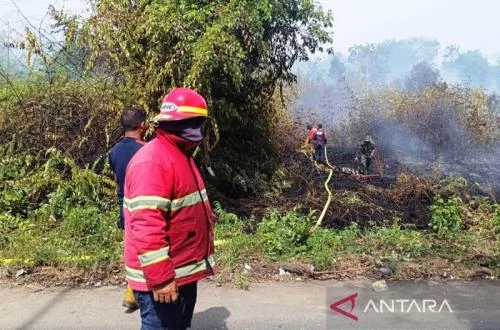
MEULABOH, REPUBLIKA.CO.ID – A significant land fire incident prompted a rapid and coordinated response from the Regional Disaster Management Agency (BPBD) of Aceh Barat Regency on Friday, July 17th, at approximately 13:30 Western Indonesian Time (WIB). The blaze, which erupted in the vicinity of Gunong Kleng Village, Meurebo District, posed an immediate threat due to its close proximity to residential areas. Thanks to the swift deployment of personnel and equipment, the fire, which had spread across an estimated 0.5 hectares, was successfully brought under control, mitigating potential widespread disaster and safeguarding local communities. The incident highlighted the persistent challenges faced by local authorities in managing land fires, particularly concerning resource accessibility and environmental conditions.
The initial report of the fire reached the Meureubo Fire Post, which promptly relayed the critical information to the Aceh Barat BPBD Command Headquarters (Mako). Upon receiving the alert, Acting Head of Aceh Barat BPBD, Teuku Ronal, wasted no time in mobilizing his teams. "The moment we received the report from the community, it was immediately escalated to our Mako," Teuku Ronal stated. "We swiftly dispatched teams from both the Mako and the Meureubo Post to the location to commence firefighting operations." This immediate and decisive action underscored the agency’s commitment to rapid response, a crucial factor in preventing smaller incidents from escalating into larger, more devastating events, especially when residential zones are directly threatened. The strategic placement of fire posts, such as the one in Meureubo, plays a vital role in the early detection and reporting mechanism, forming the first line of defense in disaster mitigation efforts.
Rapid Response and Initial Containment Efforts
The chronology of events began shortly after midday when plumes of smoke were observed rising from the land near Gunong Kleng Village. Residents, acutely aware of the dangers posed by uncontrolled fires, particularly during dry spells, quickly alerted local authorities. The call reached the Meureubo Fire Post, which, acting as a crucial local hub, verified the report and transmitted it to the BPBD Command Headquarters. Within minutes of the official dispatch, emergency response teams comprising personnel from BPBD Aceh Barat and the Fire Department’s Regu I Mako, along with the Damkar Pos Meureubo unit, were en route to the scene. Their primary objective was to assess the scale of the fire, identify its perimeters, and initiate immediate suppression efforts to prevent further spread. Upon arrival, the teams faced a challenging scenario, with flames consuming dry vegetation and the fire line moving rapidly, driven by prevailing winds. The immediate priority was to establish a perimeter and protect the nearest residential structures, deploying initial water streams and attempting to create firebreaks where feasible.
Battling the Blaze: Challenges and Tactical Deployments
The firefighting teams encountered significant obstacles that complicated their efforts to extinguish the flames quickly. Teuku Ronal elaborated on the difficulties faced by the ground teams. "The primary challenge we encountered was the scarcity of readily available water sources in the immediate vicinity of the fire," he explained. This lack of proximate hydrants or natural water bodies necessitated a more logistical approach to water supply, significantly impacting the speed and efficiency of the initial response. In many rural and semi-urban areas of Indonesia, infrastructure for firefighting can be limited, making water transportation a critical, yet often time-consuming, aspect of fire suppression.
Compounding the water supply issue was the presence of strong winds across the incident area. Strong winds are a notorious adversary in firefighting, as they not only accelerate the spread of flames by providing a constant supply of oxygen but also carry embers over significant distances, creating new ignition points and making containment far more challenging. The combination of these two factors—limited water and high winds—demanded a more intensive and resource-heavy approach. To overcome these hurdles and expedite the containment process, BPBD Aceh Barat mobilized additional resources. A total of two water tanker units were dispatched to continuously supply water to the main firefighting apparatus, a dedicated fire engine. This strategy of continuous shuttle operations, where tankers ferry water from distant sources to the frontline, is common in areas lacking direct water access but requires significant coordination and logistical planning. The deployment of multiple assets ensured that the fire engine could maintain a consistent flow of water onto the flames, despite the adverse conditions.
Environmental and Health Ramifications
While the fire was contained without any reported casualties, its impact on the local environment and public health was noticeable. The 0.5 hectares of land affected primarily consisted of local vegetation, including shrubs, grasses, and potentially young trees, which are typical components of the landscape in rural Aceh. The destruction of this vegetation, while localized, contributes to a broader pattern of habitat degradation and can impact local biodiversity. Soil quality can also be compromised, leading to erosion and reduced fertility in the aftermath of a fire.
More immediately concerning was the impact of the thick smoke emanating from the burning land. "Kepulan asap tebal mulai mengganggu pernapasan para pengguna jalan yang melintas serta warga yang tinggal di sekitar lokasi kejadian," Teuku Ronal confirmed, indicating that the dense smoke began to affect the breathing of both commuters passing through the area and residents living in the immediate vicinity. Smoke from land fires contains a cocktail of particulate matter, carbon monoxide, and various volatile organic compounds, all of which can pose significant health risks. Short-term exposure can lead to respiratory irritation, coughing, shortness of breath, and exacerbation of existing conditions like asthma and chronic obstructive pulmonary disease (COPD). For vulnerable populations, including children, the elderly, and individuals with pre-existing heart or lung conditions, prolonged exposure can have more severe consequences. The disruption to daily life, including reduced visibility on roads, further underscored the broader public safety implications of such incidents.
Inter-Agency Collaboration and Ongoing Investigation
The successful containment of the Gunong Kleng land fire was a testament to the robust inter-agency collaboration that forms the backbone of disaster management in Indonesia. The effort was not solely carried out by BPBD personnel but involved a comprehensive network of government agencies and local community members. Personnel from the Indonesian National Armed Forces (TNI) and the Indonesian National Police (Polri) actively participated, providing additional manpower, logistical support, and ensuring public order and safety in the affected zone. Their presence is crucial in large-scale emergencies, lending authority and resources that complement civilian agencies.
Crucially, the spirit of "gotong-royong," a traditional Indonesian concept of mutual cooperation and communal work, was evident. Local community members joined the uniformed personnel, assisting in various capacities, from reporting the fire and guiding responders to the site to helping clear debris and establishing temporary firebreaks. This community involvement is often pivotal in rural areas, where local knowledge and collective action can significantly enhance emergency response capabilities.
Regarding the cause of the fire, Teuku Ronal stated that the matter is currently under investigation by the relevant authorities. Land fires in Indonesia can stem from a variety of sources, both natural and anthropogenic. Natural causes might include prolonged dry spells leading to spontaneous combustion of highly flammable vegetation, although this is less common for smaller fires. More frequently, human activities are the primary culprits. These can range from accidental ignitions, such as discarded cigarette butts, sparks from machinery, or unattended campfires, to deliberate acts like slash-and-burn practices for land clearing, which, despite being illegal, still occur in some areas. Given the proximity to settlements, investigators will likely focus on human-related factors, examining any recent activities in the area that could have inadvertently or intentionally started the blaze. Determining the cause is vital not only for potential legal action but also for implementing targeted prevention strategies to avoid future recurrences.
The Broader Landscape of Land Fires in Indonesia
The incident in Aceh Barat, while relatively contained, serves as a microcosm of the larger challenge of land and forest fires that Indonesia faces annually, particularly during the dry season. Historically, Sumatra and Kalimantan have been hotspots for such fires, often leading to transboundary haze that affects neighboring countries. While Aceh is not typically among the most severely impacted provinces in terms of vast peatland fires, localized land fires, especially near agricultural or scrubland areas, are a recurring concern.
Indonesia’s dry season, typically peaking between July and October, creates conditions highly conducive to fire ignition and spread. Factors such as prolonged droughts, exacerbated by climate change, contribute to drier vegetation and peatlands, making them more susceptible to burning. Government initiatives like the National Peatland Restoration Agency (BRGM) and various policies aimed at preventing land and forest fires, including strict penalties for illegal burning, have been implemented to address this persistent issue. These efforts often involve a multi-pronged approach: early warning systems, satellite monitoring, community-based fire prevention teams (Masyarakat Peduli Api – MPA), and law enforcement.
The economic implications of land fires can be substantial, impacting agricultural productivity, tourism, and various industries. Health costs associated with smoke-related illnesses also place a significant burden on public healthcare systems. Environmentally, fires contribute to greenhouse gas emissions, accelerate deforestation, and destroy critical ecosystems, threatening biodiversity. The specific context of Aceh, with its diverse landscapes ranging from coastal areas to mountainous regions, means that fire risks can vary, but the principles of prevention and rapid response remain universally critical. This incident underscores the ongoing need for vigilance and robust preparedness mechanisms at the regional and local levels.
Towards Prevention and Resilience
The successful containment of the Gunong Kleng land fire in Aceh Barat is a testament to the dedication and coordinated efforts of local disaster management agencies and community involvement. However, it also highlights the persistent vulnerabilities and the need for continued focus on fire prevention and enhanced response capabilities. Moving forward, several key areas demand attention to build greater resilience against future fire incidents.
Firstly, strengthening public awareness campaigns about responsible land management practices is paramount. Educating communities on the dangers of open burning, proper waste disposal, and the prevention of accidental ignitions can significantly reduce the incidence of human-caused fires. Secondly, investing in and maintaining adequate firefighting infrastructure, particularly in rural and remote areas, is crucial. This includes ensuring access to reliable water sources, modern equipment, and well-trained personnel. Regular drills and simulations can also enhance the preparedness and coordination of response teams.
Furthermore, leveraging technology, such as advanced satellite monitoring and drone surveillance, can provide early detection capabilities, allowing for even swifter responses to nascent fires before they escalate. Integrating climate data into risk assessments can help predict periods of high fire danger, enabling proactive measures such such as increased patrols and community alerts. Finally, continued inter-agency collaboration, involving all levels of government, law enforcement, military, and local communities, is fundamental. This holistic approach ensures that resources are effectively pooled, communication channels are open, and a unified strategy is in place to protect lives, livelihoods, and the environment from the devastating impacts of land fires. The incident in Gunong Kleng, while contained, serves as a timely reminder of the ongoing imperative to strengthen these measures across Aceh Barat and indeed, throughout Indonesia.