Azin Asro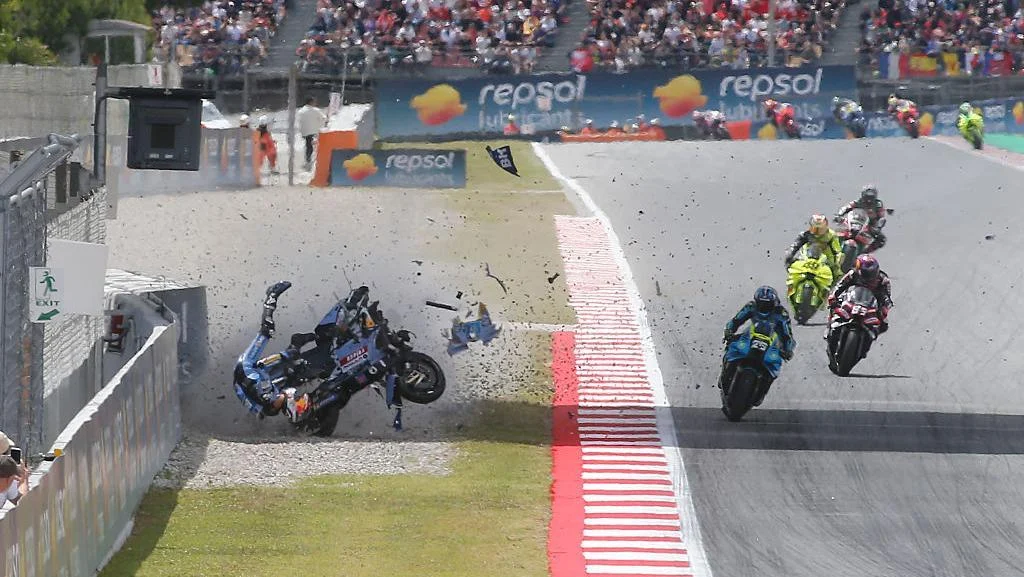
The high-stakes environment of the MotoGP World Championship often serves as a catalyst for intense debate regarding the sport’s regulatory framework, particularly when safety and competitive fairness intersect. Following the recent events at the Gran Premi de Catalunya, Aprilia Racing CEO Massimo Rivola has publicly voiced significant concerns regarding the current interpretation of "red flag" protocols. Rivola’s critique stems from an incident involving Red Bull GASGAS Tech3 sensation Pedro Acosta, whose technical misfortune triggered a race stoppage but who was subsequently permitted to participate in the restart. This situation has exposed what Rivola describes as a "legal loophole" that requires immediate attention from the Grand Prix Commission to ensure the logical integrity of the sport.
The Genesis of the Controversy: A Technical Failure and a Domino Effect
The controversy began during the initial stages of the premier class race at the Circuit de Barcelona-Catalunya. Pedro Acosta, the Spanish rookie who has taken the 2024 season by storm, was demonstrating the formidable pace that has become his trademark. Positioned at the front of the field, Acosta was battling for the lead when his KTM RC16 suddenly succumbed to a critical technical malfunction.
According to Acosta’s post-race debrief, the bike suffered a sudden loss of throttle response, which he attributed to an electronic failure. In the high-speed environment of MotoGP, a motorcycle that abruptly decelerates in the middle of the racing line creates an immediate and catastrophic hazard for following riders. The sudden change in velocity triggered a chaotic chain reaction. As riders behind Acosta scrambled to avoid his slowing machine, a multi-bike collision ensued, involving Alex Marquez and Johann Zarco.
The severity of the incident and the presence of debris and fallen riders on the track left Race Direction with no choice but to deploy the red flag, halting the race immediately. While the primary focus was on the health of the riders involved—specifically Marquez and Zarco—the subsequent administrative decisions regarding the restart procedure quickly became the focal point of paddock discussion.
The Regulatory Loophole: Why Acosta Was Allowed to Restart
Under the current FIM (Fédération Internationale de Motocyclisme) World Championship Grand Prix Regulations, the conditions for participating in a restarted race are specific. Generally, for a rider to be eligible for a restart, they must have been "active" at the time the red flag was displayed and must return to the pit lane within a designated timeframe, typically with their motorcycle.
In the Catalunya incident, the timing of the red flag deployment played a crucial role in Acosta’s favor. Because the race was halted almost immediately after his mechanical failure, Acosta was able to bring his machine back to the garage under the red flag conditions. Had the race continued for even a single lap longer before the stoppage, Acosta likely would have been unable to reach the pits under his own power or within the time limit, effectively ending his afternoon.
Massimo Rivola’s contention is built on the principle of cause and effect. He argues that a rider who is the direct cause of a red flag—regardless of whether the cause was a rider error or an uncontrollable mechanical failure—should be disqualified from taking the restart.
"I am not criticizing Race Direction, because this approach has been taken many times before," Rivola stated in an interview with Motorsport.com. "However, we all need to start reflecting on this. I think a rider who, for one reason or another—even for reasons beyond their control like a technical problem—causes a red flag, should not be allowed to race again."
A Call for Logical Consistency in MotoGP Rules
Rivola’s argument is rooted in the idea of sporting "natural justice." He posits that if the red flag had not been deployed, Acosta’s race would have been over the moment his engine or electronics failed. The deployment of the red flag, intended to ensure safety, essentially acted as a "reset button" that granted Acosta a second chance he would not have earned under normal racing conditions.
"I have no problem with Pedro," Rivola clarified, emphasizing that his critique was not a personal attack on the young Spaniard’s talent or character. "But I think there are things that need to be reviewed. If Acosta had not been allowed to join the restart, it would not have harmed anyone. The race would have proceeded normally, as it would have if there had been no red flag."
The Aprilia CEO highlighted the arbitrary nature of the current rule, which rewards or punishes riders based on the timing of a marshal’s decision. "If the red flag had come out one lap after Pedro’s engine broke, he would not have been able to restart because the rules state a rider must return to the pit with the bike. Allowing him back on the grid when he triggered the red flag, even unintentionally, does not seem right to me."
Pedro Acosta’s Perspective and the Technical Reality
For his part, Pedro Acosta remained transparent about the circumstances leading to the stoppage. The rookie explained that the sensation was as if the "gas simply stopped working," pointing toward a sophisticated electrical glitch rather than a mechanical seizure.
"It seems we had an electrical problem in the middle of the first race," Acosta explained. "I was riding normally, and then suddenly the throttle didn’t work. I only want to send my prayers and strength to Alex [Marquez] and Johann [Zarco], because it seems they took the worst impact of what happened today."
Acosta’s empathy for his colleagues underscores the inherent danger of technical failures in a sport where bikes reach speeds exceeding 350 km/h. While Acosta benefited from the restart, his second chance did not lead to a podium finish. In the restarted 12-lap sprint, Acosta initially led for nine laps, showcasing his raw speed. However, his performance began to taper off in the closing stages, and he eventually recorded a DNF (Did Not Finish) after a collision with Ai Ogura in the final corner.
Supporting Data: The Frequency and Impact of Red Flags
The debate raised by Rivola is timely, given the increasing frequency of red flags in modern MotoGP. As the field becomes more competitive and the aerodynamic packages make following other bikes more turbulent, the margin for error has shrunk.
In the 2023 season, several high-profile red flags sparked similar discussions. At the Spanish Grand Prix in Jerez, a crash involving Miguel Oliveira and Fabio Quartararo led to a restart, and at the Catalan Grand Prix later that year, a massive first-turn pileup followed by Francesco Bagnaia’s frightening highside also resulted in a race stoppage. In many of these cases, riders involved in the initial incidents were able to take the restart if they could return to the pits, leading to inconsistent outcomes for those who were "lucky" with timing versus those who were not.
The complexity of modern MotoGP bikes, which feature intricate ride-height devices, advanced electronics, and sensitive aerodynamic wings, means that technical failures can have more dramatic consequences than in previous eras. Rivola’s suggestion of a "cause-based exclusion" would represent a radical shift in how the FIM manages race interruptions.
Broader Implications for the Grand Prix Commission
The Grand Prix Commission, composed of representatives from the FIM, Dorna (the commercial rights holder), IRTA (the teams’ association), and the MSMA (the manufacturers’ association), is the body responsible for changing MotoGP regulations. Rivola’s comments are likely intended to influence the MSMA’s agenda for future meetings.
If Rivola’s proposal were adopted, it would create a new category of "non-participation" for restarts. This would likely involve a two-step verification process:
- Identification of Cause: Race Direction would need to determine if a specific rider’s action or technical failure was the primary trigger for the red flag.
- Automatic Exclusion: If identified as the cause, that rider would be barred from the restart, regardless of whether they returned to the pits with their machine.
Critics of such a change argue that it could be difficult to implement fairly. For example, in a multi-rider incident, determining a single "cause" can be subjective and lead to protracted protests. Furthermore, punishing a rider for a technical failure beyond their control—like Acosta’s electronic glitch—could be seen as overly harsh.
However, Rivola’s point remains that the current system is equally arbitrary, as it relies on the speed of a flag marshal’s reaction to determine a rider’s eligibility. By formalizing the exclusion of the "triggering party," the sport could move toward a more predictable and logically consistent model.
Conclusion: A Sport in Constant Evolution
The 2024 MotoGP season continues to be a laboratory for both technical innovation and regulatory evolution. Massimo Rivola’s critique of the Pedro Acosta incident at Catalunya serves as a reminder that the rules governing the world’s premier motorcycle racing series are not static. As the bikes become faster and the competition closer, the pressure on Race Direction and the FIM to provide a fair and safe environment grows.
While Pedro Acosta’s debut season remains one of the most impressive in recent history, the "Catalunya Loophole" will likely be remembered as a pivotal moment in the ongoing discussion about race restarts. Whether Rivola’s call for reform leads to a formal rule change remains to be seen, but the debate has certainly highlighted the complexities of managing a sport where a split-second technical failure can change the course of an entire championship. For now, the MotoGP paddock moves forward, but the questions raised under the Catalan sun will undoubtedly continue to resonate in the boardrooms of the sport’s governing bodies.