Nila Kartika Wati
The Malacca Strait, one of the world’s busiest and most strategic maritime corridors, continues to be a primary hotspot for the illicit trafficking of natural resources. In a series of coordinated enforcement actions, the Riau Islands Regional Police (Polda Kepri) recently dismantled two separate smuggling operations involving the illegal export of 12,000 mangrove logs to Singapore and the unauthorized transport of 19 tons of tin and tin slag within the Riau archipelago. These cases highlight the persistent challenges Indonesian authorities face in protecting the nation’s ecological integrity and mineral wealth from transnational criminal networks that exploit the region’s complex geography.
According to Kombes Pol. Nona Pricillia Ohei, the Head of Public Relations for the Riau Islands Police, the first major seizure involved a massive shipment of mangrove timber that had already been processed into smaller sections for easier transport and concealment. Speaking at a press conference on Thursday, April 23, 2026, Ohei confirmed that the investigation is ongoing as authorities seek to map out the broader network behind the environmental crime. The discovery of the shipment was the result of a targeted intelligence operation aimed at disrupting the flow of illegal timber from Indonesia’s coastal forests to neighboring Singapore.
Chronology of the Mangrove Interdiction
The operation to intercept the mangrove shipment began following reports of suspicious maritime activity in the waters around Batam. On Wednesday, April 22, 2026, the Riau Islands Police’s Maritime and Air Unit (Satpolairud) conducted a high-stakes interception of the KM Citra Samudra 9, a vessel with a capacity of 99 gross tonnage (GT). The vessel was spotted traversing the waters near Pulau Panjang, Batam, an area known for its proximity to international shipping lanes.
Upon boarding and inspecting the vessel, officers discovered thousands of mangrove logs stashed in the cargo hold. When questioned, the ship’s captain, identified by the initials LE, was unable to produce the mandatory Forest Product Legality Certificate (SKSHH), a document required under Indonesian law to prove that timber has been harvested sustainably and legally. LE subsequently admitted to investigators that the 12,000 logs were destined for Singapore.
Following the discovery, the police detained LE along with six crew members for further interrogation. The subsequent investigation revealed that the timber originated from Pulau Jaloh, located in the Judah Village area of the Moro District, Karimun Regency. This remote island is part of a delicate ecosystem that has increasingly come under threat from illegal loggers.
The Singaporean Connection and Financial Support
The investigation into the KM Citra Samudra 9 has uncovered a sophisticated organizational structure behind the smuggling attempt. Police have identified a Singaporean national, referred to by the initial M, as the alleged mastermind and primary financier of the operation. M is suspected of coordinating the logistics from abroad, including the rental of the vessel in Batam through a local intermediary.

Captain LE played a dual role in the scheme, acting not only as the vessel’s navigator but also as the technical coordinator on the ground. He was responsible for organizing the collection of the mangrove logs from the harvesters in Karimun and managing the logistics of the voyage to Singapore. Police also noted that the flow of funds for the purchase of the timber was managed by a trusted associate of the financier based in Batam, indicating a well-established money laundering or informal banking route used to facilitate the trade.
The KM Citra Samudra 9 and its cargo of 12,000 mangrove logs are currently being held at the Ditpolairud Polda Kepri headquarters as evidence. The suspects face severe legal consequences under Law Number 18 of 2013 concerning the Prevention and Eradication of Forest Destruction, in conjunction with the Indonesian Criminal Code (KUHP), which addresses the involvement of multiple parties in criminal conspiracies.
Seizure of Illegal Tin and Tin Slag in Karimun
In a separate but equally significant enforcement action just five days later, the Gakkum Unit of the Karimun Resort Police (Polres Karimun) thwarted an attempt to smuggle tin and tin slag. Tin slag is a solid waste byproduct of the tin smelting process that still contains trace amounts of the metal and holds significant industrial value in secondary markets.
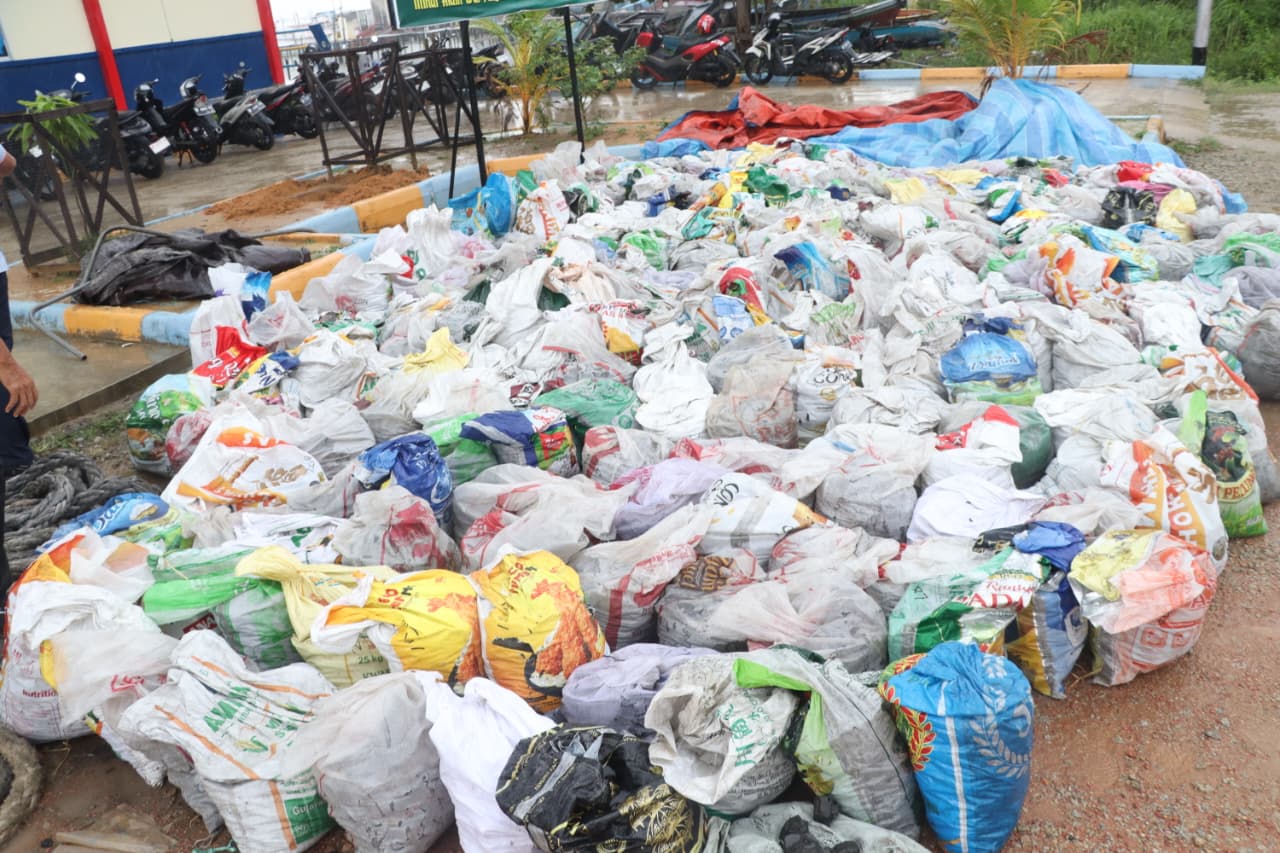
This second case was initiated on Tuesday, April 28, 2026, at approximately 10:00 PM, when officers at the Parit Rampak Roro Port in Karimun Regency became suspicious of a transport truck attempting to board a ferry. A thorough inspection of the vehicle led to the discovery of six large tin ingots weighing 67 kilograms and 307 bags containing approximately 9.5 tons of tin slag. The total weight of the seized materials across the investigation was reported to reach 19 tons.
Iptu Judit Dwi Laksono, Head of the Karimun Police Maritime Unit, explained that the commodities were sourced from a former tin processing site in the West Pangke area of Karimun. To evade detection, the perpetrators had attempted to disguise the cargo among other goods. The police have since named the truck driver, MS, and his assistant, JM, as suspects. A third individual, JF, remains at large and has been placed on the Wanted List (DPO). The estimated loss to the state from this single smuggling attempt is valued at approximately Rp167 million.
Environmental Crisis: The Rapid Decline of Kepri’s Mangroves
The recent arrests have brought renewed attention to the alarming rate of mangrove deforestation in the Riau Islands. Hendrik Hermawan, an environmental activist and founder of Akar Bhumi, a Batam-based conservation organization, praised the police for their swift action but warned that the regional ecosystem is reaching a breaking point.
According to data cited by Hermawan, the Riau Islands Province lost approximately 1,000 hectares of mangrove forest between 2022 and 2023 alone. This destruction is driven by a combination of illegal logging, land conversion for industrial use, and coastal development. Karimun Regency, which holds one of the largest mangrove reserves in the province—totaling some 13,000 hectares—is particularly vulnerable.
"Our mangrove potential is being continuously reduced," Hermawan stated. "Whether it is through land conversion or outright deforestation for export, the loss of these forests is a direct threat to our coastal resilience."
The activist noted that a significant portion of the illegal mangrove trade is driven by the production of mangrove charcoal. To avoid detection by authorities and environmental monitors, illegal producers have adopted new tactics, such as shielding their charcoal kilns with zinc sheets to hide the smoke and structures from view.
Geopolitical and Ecological Implications
The smuggling of mangroves is not merely an environmental issue; it is also a matter of national security and territorial integrity. Mangroves serve as a natural barrier against coastal erosion and abrasion. In an archipelagic province like the Riau Islands, where many small islands define the maritime border between Indonesia, Singapore, and Malaysia, the loss of mangroves can lead to the physical shrinking of islands.
"The issue of mangroves in Kepri has become a geopolitical concern," Hermawan explained. "These forests protect our territorial lines. When the mangroves are stripped away, the land follows, and our maritime boundaries can effectively be compromised over time."
Furthermore, the demand for mangrove logs in Singapore is reportedly driven by the construction industry. The timber is often used as scaffolding or temporary support structures (stut) in building projects because of its durability in moist environments. The fact that Indonesian natural resources are being extracted illegally to support urban development in neighboring countries has sparked calls for stricter cross-border cooperation and more rigorous supply chain tracing.
Legal Framework and Future Enforcement
The suspects in the mangrove case are being processed under a legal framework designed to deter large-scale environmental destruction. Law Number 18 of 2013 is one of Indonesia’s primary tools for combating the "forestry mafia," providing for heavy fines and lengthy prison sentences for those who organize, finance, or execute the illegal removal of timber from protected areas.
Additionally, Law Number 13 of 2018 regarding the conservation of certain ecosystems is being invoked to ensure that the ecological damage is factored into the prosecution. For the tin smuggling case, the suspects face charges related to the Mining Law, which regulates the transport and sale of mineral products.

The Riau Islands Police have signaled that they will not stop at the arrests of the ship crews and truck drivers. The focus has shifted toward the "intellectual actors" and financiers who operate from the shadows, often across international borders. By targeting the financial nodes of these smuggling rings, authorities hope to make the illegal trade of mangroves and tin economically unviable.
Conclusion: A Call for Integrated Surveillance
The back-to-back seizures in the Malacca Strait serve as a stark reminder of the vulnerability of Indonesia’s natural resources. While the police have successfully intercepted thousands of logs and tons of tin, the scale of the problem suggests that many more shipments may be slipping through the cracks of the region’s vast maritime territory.
Environmentalists and policy analysts argue that a more integrated approach is needed. This includes the use of satellite monitoring to detect changes in mangrove cover in real-time, increased patrols in the "gray zones" between islands, and a diplomatic push to ensure that recipient countries like Singapore take greater responsibility for the legality of the raw materials entering their markets.
As the Riau Islands continue to serve as a vital transit point for global trade, the battle to protect its mangroves and minerals remains a critical front in Indonesia’s broader effort to achieve environmental sustainability and economic justice. The success of these recent operations is a positive step, but the pressure on the region’s ecosystems remains at an all-time high.