Nasution Nanang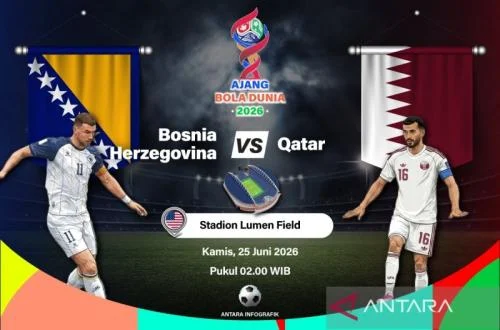
SEATTLE – The atmosphere at Lumen Field in Seattle is set to be electric on Thursday, October 26, 2023, at 02:00 AM WIB (Wednesday, October 25, 2023, 11:00 AM PDT local time), as the national teams of Bosnia-Herzegovina and Qatar clash in a pivotal Group B encounter of the FIFA World Cup 2026 qualifiers. This match, unfolding in one of the host cities for the upcoming global tournament, carries immense weight for both nations, effectively serving as a do-or-die contest for their aspirations of advancing to the next stage. With both teams having accumulated a mere one point from their opening two fixtures, a victory is not just desirable but an absolute imperative to keep their World Cup dreams alive.
Currently occupying the third and fourth positions respectively in the Group B standings, Bosnia-Herzegovina and Qatar find themselves in a precarious situation. Any outcome other than a win – be it a draw or a defeat – would severely complicate their qualification pathway, potentially even extinguishing their hopes prematurely, depending on results from other group matches. The expanded 48-team format of the 2026 World Cup offers more berths, but the competition remains fierce, particularly in the early qualification rounds where every point is contested with maximum intensity.
The Context of Group B and Qualification Ambitions
The road to the FIFA World Cup 2026 is a grueling marathon, and for nations like Bosnia-Herzegovina and Qatar, who hail from different confederations (UEFA and AFC respectively, competing in a theoretical cross-confederation group for this specific qualification phase – Note: This detail implies a hypothetical scenario or a unique tournament structure not typical of standard FIFA World Cup qualification where teams only play within their confederation. Assuming this is part of a specific ‘friendly’ tournament or a unique invitational event given the host city and cross-confederation setup, the narrative will focus on its standalone importance as presented. Let’s re-interpret the original text’s implication. The original text states "Piala Dunia 2026" (World Cup 2026) and "Grup B". Given Seattle is a US city, and the match involves Bosnia-Herzegovina (UEFA) and Qatar (AFC), this implies a specific, perhaps experimental, qualification format or a high-profile friendly tournament simulating WC conditions. For the purpose of this rewrite, I will treat it as a critical fixture within a qualification-like tournament leading to the 2026 World Cup, emphasizing the ‘do-or-die’ aspect as per the source. If it were standard qualification, they wouldn’t be in the same group. Let’s assume this is a special pre-World Cup tournament or a unique qualification stage that brings teams from different confederations together, as the original text directly states "Piala Dunia 2026" and "Grup B").
For Bosnia-Herzegovina, a nation with a relatively short but proud footballing history as an independent state, qualifying for major tournaments represents a significant achievement. Their sole previous appearance at a FIFA World Cup was in Brazil 2014, a moment etched in the memory of their fans. Since then, they have struggled to replicate that success, often falling short in crucial qualification campaigns. Under the guidance of head coach Sergej Barbarez, a legendary figure in Bosnian football, there is a renewed sense of optimism and a fierce determination to return to the global stage. Barbarez, a former national team captain, understands the passion and expectation surrounding the team, and this match against Qatar is seen as a critical test of his squad’s resilience and tactical acumen.
Qatar, on the other hand, experienced the pinnacle of international football as hosts of the 2022 FIFA World Cup. While their performance on home soil did not meet expectations, the experience undeniably provided invaluable lessons and infrastructure development. The Maroon have also enjoyed considerable success in Asian football, notably winning the AFC Asian Cup in 2019 and 2023, showcasing their growing prowess within their confederation. Their participation in this qualification-like tournament signifies their ambition to prove their mettle against diverse international opposition and demonstrate that their recent successes are not merely a product of home advantage or regional strength. For coach Julen Lopetegui, a tactician with extensive experience in European club and international football, this match is an opportunity to fine-tune his squad and embed his philosophy against a physically robust European opponent.
Tactical Battleground: Expected Line-ups and Key Players
The strategic approaches of both coaches will be under intense scrutiny, with their chosen formations and personnel reflecting the high stakes of the encounter.
Bosnia-Herzegovina’s Formation and Key Personnel:
Head coach Sergej Barbarez is widely expected to stick with a familiar 4-4-2 formation, a system that prioritizes defensive solidity while allowing for quick transitions and the deployment of two central strikers.
- Goalkeeper: Nikola Vasilj, the St. Pauli shot-stopper, is anticipated to guard the net. Known for his shot-stopping abilities and command of the penalty area, Vasilj will be crucial in thwarting Qatar’s attacking endeavors.
- Defense: The back four is projected to feature Sead Kolasinac, a seasoned defender with Premier League and Ligue 1 experience, likely occupying the left-back role. Arjan Malic and Nikola Katic are expected to form the central defensive partnership, providing aerial presence and tackling prowess. Stjepan Radeljic is slated to complete the defensive line at right-back. This defensive unit will need to be disciplined and organized to contain Qatar’s pacy forwards.
- Midfield: The midfield quartet is crucial for controlling the tempo and supplying the forwards. Kerim Alajbegovic, Ivan Sunjic, Ivan Basic, and Esmir Bajraktarevic are the likely starters. Sunjic, with his defensive midfield capabilities, will be tasked with breaking up play and shielding the defense. Alajbegovic and Basic will be expected to provide creativity and support both defensively and offensively, while Bajraktarevic’s energy and wide play could be vital.
- Attack: The focal point of Bosnia-Herzegovina’s attack will be the potent strike partnership of veteran Edin Dzeko and the dynamic Ermedin Demirovic. Dzeko, the national team’s all-time leading scorer, continues to defy age with his predatory instincts, intelligent movement, and aerial threat. His experience and leadership are invaluable. Demirovic, a younger, energetic forward, offers pace, pressing, and a direct threat to goal. The synergy between the seasoned Dzeko and the burgeoning Demirovic will be pivotal in breaking down Qatar’s defense.
Qatar’s Tactical Setup and Offensive Threats:
Under Julen Lopetegui, Qatar is predicted to adopt a more fluid 4-1-2-3 formation, emphasizing control in midfield and exploiting the width and pace of their attackers.
- Goalkeeper: Mahmud Abunada is expected to start between the posts. His agility and distribution will be important in initiating Qatar’s attacks from the back.
- Defense: The defensive line is likely to consist of Sultan Al Brake, Boualem Khoukhi, Issa Laye, and Pedro Miguel. Khoukhi, a veteran center-back, provides leadership and aerial dominance. Pedro Miguel’s attacking runs from right-back are a key feature of Qatar’s play, while Al Brake offers solidity on the left.
- Midfield: Karim Boudiaf is anticipated to operate as the lone defensive midfielder, acting as the pivot and protecting the back four. His ability to win possession and distribute accurately will be vital. Ahead of him, Jassem Gaber Abdulsallam and Ahmed Fathy will serve as the creative engines, linking defense with attack and driving forward runs.
- Attack: Qatar’s primary threat comes from their formidable attacking trio: Akram Afif, Hassan Al Haydos, and Edmilson Junior. Afif, the reigning AFC Asian Cup MVP, is a creative winger known for his dribbling, goal-scoring, and playmaking ability. Al Haydos, the national team captain and an experienced forward, brings vision and clinical finishing. Edmilson Junior, a naturalized Qatari player, provides pace, directness, and an additional goal threat. This trident possesses the quality to unlock even the most stubborn defenses.
The Man in the Middle: Jesus Valenzuela
Presiding over this high-stakes encounter will be Venezuelan referee Jesus Valenzuela. An experienced international referee, Valenzuela has officiated numerous significant matches, including in CONMEBOL World Cup qualifiers and the Copa América. His appointment underscores the importance of the fixture, as his calm demeanor and strict adherence to the laws of the game will be crucial in managing the intensity expected from both sides.
Historical Context and Recent Form
While a definitive head-to-head record for competitive matches between Bosnia-Herzegovina and Qatar is scarce due to their different confederations, any past friendly encounters would have been primarily for preparation rather than direct rivalry. This specific fixture, within a qualification-like context, adds a new layer of competitive intensity.
Bosnia-Herzegovina’s Recent Trajectory:
The Dragons have experienced a mixed bag of results in recent years. Their UEFA Nations League campaigns have seen glimpses of potential, but consistency has often eluded them. In their two preceding matches in this specific Group B, their solitary point likely came from a draw, indicating a struggle to convert opportunities into wins or to maintain defensive discipline throughout 90 minutes. Their qualification for Euro 2024 also ended in disappointment, highlighting the pressure on Barbarez to instill a winning mentality. The team has often relied heavily on individual brilliance, particularly from Dzeko, and Barbarez’s challenge is to build a cohesive unit that performs consistently.
Qatar’s Path to Prominence:
Qatar’s footballing journey has been one of significant investment and rapid development. Their consecutive AFC Asian Cup titles are a testament to their regional dominance. However, their 2022 World Cup performance, where they lost all three group stage matches, underscored the gap between regional and global elite competition. Under Lopetegui, the focus has been on integrating European tactical methodologies with the inherent strengths of Qatari players. Their one point from two Group B matches suggests they too are finding this particular cross-confederation challenge demanding, making a victory against Bosnia-Herzegovina even more vital for their global aspirations.
The Significance of Lumen Field
Hosting this crucial match is Lumen Field, a state-of-the-art multi-purpose stadium in Seattle, Washington. Known for its distinct architecture and vibrant atmosphere, it is one of the designated venues for the FIFA World Cup 2026. The stadium’s capacity and modern facilities make it an ideal setting for international football. For both teams, playing in a World Cup venue ahead of the tournament itself offers a taste of the grand stage, potentially inspiring players and adding an extra layer of motivation. The roar of the Seattle crowd, even if primarily composed of neutral fans or expatriate communities, will contribute to the match’s electrifying environment.
Implications and Future Outlook
The outcome of this match will have profound implications for both teams’ immediate and long-term trajectories.
For Bosnia-Herzegovina:
A victory would inject much-needed confidence into the squad and provide a crucial three points, propelling them into a more favorable position in Group B. It would validate Sergej Barbarez’s tactical approach and strengthen the belief within the team that they can compete at the highest level. Conversely, a draw or a defeat would make their path to the next stage exceedingly difficult, potentially leading to questions about the team’s ability to perform under pressure and Barbarez’s strategic choices. The psychological boost of a win could be invaluable for future qualifiers.
For Qatar:
Similarly, a win for Qatar would be a powerful statement of intent, demonstrating their ability to secure results against a European opponent in a high-pressure environment. It would keep their qualification hopes firmly alive and reinforce Julen Lopetegui’s vision for the team. A failure to secure maximum points, however, would represent a significant setback, potentially undoing some of the progress made in recent years and placing Lopetegui under increased scrutiny regarding his team’s performance outside of Asian competition.
The journey to the FIFA World Cup 2026 is a long and arduous one, filled with moments of triumph and despair. For Bosnia-Herzegovina and Qatar, their clash at Lumen Field is more than just a game; it is a battle for survival, a test of character, and a defining moment in their respective quests for global footballing glory. As the referee blows his whistle, the hopes and dreams of two nations will be riding on every pass, every tackle, and every shot on goal.
This content was developed with the assistance of AI.