
 Paryono Ramadhan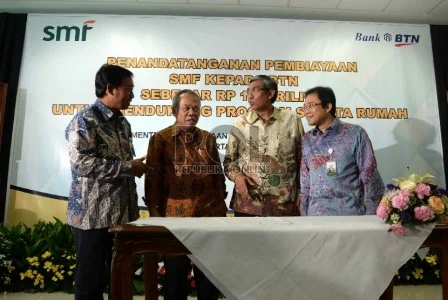
The Indonesian government is committing to a full mobilization of its available resources to ensure the successful implementation of the One Million Houses Program, a flagship initiative aimed at addressing the nation’s significant housing deficit. This commitment was underscored by Minister of Public Works and Public Housing, Basuki Hadimuljono, who emphasized the program’s particular focus on low-income communities. The Minister’s remarks came during a pivotal event in Jakarta last week, which saw the formal signing of a cooperation agreement between PT Sarana Multigriya Finansial (SMF) and Bank Tabungan Negara (BTN) – a collaboration designed to significantly boost the program’s financial backbone.
Unlocking Financial Pathways for Affordable Housing
At the heart of the latest push is a substantial financial injection facilitated by SMF, a state-owned enterprise mandated to develop the secondary mortgage market. SMF has extended a loan facility worth IDR 1.5 trillion (approximately USD 100 million) to BTN, the state-owned housing bank. This significant capital infusion is specifically earmarked to support the ambitious One Million Houses Program, with the explicit goal of simplifying the path to homeownership for individuals and families in the low-income bracket. The partnership between SMF and BTN is a strategic move to enhance liquidity in the housing finance sector, enabling BTN to expand its mortgage offerings and reach a wider segment of the population that traditionally struggles with access to affordable housing finance.
The One Million Houses Program, officially launched in April 2015, represents a monumental effort by the Indonesian government to tackle the country’s chronic housing backlog, which at the time of its inception was estimated to be around 13.5 million units. The program’s overarching objective is not merely to construct a large volume of houses but to ensure that these homes are accessible and affordable, particularly for low-income citizens and civil servants. This involves a multi-pronged approach that integrates various stakeholders, including government ministries, state-owned enterprises, private developers, and financial institutions, all working in concert to streamline the construction and financing processes.
Minister Basuki elaborated on the diverse funding avenues being explored and utilized to sustain the program’s momentum. Beyond the crucial SMF-BTN collaboration, other significant potential financing sources include substantial contributions from BPJS Ketenagakerjaan (the Workers’ Social Security Agency), amounting to an estimated IDR 48.5 trillion. Additionally, the government itself is directly channeling funds through the Housing Finance Liquidity Facility (FLPP) with IDR 5.1 trillion, and through direct budget allocations from the State Budget (APBN) via DIPA (Daftar Isian Pelaksanaan Anggaran) amounting to IDR 8.1 trillion. This comprehensive financial strategy underscores the government’s recognition that a robust and diversified funding model is indispensable for a program of this scale and ambition.
The Role of Key Financial Institutions
PT Sarana Multigriya Finansial (SMF) plays a critical role in strengthening Indonesia’s housing finance ecosystem. As a non-bank financial institution, SMF’s primary mandate is to facilitate the long-term funding of the housing sector by securitizing mortgage loans and issuing bonds. By providing liquidity to primary mortgage lenders like BTN, SMF helps to stabilize interest rates, extend loan tenors, and ultimately make mortgages more accessible and affordable for a broader segment of the population. The IDR 1.5 trillion loan to BTN is a testament to SMF’s commitment to its mission and its direct contribution to government housing initiatives. This mechanism allows banks to originate more mortgages without depleting their own capital reserves, thereby creating a sustainable financing cycle.
Bank Tabungan Negara (BTN) has historically been at the forefront of housing finance in Indonesia, particularly for government-backed programs. With a strong focus on retail mortgage lending, BTN has been the primary executor of various affordable housing schemes, including those supported by FLPP. Its extensive branch network and expertise in handling mass housing projects make it an indispensable partner in the One Million Houses Program. The additional funding from SMF empowers BTN to significantly scale up its lending capacity, reaching more eligible beneficiaries and accelerating the pace of homeownership for low-income families.
Diversified Funding Landscape for Program Sustainability
The program’s financial sustainability hinges on its ability to tap into multiple, robust funding sources. The projected IDR 48.5 trillion from BPJS Ketenagakerjaan highlights the significant potential of social security funds to contribute to national development goals. BPJS Ketenagakerjaan, which manages mandatory social security programs for workers, possesses substantial investable assets. By channeling a portion of these funds into housing, the agency not only supports a critical social welfare objective but also potentially secures long-term, stable returns on its investments. BPJS Ketenagakerjaan typically facilitates housing ownership through various schemes, including housing loans for participants, down payment assistance, and construction financing for developers focused on affordable housing. This synergy aligns social security mandates with national housing priorities.
The Fasilitas Likuiditas Pembiayaan Perumahan (FLPP), or Housing Finance Liquidity Facility, is a long-standing government subsidy program designed to make housing more affordable by providing interest rate subsidies for mortgages. The IDR 5.1 trillion allocated through FLPP is crucial for reducing the monthly financial burden on low-income homeowners, making mortgage payments manageable. Under the FLPP scheme, the government partners with participating banks to offer mortgages at significantly lower, fixed interest rates compared to conventional market rates. This mechanism directly addresses affordability, which is often the biggest barrier to homeownership for the target demographic. The funds channeled through FLPP ensure that the interest component of housing loans remains stable and predictable over the long term, protecting beneficiaries from market fluctuations.
Furthermore, direct government budget allocations through DIPA (Daftar Isian Pelaksanaan Anggaran) APBN, amounting to IDR 8.1 trillion, demonstrate the state’s direct financial commitment. DIPA represents the operational budget allocation for government ministries and agencies. These funds are typically used for direct construction projects, infrastructure development supporting housing areas, land acquisition, or to directly subsidize specific housing components that fall outside the FLPP’s scope. This direct budgetary support is essential for foundational elements of the program, such as developing basic urban infrastructure, public utilities, and community facilities in new housing complexes, ensuring that the new homes are part of livable communities.

Key Challenges and Expert Recommendations
Despite the robust financial planning and government commitment, the successful realization of the One Million Houses Program faces multifaceted challenges. Indonesia Property Watch, a prominent real estate research and consulting firm, has consistently highlighted five critical areas that require urgent government attention for the program to achieve its ambitious targets. These recommendations provide a comprehensive framework for addressing systemic issues that hinder affordable housing development.
Firstly, the issue of land availability remains paramount. Rapid urbanization and speculative land practices have driven up land prices, making it increasingly difficult for developers to construct affordable housing, especially in strategic urban and suburban areas. Indonesia Property Watch advocates for the establishment of a dedicated land bank. A land bank would allow the government to acquire and hold land for future development, insulating it from market speculation and ensuring that land prices for affordable housing projects remain controlled and reasonable. This proactive approach would provide a stable land supply for developers, reducing one of the most significant cost components in housing construction. Without a robust land bank, developers are often forced to build further from urban centers, increasing transportation costs and reducing the desirability of affordable housing units.
Secondly, the need for a focused institutional body dedicated solely to people’s housing is critical. The current fragmented approach, involving multiple ministries and agencies, can lead to coordination challenges, bureaucratic inefficiencies, and delays. A specialized agency with a clear mandate, streamlined processes, and dedicated resources could centralize efforts, enhance oversight, and accelerate the implementation of housing projects. Such an institution could act as a single point of contact for developers, coordinate funding, manage land banks, and ensure consistent policy implementation across regions, thereby significantly improving the program’s efficiency and responsiveness.
Thirdly, sustainable and diversified funding is crucial. While the current financial commitments from SMF, BTN, BPJS, FLPP, and DIPA are substantial, ensuring their long-term continuity and exploring additional funding sources is vital. Indonesia Property Watch emphasizes the importance of consistent government support for FLPP and encouraging greater participation from other non-bank financial institutions and the private sector. The sheer scale of the housing deficit necessitates a continuous flow of capital that can adapt to economic shifts and evolving market demands. Innovative financing models, such as public-private partnerships and housing bonds, could further diversify the funding base and reduce reliance on a few primary sources.
Fourthly, the availability of accurate data and information on housing shortages is essential for effective planning and targeted interventions. Without precise data on the actual housing backlog, demographic trends, and specific needs of different income groups across various regions, resource allocation can be inefficient. Comprehensive and up-to-date databases would enable the government to identify critical areas of need, prioritize projects, and tailor housing solutions to specific community requirements. This includes detailed information on existing housing stock, quality, occupancy, and affordability levels, allowing for evidence-based policy formulation and strategic deployment of resources.
Finally, streamlining bureaucratic processes and reducing associated costs is imperative. High costs related to permits, certification, and utility connections (such as electricity from PLN) significantly inflate the final price of housing units, often pushing them beyond the reach of low-income families. Simplifying permitting procedures, reducing administrative fees, and accelerating the process for obtaining necessary certifications and utility hookups would substantially lower development costs. This would not only make housing more affordable but also encourage greater participation from developers by reducing the time and financial risks associated with project execution. Government initiatives to cut red tape and harmonize regulations across different levels of administration are key to achieving this efficiency.
Broader Impact and Implications
The One Million Houses Program carries profound implications beyond merely constructing physical structures. Economically, it serves as a powerful stimulus, creating millions of jobs across the construction sector and related industries, from manufacturing building materials to logistics and services. This job creation contributes to economic growth, particularly in regions where housing projects are concentrated. The multiplier effect of housing development extends to local economies, fostering small and medium enterprises that supply goods and services to construction sites and new communities.
Socially, the program aims to elevate the living standards of millions of Indonesians, particularly those currently residing in informal settlements or substandard housing. Access to safe, decent, and affordable housing is a fundamental human right and a cornerstone of social stability. Improved housing conditions lead to better health outcomes, enhanced educational opportunities for children, and increased overall community well-being. By providing secure tenure, the program empowers families, reduces poverty, and fosters a sense of belonging and civic pride. It also contributes to more organized urban planning, helping to mitigate the challenges of rapid urbanization and prevent the proliferation of informal settlements.
However, the program also presents sustainability challenges. The rapid construction of housing units must be accompanied by robust infrastructure development, including water, sanitation, waste management, and transportation networks, to ensure the long-term viability and livability of new communities. Environmental considerations, such as the use of sustainable building materials and energy-efficient designs, are crucial to minimize the ecological footprint of these large-scale developments. Quality control in construction is also paramount to ensure the durability and safety of the homes.
The long-term success of the One Million Houses Program hinges on sustained political will, adaptive policy-making, and continuous collaboration among all stakeholders. The challenges identified by Indonesia Property Watch are not insurmountable but require integrated policy solutions, consistent funding, and a commitment to bureaucratic reform. The partnership between SMF and BTN, along with the diverse funding mechanisms from BPJS Ketenagakerjaan, FLPP, and DIPA APBN, represents a critical step forward in addressing the financial complexities of this ambitious national endeavor. As Indonesia continues its development trajectory, ensuring that every citizen has access to adequate housing remains a cornerstone of its inclusive growth strategy, embodying a vision of prosperity that reaches every segment of society.








