Bambang Pamungkas
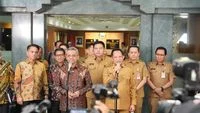
Jakarta, CNBC Indonesia — In a strategic move to address pressing national administrative and fiscal challenges, Minister of Home Affairs Muhammad Tito Karnavian and Deputy Minister of Finance Suahasil Nazara convened a high-level coordination meeting at the Ministry of Home Affairs (Kemendagri) headquarters in Jakarta. The Tuesday session brought together key economic and governance architects to deliberate on critical financial matters, most notably the multi-year funding framework for the rehabilitation and reconstruction of post-disaster Sumatra, as well as targeted fiscal interventions for structurally constrained regional governments.
The discussions underscored the government’s commitment to disciplined financial planning, seamless inter-ministerial collaboration, and performance-driven regional governance. As economic pressures evolve and regional disparities persist, the joint meeting served as a crucial platform to synchronize central policy objectives with regional implementation realities, ensuring that local authorities possess the fiscal bandwidth required to meet public service mandates while executing long-term infrastructure projects.
Comprehensive Financing Strategy for Sumatra Post-Disaster Recovery
A primary focus of the ministerial dialogue centered on the ongoing and future financial allocations required for the comprehensive rehabilitation and reconstruction (rehab-rekon) of disaster-affected regions across Sumatra. Minister Tito Karnavian, who also serves as the Head of the Task Force for the Acceleration of Sumatra Post-Disaster Rehabilitation and Reconstruction (Kasatgas PRR), outlined the operational roadmap mapped out in the master plan.
According to the master plan, the massive recovery initiative spans a critical three-year window from 2026 through 2028. While initial implementation milestones have been set for the current year, the coordination meeting specifically targeted the financial architecture needed to sustain momentum into the 2027 fiscal year.
Addressing reporters following the closed-door session, Minister Tito expressed optimism regarding the fiscal backing of the initiative. "We have held comprehensive discussions with the Minister of Finance, and praise be to God, God willing, the budget will be fully available," he stated.
Echoing this sentiment, Deputy Minister of Finance Suahasil Nazara emphasized the strict adherence to project timelines mandated by the central government. Suahasil noted that administrative and financial priority remains firmly anchored on successfully concluding all scheduled rehabilitation and reconstruction targets slated for the current year before scaling up funding operations for the subsequent phases in 2027 and 2028.
"What has been budgeted and planned for 2026 must be entirely completed. Following that, we are also mapping out provisions for 2027," Suahasil explained. He issued a firm directive that fiscal management must prevent any operational bottlenecks or stalled initiatives. "There must be no hanging projects or work left unfinished," he added, underscoring the Ministry of Finance’s zero-tolerance policy for administrative delays in critical infrastructure development.
Addressing Regional Fiscal Distress and High Personnel Expenditure
Beyond disaster recovery operations, the high-level meeting tackled structural fiscal imbalances plaguing several local government units (Pemda) across the archipelago. The Ministry of Home Affairs and the Ministry of Finance have identified numerous regional administrations grappling with low fiscal capacity, which severely impedes their ability to finance public investments and stimulate local economic activity.
A major structural vulnerability highlighted during the discussions is the disproportionately high allocation of regional budgets toward personnel expenditures (belanja pegawai). Many local governments currently allocate between 40% and 50%—or even higher—of their total regional budgets (APBD) solely to civil servant salaries and administrative overhead. This leaves meager fiscal space for capital investments, social programs, or maintenance of public infrastructure, despite the heavy influx of financial transfers and programmatic support from the central government.
To untangle this systemic issue, Minister Tito announced the formation of a joint technical team comprising representatives from both the Ministry of Finance and the Ministry of Home Affairs. This specialized task force will conduct granular audits of distressed regions, design tailored fiscal consolidation strategies, and formulate viable pathways to optimize regional expenditure efficiency.
"We are establishing a joint technical team from the Ministry of Finance and Kemendagri to formulate solutions to these problems, particularly for regions where personnel spending exceeds 40% to 50%, even though central government programs are already operating extensively in those areas," Tito elaborated.
The intervention aims to guide local governments toward a more balanced fiscal posture, shifting expenditure patterns from purely administrative consumption toward productivity-enhancing capital outlays.
Incentivizing Regional Performance and Fostering Healthy Competition
In tandem with addressing fiscal deficits, the ministers evaluated mechanisms to reward high-performing regional administrations through enhanced fiscal incentives. The meeting reviewed the distribution framework for central government assistance designed to appreciate regions that demonstrate superior governance, fiscal prudence, innovation, and public service delivery based on rigorous evaluation categories.
Kemendagri views the provision of performance-based fiscal incentives not merely as a financial reward, but as a strategic policy instrument to cultivate a competitive and meritocratic climate among regional leaders (governors, regents, and mayors). By tying financial rewards to measurable developmental outputs—such as regional economic growth, poverty alleviation, ease of doing business, and bureaucratic transparency—the central government hopes to incentivize local executives to optimize their local revenue generation (Pendapatan Asli Daerah/PAD) and improve administrative accountability.
This performance-oriented approach aligns with broader national decentralization reforms, which seek to transition regional governments away from total reliance on intergovernmental fiscal transfers and toward greater fiscal self-reliance and operational efficiency.
Broader Economic Implications and Institutional Outlook
The strategic alignment between the Ministry of Home Affairs and the Ministry of Finance carries profound implications for Indonesia’s macroeconomic stability and decentralized governance structure. By securing multi-year funding for the Sumatra disaster recovery master plan (2026–2028), the government mitigates the risk of protracted infrastructural paralysis, ensuring that displaced communities and damaged economic corridors can be restored efficiently. Timely reconstruction not only revitalizes regional supply chains but also bolsters consumer confidence and local economic resilience in disaster-prone territories.
Simultaneously, the targeted intervention for regions with high personnel expenditure ratios represents a vital step toward fiscal sustainability at the sub-national level. Without structural adjustments to local government payroll burdens, decentralization risks producing administrative apparatuses that consume public funds rather than deliver public goods. The establishment of the joint technical team signals a more proactive, hands-on supervisory role by the central government to assist financially constrained regions without compromising local autonomy.
As Indonesia navigates its fiscal targets amidst global economic uncertainties, the synergy demonstrated between Minister Tito Karnavian and Deputy Minister Suahasil Nazara highlights the indispensability of inter-institutional coordination. By harmonizing fiscal prudence with localized developmental needs, the central government aims to build a more resilient, equitable, and competitive regional governance framework capable of withstanding both structural economic pressures and unforeseen natural disasters.